Table of Contents
- Rocketlane at a glance
- What is Rocketlane?
- How we evaluated Rocketlane
- Rocketlane's main features
- A practical Rocketlane pilot
- Rocketlane pricing in 2026
- Rocketlane advantages
- Rocketlane limitations and open questions
- Who should use Rocketlane?
- Rocketlane alternatives
- Is Rocketlane worth it?
- Our final verdict
- Frequently asked questions
Rocketlane is professional services automation software built around customer onboarding, implementation, and client-facing delivery. It brings project plans, customer collaboration, time tracking, resourcing, project financials, reporting, and automation into one system. Its newer Nitro layer adds AI agents intended to execute routine delivery work and surface risk.
Our short verdict is that Rocketlane is a strong shortlist candidate for B2B SaaS implementation teams and professional-services organisations that have outgrown generic project management. The customer portal is not an afterthought, while the higher plans connect delivery to capacity, utilisation, margin, invoicing, and revenue recognition. That breadth is the advantage and the caveat: a small team needing only a checklist and shared portal may buy more system than it can use.
The most important buying question is therefore not “Does Rocketlane have enough features?” It is whether your organisation is ready to standardise delivery, maintain resource and financial data, and give the platform enough operational discipline to produce reliable insights.
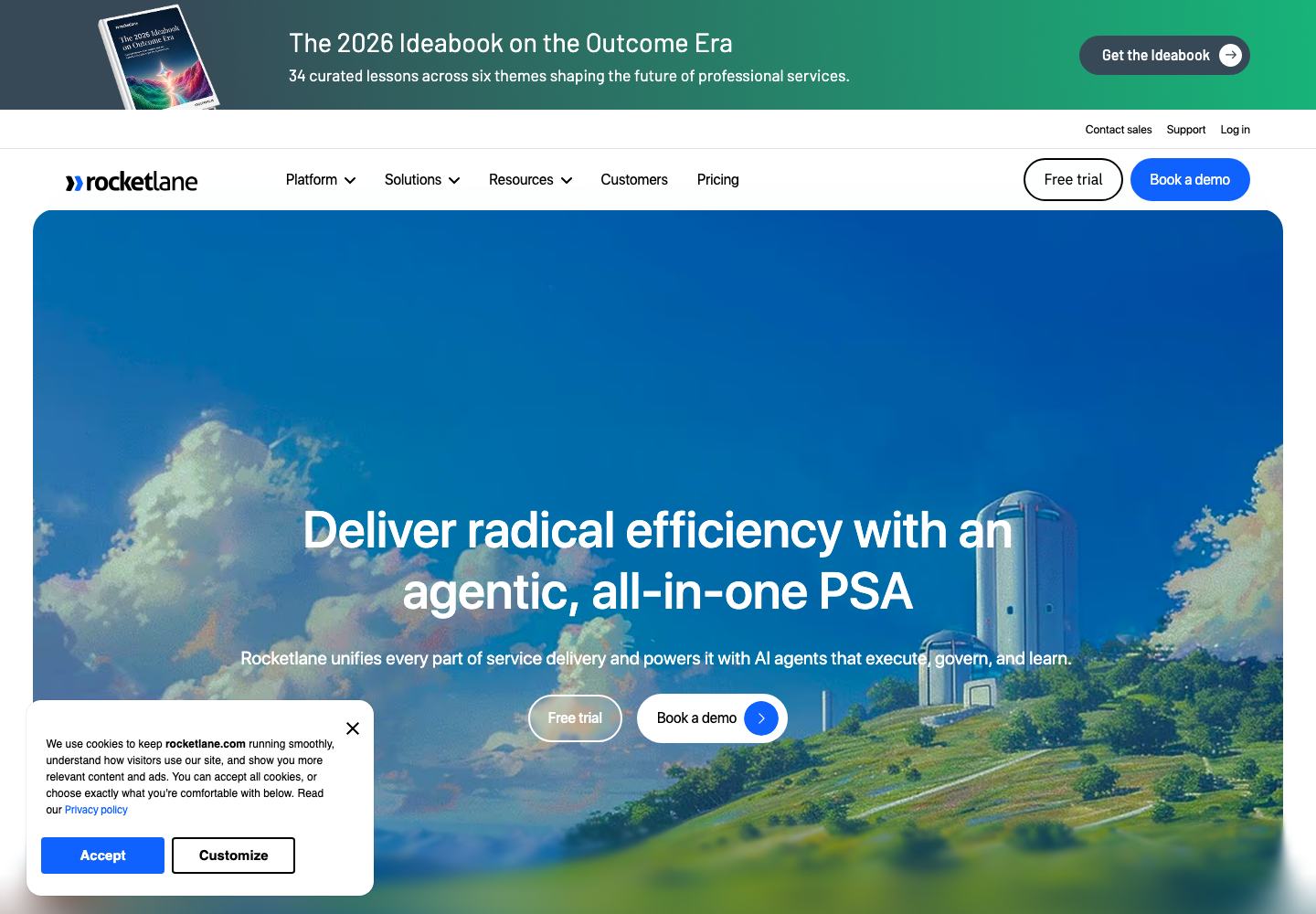
Rocketlane's current homepage presents an all-in-one PSA powered by delivery agents. Screenshot source: Rocketlane.
Rocketlane at a glance
| Question | Answer |
|---|---|
| What is Rocketlane? | Customer onboarding and professional services automation software |
| Core jobs | Project delivery, client collaboration, resourcing, time, financials, reporting, and governance |
| Who is it best for? | SaaS implementation teams, IT services, consultancies, and professional-services operations |
| Starting price | $19 per team member/month billed annually, five-seat minimum |
| Trial | 14-day free trial advertised |
| Main strength | Client-facing delivery and internal PSA operations in one product |
| Main concern | Process and data discipline are required to realise the platform's full value |
| Review status | Public-evidence review, not an authenticated product test |
What is Rocketlane?
Rocketlane sits between customer onboarding software, project management, and a full PSA. A generic project tool can schedule tasks, but service leaders also need to answer questions about staffing, billable utilisation, project margin, revenue, scope, customer accountability, and delivery risk. Rocketlane is designed to connect those questions.
Its public product structure covers three broad layers:
- Projects and process: templates, plans, tasks, forms, documents, approvals, status, governance, and automations.
- People and finance: time, capacity, allocations, rates, budgets, profitability, billing, invoicing, and revenue recognition.
- Customer experience: branded portals, shared visibility, collaboration, approvals, updates, and milestone CSAT.
That makes Rocketlane more operational than a digital sales room and more customer-facing than many traditional PSA systems. It is particularly relevant once the handoff from sales to implementation starts affecting retention, expansion, margin, and reputation.
How we evaluated Rocketlane
We assessed the product against the decisions a delivery leader needs to make:
- Can it give customers and internal teams one trustworthy project view?
- Can repeatable onboarding processes be templated without becoming inflexible?
- Do staffing, time, and financial features support real operational decisions?
- Does automation reduce administration while preserving accountability?
- Are Nitro's AI claims tied to inspectable delivery workflows?
- Does the price make sense once minimum seats, implementation, and add-ons are included?
Rocketlane advertises a 4.7/5 rating from 758 reviews on its site and links to G2. That is a meaningful volume signal, but buyers should still read recent reviews from organisations with similar team size, service model, and integration requirements. Vendor case studies are useful proof of possible outcomes, not a forecast for every customer.
Rocketlane's main features
Customer onboarding and project delivery
Project and document templates help teams turn a repeatable implementation method into a usable workspace. Tasks can be viewed in list, Kanban, and Gantt formats. Forms, files, updates, approvals, sprint planning, key events, and intervals support more involved delivery programmes.
The practical benefit is consistency. A service organisation can define what “good delivery” means, then create enough structure to spot when a project deviates. Dynamic templates and SmartFill on higher plans aim to reduce repetitive setup.
However, template maturity matters more than template count. Before migration, map the minimum viable lifecycle: sales handoff, discovery, dependencies, approvals, milestones, risk, change control, go-live, and closure. Importing years of inconsistent project structures will reproduce inconsistency in a nicer interface.
Branded customer portal
Rocketlane's customer portal provides shared progress, tasks, files, communication, approvals, and customer access through magic links. Unlimited customer members are listed across public plans.
This is central to the product's differentiation. Customers should not need an internal licence or navigate an operations-heavy PSA just to see what they owe, what is late, and what happens next. During a trial, test the portal with real customer participants—not only project managers—and measure whether it reduces status emails and meeting time.
Resource planning and capacity
Premium introduces Resource AI, planning, availability, auto-allocation, capacity management, and utilisation tracking. Enterprise adds tentative allocations and a skills matrix.
These capabilities matter when project demand, specialist skills, leave, and margin compete for the same people. The output will only be credible when availability, skills, project estimates, and time data stay current. Teams should test how Rocketlane handles shared resources, contractors, soft bookings, last-minute scope changes, and multi-week forecasting.
Time and financial management
Time tracking and timesheets begin on Essential, with calendar-supported capture on Standard. Premium adds project budgets, rate cards, flexible billing, margins, revenue recognition, invoicing, expenses, and profitability reporting. Enterprise adds multiple currencies and more billing controls.
This progression is sensible: smaller teams can manage execution first, while established service businesses can connect the delivery system to commercial performance. Finance and operations should jointly validate billing rules, rate overrides, write-offs, revenue treatment, accounting handoffs, and report definitions before treating any dashboard as the source of truth.
Reporting, governance, and risk
The product lists CSAT, project performance, people performance, portfolio, profitability, operations, and custom reports depending on plan. Governance features include automated updates, warning systems, escalation paths, and forms.
Good governance should reduce surprises rather than add reporting theatre. A useful pilot defines a handful of signals—late dependencies, forecast overrun, low participation, unsubmitted time, margin erosion—and tests whether the right owner receives a clear next action.
Nitro AI agents
Rocketlane presents Nitro as agents for meetings, governance, analysis, documentation, migration, and workforce tasks. Public pricing lists Nitro Premium and Enterprise as sales-led packages, while AI Fills can be added to an existing plan for $29 per user per month. AI Fills is described as converting meetings into emails, project documents, and notes across Google Meet, Microsoft Teams, Zoom, and Gong.
This is promising because delivery administration contains repeatable, context-rich work. But agentic language should not replace evaluation. Ask what the agent can execute, what requires approval, which data it reads, where outputs are logged, how mistakes are reversed, and whether your content trains shared or third-party models. Review generated plans, summaries, and risk flags against human decisions during the trial.
For a structured comparison of business AI options before committing, the free AI Tool Chooser can help define the job, data sensitivity, integration requirements, and acceptable level of automation.
Integrations and security
Public plans list Zapier on Essential; HubSpot, Jira, Slack, and API access on Standard; Salesforce and Workato on Premium; and Snowflake on Enterprise. The pricing page also lists SOC 2, GDPR, ISO 27001, HIPAA, ISO 42001, and other compliance claims.
Compliance badges do not complete a security review. Enterprise buyers should request current reports, scope, subprocessors, retention rules, data residency, SSO details, role behaviour, audit logs, and AI-specific data handling. Integration testing should cover both successful syncs and failures, duplicates, field ownership, and permission boundaries.
A practical Rocketlane pilot
Use one representative onboarding programme rather than a cosmetic demo:
- Select a project with external dependencies, multiple roles, and a measurable deadline.
- Build one reusable template with clear owners, approvals, risks, and milestones.
- Invite real customer participants into the branded portal.
- Connect the CRM and one communication system needed for the workflow.
- Load availability, project estimates, rates, and budget data for the delivery team.
- Run weekly updates and compare manual reporting time with the prior process.
- Test one automation and one AI-supported workflow with human review.
- Measure customer participation, time-to-value, forecast accuracy, admin time, and margin visibility.
This distinguishes successful configuration from genuine operational improvement.
Rocketlane pricing in 2026
Rocketlane's public annual pricing on 20 July 2026 was:
| Plan | Price per team member/month | Minimum seats | Best fit |
|---|---|---|---|
| Essential | $19 | 5 | Foundational project delivery and client portal |
| Standard | $49 | 5 | Scaling workflows, reporting, partners, and core integrations |
| Premium | $69 | 5 | Resources, utilisation, financials, and profitability |
| Enterprise | $99 | Ask sales | Advanced controls, custom reporting, currencies, and scale |
The minimum annual software floor is therefore higher than the headline per-seat figure suggests. Five Essential seats equal $1,140 per year; five Standard seats $2,940; and five Premium seats $4,140, before tax, implementation, support upgrades, or AI add-ons.
Rocketlane states that implementation packages are charged separately based on scope. AI Fills is listed at $29 per user/month. Nitro pricing is custom. Confirm contract term, seat changes, sandbox availability, data migration, implementation scope, API limits, support, and renewal treatment on Rocketlane's live pricing page.
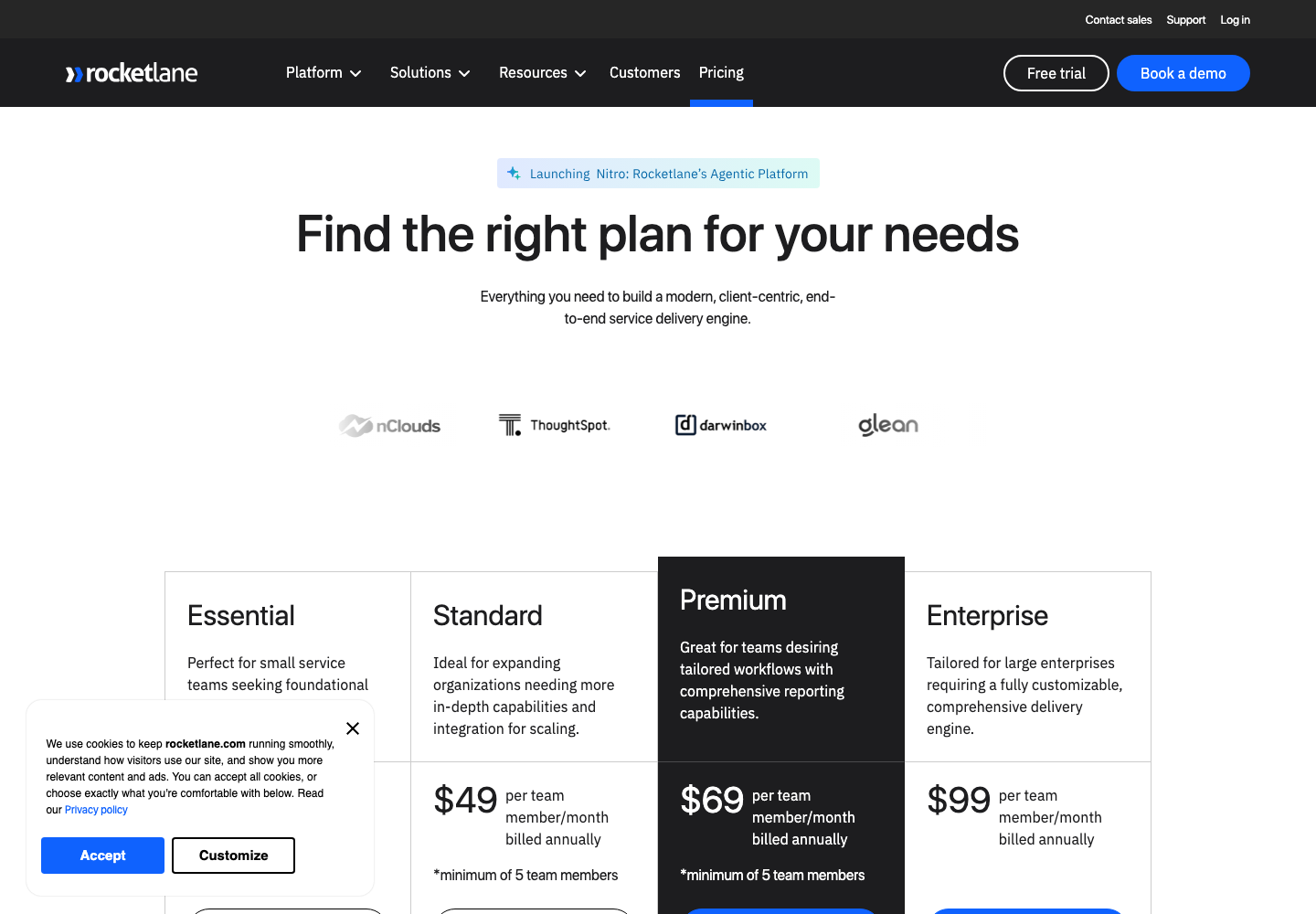
Rocketlane publishes per-seat annual pricing for its four PSA tiers. Screenshot captured 20 July 2026; check the live page for changes.
Rocketlane advantages
Purpose-built customer collaboration
The client experience is part of the delivery model, not a bolted-on internal task board.
Broad PSA depth
Projects, resources, time, financials, governance, and customer experience can operate in one system, reducing reconciliation across disconnected tools.
Transparent standard pricing
Published plan prices and feature comparisons make initial budgeting easier, even though implementation and Nitro require additional quotes.
Scales beyond onboarding
The platform can support professional services operations after initial implementation, including partners, capacity, utilisation, margins, and invoicing.
Rocketlane limitations and open questions
It can be more platform than a small team needs
Teams that need a simple mutual action plan or customer portal may find a lighter product faster and less expensive.
Value depends on operational adoption
Resource and financial dashboards become unreliable when estimates, allocations, rates, and time are incomplete. Software cannot compensate for unclear process ownership.
The real cost exceeds headline seats
Minimum seats, implementation, premium support, integrations, and AI additions should be modelled over the full contract term.
Agentic claims require controlled testing
Buyers should validate execution boundaries, approvals, logs, accuracy, privacy, and failure handling instead of purchasing on the label alone.
Who should use Rocketlane?
Rocketlane is best suited to:
- B2B SaaS implementation and onboarding teams.
- IT services and systems-integration firms.
- Consultancies managing repeatable client projects.
- Professional-services leaders needing resource and margin visibility.
- Organisations replacing combinations of spreadsheets, generic PM tools, portals, and PSA systems.
It is less suitable when projects are simple, client collaboration is minimal, the team will not maintain operational data, or the organisation only needs internal task management.
Rocketlane alternatives
| Alternative | Consider it when |
|---|---|
| GuideCX | Customer onboarding structure and accountability are the main need |
| Kantata | Mature resource and professional-services operations dominate the requirement |
| Certinia | Salesforce-centred professional services and financial workflows are essential |
| Arrows | A lighter HubSpot-native onboarding experience is preferred |
| Monday.com or Asana | Internal work management and flexibility matter more than full PSA depth |
Evaluate alternatives using the same scenario, data, users, and success measures. Feature matrices miss the friction created by configuration, permissions, client adoption, and reporting definitions.
Is Rocketlane worth it?
Rocketlane is worth serious consideration when customer-facing delivery is strategically important and the organisation needs more than task management. Its clearest value comes from replacing fragmented views of the same work: the customer sees progress, the project manager sees execution, the operations leader sees resources, and finance sees commercial performance.
The purchase becomes less compelling when only one of those views is required. In that case, a focused portal or project tool may deliver enough value with less change management.
Our final verdict
Rocketlane has a credible product shape for modern service delivery: strong client collaboration at the front, structured project execution in the middle, and PSA economics behind it. Published prices are clear, the trial lowers initial evaluation risk, and Nitro gives the company a plausible route from tracking work to assisting with execution.
We would shortlist Rocketlane for a disciplined, real-project pilot. We would not buy solely from a polished demo or claimed AI efficiency. The deciding evidence should be lower administration, better customer accountability, more accurate forecasts, and clearer margin or capacity decisions in your own operating environment.
Frequently asked questions
What does Rocketlane do?
Rocketlane combines customer onboarding, project delivery, client portals, time tracking, resource planning, project financials, reporting, automations, and AI-supported service operations.
How much does Rocketlane cost?
Published annual prices start at $19 per team member/month for Essential, then $49 Standard, $69 Premium, and $99 Enterprise. Essential through Premium show a five-seat minimum. Implementation and some AI capabilities cost extra.
Does Rocketlane offer a free trial?
Yes. Rocketlane advertises a 14-day free trial and says an extension may be available after usage review.
Is Rocketlane only for customer onboarding?
No. Customer onboarding is a major use case, but the platform also supports broader professional-services delivery, resources, utilisation, budgets, profitability, billing, and governance.
What is Rocketlane Nitro?
Nitro is Rocketlane's AI-agent layer for delivery and back-office work, including meetings, analysis, governance, documentation, migration, and workforce-related tasks depending on package.
Is Rocketlane suitable for small teams?
It can be, particularly on Essential, but the five-seat minimum and platform breadth mean very small teams should compare lighter onboarding and project tools.
Was this Rocketlane review hands-on?
No. This is a public-evidence first-look review. We did not access an authenticated workspace and do not present vendor claims or screenshots as independent product testing.

Tolu S.
Associate Director
Evidence-led product reviews and founder profiles for search, marketing, authority, and AI visibility teams.