Table of Contents
Sona is a B2B revenue intelligence platform for connecting sales and marketing data, identifying website visitors, scoring accounts, modelling buyer journeys, measuring marketing influence, building audiences, and activating workflows. It is designed to help growth, RevOps, marketing, and sales teams move from fragmented signals to coordinated action.
Our short verdict is that Sona is most compelling for B2B teams that already have meaningful CRM, website, advertising, and campaign data but cannot turn it into one reliable account journey. Its combination of company and person identification, enrichment, intent, attribution, audiences, and workflows is broader than a reporting-only attribution product. The trade-off is substantial operational dependence on identity quality, consent, data governance, CRM hygiene, and agreement about what “influence” means.
Sona should be judged on decisions improved and actions executed—not the volume of data connected. A successful pilot should make high-fit demand easier to recognise, route, and measure without creating another conflicting source of truth.
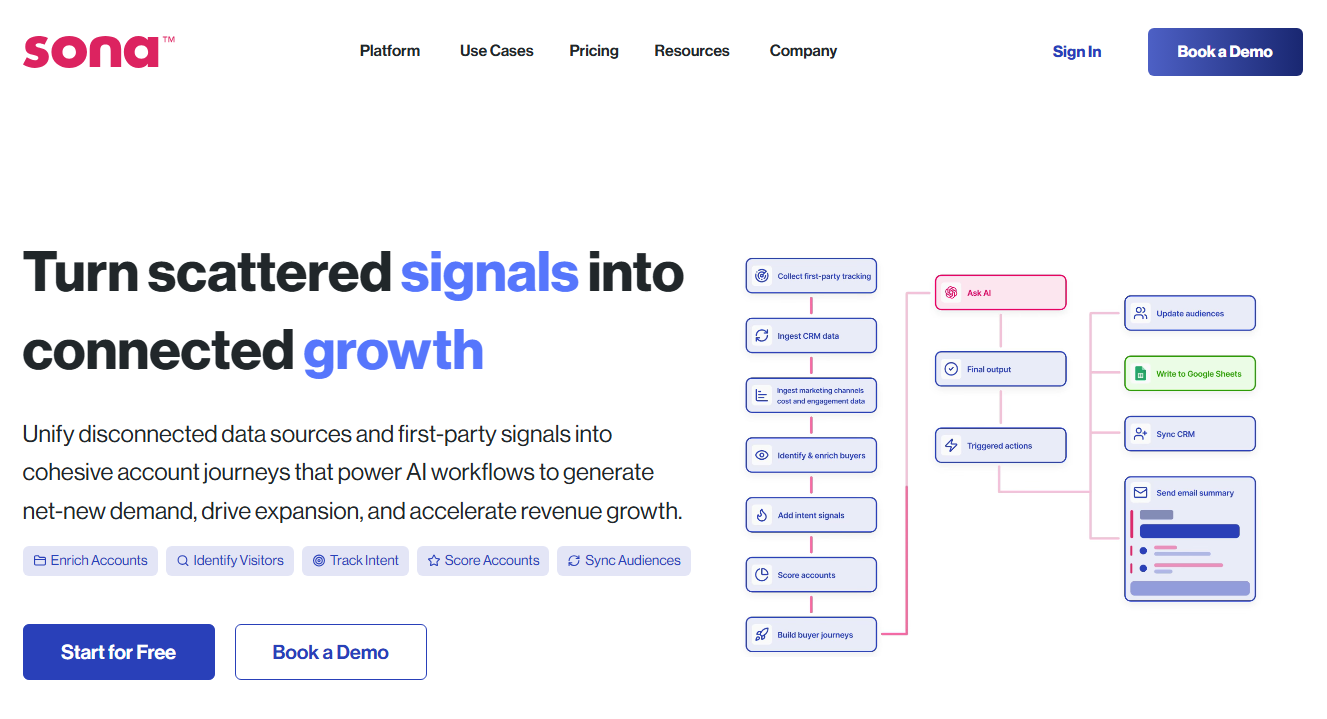
Sona's official artwork frames the product as a connected growth system rather than a standalone attribution dashboard. Image source: Sona.
Sona at a glance
| Question | Answer |
|---|---|
| What is Sona? | B2B revenue intelligence, attribution, identification, and activation software |
| Core jobs | Reveal visitors, enrich accounts, score fit and intent, map journeys, attribute influence, build audiences, and automate actions |
| Who is it best for? | B2B marketing, growth, RevOps, and sales teams with multi-channel data |
| Starting price | Free plan at $0; Growth is $599/month billed annually |
| Free access | 250 credits per month and unlimited users on the public Free plan |
| Main strength | Connects measurement and account intelligence to audience and workflow activation |
| Main concern | Identity, attribution, privacy, and CRM quality need rigorous validation |
| Review status | Public-evidence review, not an authenticated product test |
What is Sona?
Sona aims to make the B2B buyer journey visible at account and contact level. It connects data from CRM, analytics, advertising, marketing, and other sources, then creates profiles and journeys that sales and marketing can use together.
The platform's public capabilities include:
- Identifying companies and, where available, people visiting a website.
- Enriching accounts and contacts with firmographic and professional information.
- Scoring ideal-customer-profile fit and intent.
- Predicting buying stages from engagement patterns.
- Showing account- and contact-level journeys.
- Measuring marketing influence across pipeline and revenue.
- Building dynamic audiences and syncing them to destinations.
- Triggering alerts and workflows across CRM, email, Slack, advertising, and other tools.
This means Sona overlaps several categories: attribution, reverse-IP or visitor identification, enrichment, customer data infrastructure, intent data, ABM audiences, and GTM automation. Consolidation can be valuable, but buyers should first identify which two or three jobs are causing measurable friction. Otherwise, a broad platform evaluation becomes a tour of features without a business case.
How we evaluated Sona
We used seven buyer questions:
- Can connected records be reconciled into trustworthy account and contact journeys?
- How accurate and legally usable is visitor identification in target markets?
- Can fit and intent signals improve prioritisation over existing CRM rules?
- Are attribution methods transparent enough for budget decisions?
- Can audiences and workflows be activated without creating duplicate or conflicting automation?
- Do pricing credits map clearly to the team's expected usage?
- Are privacy, consent, retention, and security controls appropriate for the data involved?
Sona's public customer quotations describe attribution, CAC visibility, and activating behavioural data. These are relevant examples, but vendor-published testimonials do not replace a controlled evaluation against your historical data.
Sona's main features
Company and person identification
Sona identifies companies behind anonymous web sessions and advertises person-level identification on applicable plans. It can reveal contact details and connect activity to enriched company or individual profiles.
This can shorten the distance between anonymous demand and sales action, but accuracy must be tested separately for company and person resolution. During a pilot, use a known validation set, measure match and false-positive rates, examine confidence data, and record geographic variation. Do not route every “identified” visitor directly to aggressive outreach.
Person-level identification also raises privacy and compliance questions. Obtain legal review for your markets, consent setup, lawful basis, notices, opt-outs, data sharing, and downstream destinations. Technical capability is not the same as permission to use the data in every context.
Enrichment and unified account intelligence
Sona combines firmographic, CRM, engagement, intent, and journey data into profiles. It lists HubSpot and Salesforce synchronisation and advertises hundreds of connectors across marketing, CRM, advertising, and analytics systems.
The value is a shared view that replaces manual joins and conflicting reports. The risk is record duplication and unclear field ownership. Define the primary key, merge rules, source priority, update frequency, deletion behaviour, and write-back permissions before switching on bidirectional sync.
ICP and intent scoring
ICP scoring prioritises accounts using configurable firmographic and intent-weighted criteria. Intent signals capture meaningful behaviours, while engagement trends examine recency and frequency. Predictive buying stages place accounts into configurable stages such as awareness, consideration, and decision.
Useful scoring should beat a simple baseline. Compare Sona's ranking with existing qualification rules over a historical cohort. Measure conversion rate, speed to opportunity, false positives, segment bias, and stability. A score is only actionable when users understand its inputs and know what to do at each threshold.
Buyer journeys
Contact- and account-level journeys show interactions across stakeholders, campaigns, and channels. This is particularly useful in B2B buying processes where several people research independently and a single lead-source field hides most of the path.
Journey completeness will depend on connector coverage, identity resolution, tracking constraints, offline data, and CRM behaviour. Treat the visualisation as a model of observable touchpoints, not a literal record of every influence.
Attribution and marketing influence
Sona describes AI-powered multi-touch attribution that weighs interactions across channels, time, and buying committees. It is intended to connect marketing activity to pipeline, revenue, ROI, and CAC decisions.
Attribution is a decision model, not ground truth. Before reallocating spend, ask which model is used, whether rules can be compared, how direct and dark traffic are handled, what conversion window applies, how offline and self-reported data enter the model, and whether results can be reproduced from exported events.
The strongest use is triangulation. Combine Sona's model with controlled experiments, CRM outcomes, sales feedback, lift tests, and finance data. If the platform produces a surprising answer, investigate the underlying path instead of treating the chart as proof.
Audiences and destinations
Sona can create dynamic account and contact audiences using attributes, behaviour, intent, and buying stage, then sync them to advertising, email, CRM, and messaging destinations. This closes the gap between observing a signal and acting on it.
Start with one low-risk audience, such as high-fit accounts showing repeated product research but no open opportunity. Define exclusions, frequency, owners, expiration, and success criteria. The ability to create many audiences quickly can otherwise produce overlapping campaigns and an inconsistent buyer experience.
AI-powered workflows and data analyst
Growth includes pre-built workflow templates; Enterprise lists custom AI-powered workflows. Sona also positions an AI data analyst for natural-language questions and actions. Workflows can update destinations, send alerts, write to Google Sheets, sync CRM records, and automate multichannel activity depending on configuration.
The evaluation standard should be operational: what data triggered the workflow, what the AI inferred, what action ran, who approved it, and how it can be stopped or reversed. Natural-language answers should cite the underlying dataset, filters, date window, and definition. A confident summary without traceability can accelerate the wrong decision.
When comparing the operating cost of AI workflows, the AI token and API cost calculator can help teams model usage that sits outside a vendor's included platform credits.
A practical Sona pilot
Use a narrow revenue workflow with existing evidence:
- Choose one region, product line, and high-quality opportunity cohort.
- Connect the minimum sources required: website, CRM, one ad platform, and marketing automation.
- Document identity, consent, field ownership, and deletion rules.
- Validate company and person matches against known records.
- Compare Sona's ICP and intent scoring with the current baseline.
- Reconcile buyer journeys against a sample of won, lost, and stalled opportunities.
- Build one audience and one workflow with explicit exclusions and human approval.
- Measure match accuracy, qualified pipeline, conversion speed, ad efficiency, seller adoption, and operational errors.
This tests whether connected data becomes a better revenue decision rather than another dashboard.
Sona pricing in 2026
Sona's public Marketing Measurement plans on 20 July 2026 were:
| Plan | Price | Credits | Users | Notable scope |
|---|---|---|---|---|
| Free | $0/month | 250 monthly | Unlimited | Company reveal, ICP scoring, company search, and intent |
| Growth | $599/month billed annually ($7,188/year) | 300,000 annually | Unlimited | Unified intelligence, audiences, automations, pre-built workflows, and onboarding |
| Enterprise | Custom annual price | Custom | Unlimited | Milestone stages, custom AI workflows, attribution insights, sales prioritisation, and white-glove support |
The Free plan is useful for checking interface fit and basic signal quality. Growth is a more meaningful operational commitment: unlimited users reduce seat friction, but the team must understand how credits are consumed, when they expire, what happens at the limit, and whether identification, enrichment, workflow, and destination actions use the same pool.
Sona also presents Enrich as a product area. Confirm whether enrichment pricing, contact reveals, export, APIs, premium data, and custom integrations are included in the selected contract. Verify current terms on Sona's pricing page.
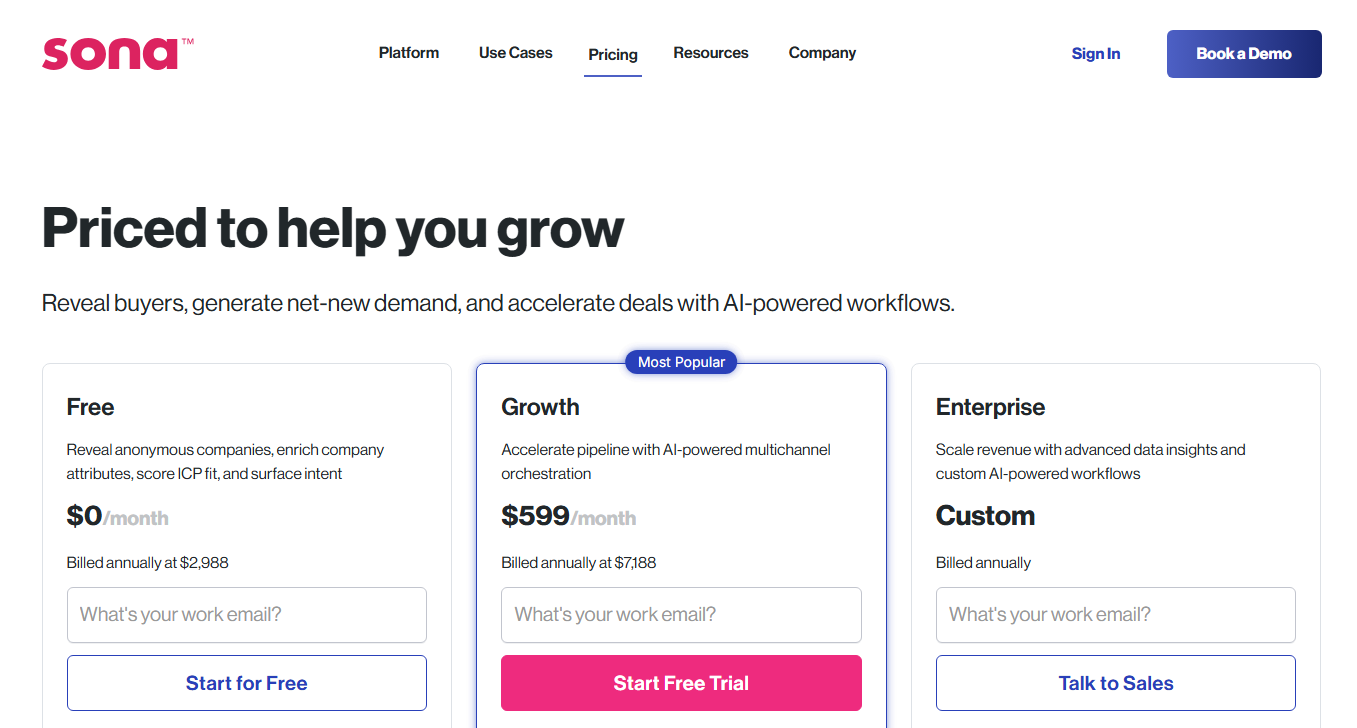
Sona publishes Free and Growth pricing, while Enterprise remains custom. Official image source: Sona; pricing checked 20 July 2026.
Sona advantages
Measurement connects to activation
Sona can move from journeys and attribution into audiences, CRM updates, alerts, and workflows, reducing the gap between analysis and execution.
Broad account intelligence
Identification, enrichment, fit, intent, buying stage, and stakeholder journeys create a richer view than a campaign-attribution report alone.
Unlimited users
Public plans list unlimited users, which can help marketing, RevOps, sales, and leadership work from the same system without per-seat resistance.
Accessible entry point
The Free plan provides a low-cost way to inspect basic fit and signal quality before an annual Growth purchase.
Sona limitations and open questions
Identity accuracy and coverage vary
Company and person identification should be validated by market, device, traffic source, and audience. False positives can waste sales time and damage trust.
Attribution remains a model
AI does not eliminate uncertainty in multi-touch attribution. Definitions, missing touchpoints, tracking loss, and model assumptions remain important.
Privacy is a core implementation requirement
Identification and audience activation require careful consent, notice, retention, regional, and downstream-data controls.
Growth requires annual commitment
At $7,188 per year, buyers need a defined workflow and measurable expected return. Credit mechanics and overages need written clarification.
Platform breadth increases governance needs
When one product can enrich, score, synchronise, segment, and trigger actions, poor field ownership or automation design can propagate mistakes quickly.
Who should use Sona?
Sona is most relevant for:
- B2B growth teams running multi-channel demand generation.
- RevOps teams reconciling CRM, website, campaign, and advertising data.
- Marketers needing account-level attribution and audience activation.
- Sales teams prioritising high-fit, high-intent accounts.
- Organisations replacing several narrow data and workflow tools.
It is less suitable for businesses with very low web volume, short consumer journeys, weak CRM discipline, no owner for data governance, or a need for simple web analytics only.
Sona alternatives
| Alternative | Consider it when |
|---|---|
| Dreamdata | B2B attribution and journey reporting are the central requirement |
| HockeyStack | Revenue analytics and marketing measurement need a strong self-serve layer |
| 6sense | Enterprise ABM, intent, and account orchestration dominate the buying case |
| Demandbase | Mature account-based advertising and GTM workflows are required |
| Factors.ai | Website intent, account analytics, and journey analysis need a lighter starting point |
| Segment | Governed customer data collection and routing matter more than packaged attribution |
Compare products using the same historical opportunity sample and activation use case. A general demo cannot reveal your match accuracy, data gaps, or attribution disagreement.
Is Sona worth it?
Sona can be worth it when disconnected systems prevent revenue teams from recognising and acting on demand. The value case is strongest when a company can connect attribution, account prioritisation, and activation to measurable pipeline improvement or reduced tooling and analysis cost.
It is harder to justify when the organisation has not agreed on lifecycle stages, keeps poor CRM records, or lacks the capacity to govern audiences and workflows. In those cases, a platform may expose the problem without solving it.
Our final verdict
Sona has an appealing product thesis: revenue data should not stop at a dashboard. Identification, unified profiles, intent, journeys, attribution, audiences, and workflows belong in a connected loop when a team can govern them well.
The Free plan makes an initial signal-quality test straightforward. Before Growth or Enterprise, we would demand evidence from our own data: accurate matches, better prioritisation than current rules, explainable influence reporting, dependable CRM sync, and at least one workflow that improves a commercial metric without creating compliance or operational risk.
Frequently asked questions
What does Sona do?
Sona connects B2B revenue data, identifies website visitors, enriches and scores accounts, maps buyer journeys, measures marketing influence, builds audiences, and activates GTM workflows.
Is the official Sona domain sona.io?
No for the product reviewed here. The verifiable B2B sales and marketing platform operates at sona.com. The supplied sona.io domain was unavailable when researched, so we corrected the domain instead of attributing unsupported claims to it.
How much does Sona cost?
Sona lists a Free plan at $0, Growth at $599 per month billed annually for $7,188, and custom Enterprise pricing.
Does Sona have a free plan?
Yes. The public Free plan lists 250 monthly credits, unlimited users, company identification, ICP scoring, company search, and intent capabilities.
Is Sona an attribution platform?
Attribution is part of Sona, but the product is broader. It also covers identification, enrichment, account intelligence, intent, audiences, destinations, and AI-powered workflows.
Can Sona identify individual website visitors?
Sona advertises person-level identification and contact enrichment. Buyers should independently test accuracy, coverage, consent, and legal usability for their markets before operational use.
Was this Sona review hands-on?
No. This is a public-evidence first-look review. We did not access an authenticated Sona workspace and have separated vendor claims from our buyer-oriented analysis.

Tolu S.
Associate Director
Evidence-led product reviews and founder profiles for search, marketing, authority, and AI visibility teams.