Short answer
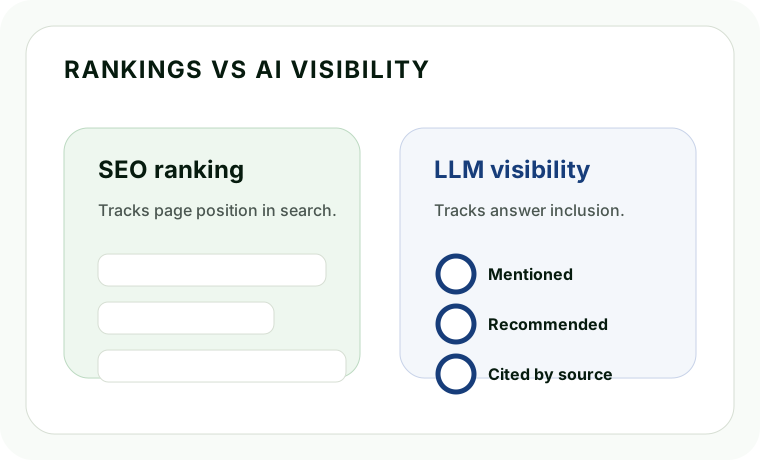
SEO rankings measure page position in search results. LLM visibility measures whether a brand appears, is recommended, or is cited inside AI answers for buyer-style prompts.
The fastest way to create a baseline is with the free LLM Visibility Checker. Use it before deeper tracking or source-building work.
Reader question
"Can we have strong rankings and weak LLM visibility?"
Yes. Ranking pages can help, but AI answers may still favor brands with clearer entity signals and stronger third-party evidence.
Useful next steps: LLM Visibility Checker, AI Citation Readiness Checker, and LLMentioned.
Table of Contents
SEO rankings and LLM visibility are connected, but they are not the same metric. Rankings measure where a page appears in search results. LLM visibility measures whether a brand, product, person, or source is included in an AI-generated answer.
This distinction matters because buyers are asking AI systems for recommendations, comparisons, shortlists, and explanations. In those moments, a classic ranking report may not show whether your brand was included.
A modern search workflow should measure both.
Short answer
SEO ranking is a page-position metric. LLM visibility is an answer-inclusion metric. You need ranking data to understand classic search presence, and you need LLM visibility checks to understand whether AI systems mention, recommend, or cite the brand.
What SEO rankings measure
SEO rankings measure where a URL appears for a query. They are useful for tracking page performance, query coverage, click potential, and classic organic search visibility.
Ranking data is still important. It tells you whether Google can crawl, understand, and trust a page for a query. It also helps you spot content decay, competitor movement, and search intent shifts.
Rankings are especially useful when the search journey still starts with a results page. They help you decide which pages deserve updates, which terms are moving up or down, and which competitors are taking traffic from you. They also give you a measurable history. If a service page moves from position twelve to position three, the team can usually connect that movement to technical fixes, content improvements, links, or changes in search demand.
The limitation is that rankings are URL-first. They tell you where a page appears, not whether an AI assistant would name the brand when a buyer asks for recommendations. A high-ranking guide can generate traffic while the brand itself remains weakly associated with the category. That is why rankings should be treated as one layer of discovery, not the whole visibility system.
What LLM visibility measures
LLM visibility measures whether a brand appears inside AI-generated answers. The appearance may be a direct mention, a recommendation, a comparison inclusion, or a citation to a source that supports the answer.
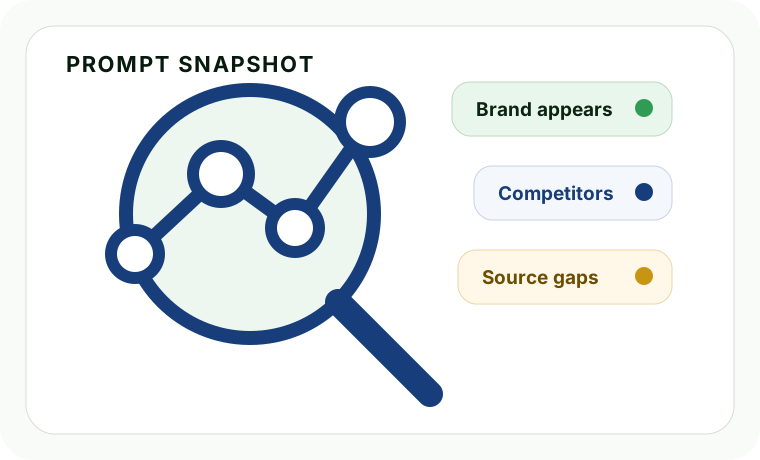
The LLM Visibility Checker gives you a prompt snapshot for this layer. It is not a replacement for rank tracking. It answers a different question: are we part of the AI answer?
LLM visibility is brand-first. It asks whether an answer includes your company, product, domain, or evidence when the user describes a problem. That makes it useful for teams who care about shortlists, recommendations, and buyer perception. A model might mention your brand directly, cite your site as a source, include you in an alternatives list, or use a third-party article that supports your category authority.
The quality of the mention matters. A passing mention at the bottom of an answer is not the same as being recommended in the first three options with a supporting citation. Good LLM visibility reporting should capture the position, context, competitors, and source trail behind the answer.
Why rankings do not guarantee AI mentions
A high-ranking page may still be ignored if the brand entity is unclear, the page is hard to summarize, or third-party sources do not confirm the brand as a category option.
AI systems often need a credible answer, not just a ranking URL. They may lean on comparison pages, trusted guides, review sources, directories, or concise pages that clearly explain the category.
Example: ranking page, missing answer
Imagine a consulting firm ranks well for "AI visibility strategy." The page may be comprehensive, but if it talks mostly about the topic and barely connects the firm to a specific service, an AI answer may use the page as background while recommending better-known competitors. The ranking page helped the model understand the topic, but it did not make the brand a clear option.
The opposite can also happen. A brand may not rank first for a broad keyword but may appear in AI recommendations because it is mentioned across comparison pages, customer discussions, industry roundups, and partner content. In that case, the external evidence trail is doing work that a rank tracker would not fully explain.
How to measure both together
Use rankings for page-level search visibility and prompt checks for answer-level brand visibility.
- Track target keywords for rankings and traffic potential.
- Run buyer-style prompts for AI answer inclusion.
- Record direct brand mentions, domain citations, and competitors.
- Map missing AI mentions to source gaps and page clarity issues.
A simple reporting table
A practical report can include one row for each buyer topic. Add columns for primary keyword, ranking URL, current ranking band, AI prompt cluster, brand mention status, competitor names, cited sources, and next action. This keeps SEO and LLM visibility in the same conversation. If the ranking is weak and the AI answer is also weak, the issue may be broad authority. If the ranking is strong but the AI answer is weak, the issue may be entity clarity or external proof. If the ranking is weak but the AI answer is strong, the brand may have good off-site recognition but needs better page-level SEO execution.
This table is also useful for leadership reporting because it avoids vague claims. Instead of saying "AI visibility improved," you can say the brand moved from absent to recommended in three buyer prompts, while the supporting page moved from page two to page one for the related search query.
Workflow for search teams
Start with the keyword or buyer problem. Check ranking pages. Then run the same problem through AI recommendation prompts. If the page ranks but the brand is absent, improve entity clarity and build stronger external proof.
Use the AI Citation Readiness Checker for page-level improvements and the GEO / LLM SEO Planner when you need a wider roadmap.
How to interpret conflicts
If rankings are improving but LLM visibility is flat, check whether the page actually states the brand's category, audience, proof, and differentiators in a way an answer can summarize. Then inspect third-party sources. The model may understand your content but lack independent support for recommending you.
If LLM visibility improves before rankings improve, do not dismiss the progress. It may mean the brand is becoming easier to recognize in answer systems because of mentions, digital PR, listicles, community references, or clearer entity signals. You should still improve the ranking page, but the AI mention data shows the brand is gaining category association.
How this changes content planning
Classic SEO briefs often start with search volume and keyword difficulty. LLM visibility planning should also include answer intent: what would a buyer ask an assistant, what brands are currently named, what sources are used, and what proof is missing? A strong content plan now needs both page quality and answer usefulness. Pages should be crawlable, structured, and optimized for search, but they should also include short definitions, comparison context, proof points, and source-friendly explanations.
Supporting content should not exist only to catch long-tail traffic. It should help an AI system understand the brand's relationship to problems, use cases, alternatives, and outcomes. That is why internal links, author clarity, evidence, and third-party validation matter more than ever.
When to use the LLM Visibility Checker
Use the LLM Visibility Checker when you need to know whether ranking work is translating into AI answer presence. Run it before a campaign, after major page changes, and after new source placements.
Recommended cadence
For most teams, monthly prompt snapshots are enough to see directional movement without overreacting to daily answer variation. Pair that with your normal ranking review. If you publish major service pages, win new reviews, secure digital PR, or update comparison content, add an extra LLM visibility check after the changes have had time to be discovered.
The goal is not to replace your SEO dashboard. The goal is to add the missing answer layer so you can see whether users who ask AI assistants for recommendations are being shown your brand, your competitors, or no credible option at all.
FAQ
Is LLM visibility more important than SEO rankings?
No. They measure different surfaces. Rankings still matter for classic search. LLM visibility matters when buyers use AI answers to shortlist options.
Can backlinks help LLM visibility?
They can help when they create credible source mentions and category proof. The value is not only the link; it is the trusted context around the brand.
How often should I compare rankings and LLM visibility?
Monthly is a practical baseline for active campaigns, with extra checks after major content updates or source placements.

Adam O'neil
1stpage Editorial Team
Our 1stpage editorial team combines hands-on SEO agency experience with evidence-backed search performance guidance. These posts are built from real search wins, audit-grade insight, and conversion-tested tactics designed to help agencies, founders, and search teams earn more traffic and trust.