Table of Contents
- Nimt.ai at a glance
- What is Nimt.ai?
- How we evaluated Nimt.ai
- Nimt.ai's main features
- What the Nimt.ai workflow could look like
- Nimt.ai pricing in 2026
- Nimt.ai advantages
- Nimt.ai limitations and open questions
- Who should use Nimt.ai?
- Nimt.ai alternatives
- Is Nimt.ai worth it?
- Our final verdict
- Frequently asked questions
Nimt.ai is an AI visibility platform that tracks how major answer engines mention, rank, cite, and describe a brand. Its bigger promise is that it does not stop at measurement. Nimt says its AI Search Agent can use that data to produce content, plan outreach, recommend technical changes, and help teams improve the sources that influence AI answers.
That combination makes Nimt more interesting than a dashboard-only tracker. It also creates the biggest question in this review: does the execution layer produce work that an experienced marketing team can trust, or does it simply add another AI writing interface to an analytics product?
Our short verdict is that Nimt appears most compelling for agencies and growth teams that want AI visibility monitoring and execution in one workflow. Its Source Tracker, prompt-level analysis, competitor visibility, and Slack-based agent form a coherent product story. However, public independent review volume is still too small to validate reliability, output quality, or return on investment at scale. Buyers should use the free credits to test those areas with real prompts and real publishing standards before committing.
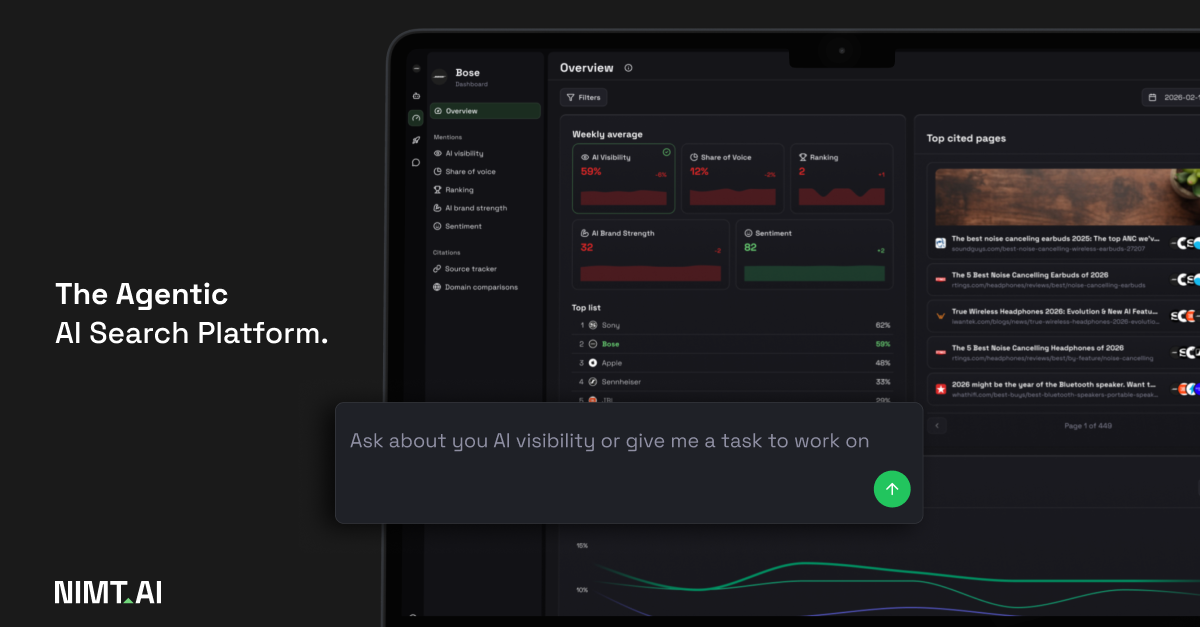
Nimt.ai presents itself as an AI search tracker that can also execute optimization work. Image source: Nimt.ai.
Nimt.ai at a glance
| Question | Answer |
|---|---|
| What is Nimt.ai? | AI visibility tracking and AI search optimization software with an execution agent |
| What does it track? | Brand visibility, share of voice, ranking, sentiment, cited sources, prompts, and competitors |
| Which AI experiences does it cover? | Nimt lists ChatGPT, ChatGPT Search, Copilot, Google AI Mode, AI Overviews, Perplexity, Gemini, and Claude |
| What is the main differentiator? | An AI Search Agent that turns tracking data into content, outreach, PR, citations, and technical recommendations |
| Who is it for? | Agencies, in-house marketing teams, growth teams, and brands investing in AEO or GEO |
| How much does it cost? | The public pricing configuration showed Flex at €79 per month with 10,000 credits and three of eight models selected |
| Is there a free option? | Nimt advertised €40 in free credits at the time of review |
| Did we test it hands-on? | No. This verdict is based on public evidence and is intentionally not scored |
What is Nimt.ai?
Nimt.ai is a Swedish software platform founded by Manuel Lemholt Berger, Martin Bergström, and Oliver Ekberg. The company describes the product as a way to understand and improve how brands appear in AI-generated answers.
Traditional rank trackers observe search-result positions. Nimt instead monitors questions that a prospective customer might ask an AI assistant, such as “What is the best CRM for a small consultancy?” It then looks for whether a tracked brand appears, where it ranks in the response, what sentiment surrounds it, which competitors appear, and which webpages the model cites.
That data is presented through metrics including:
- AI Visibility
- Share of Voice
- Ranking
- AI Brand Strength
- Sentiment
- Cited sources
- Prompt and intent groups
- Competitor performance
This measurement layer is broadly comparable to other AI visibility platforms. Nimt's distinctive claim is that tracking is only the starting point. Its AI Search Agent is designed to act on the findings inside the app or through Slack.
If the distinction between conventional rankings and answer-engine visibility is still unclear, our guide to LLM visibility versus SEO rankings explains what each measurement can and cannot tell you.
How we evaluated Nimt.ai
Because we did not receive a temporary review account, we limited the review to claims that could be traced to public sources. We used five questions:
- Coverage: Does the platform monitor a useful range of AI answer experiences?
- Diagnosis: Can it identify why a brand is winning or losing visibility?
- Actionability: Does it turn observations into specific, prioritised work?
- Workflow fit: Can a team use the findings without creating another disconnected reporting silo?
- Evidence quality: Are the product's strongest claims supported by independent customer evidence?
The first four can be assessed provisionally from product documentation. The fifth remains the main limitation. Product Hunt currently shows one public review, so its displayed rating should not be treated as a reliable consensus.
Nimt.ai's main features
1. Multi-model AI visibility tracking
Nimt says it tracks eight major AI search experiences: ChatGPT, ChatGPT Search, Copilot, Google AI Mode, Google AI Overviews, Perplexity, Gemini, and Claude. This matters because one model's answer is not a reliable proxy for another model's recommendations or source selection.
The useful question is not merely “Does ChatGPT mention us?” A stronger monitoring setup asks:
- Which model mentions the brand?
- For which questions and stages of intent?
- How often does the brand appear relative to competitors?
- Is it recommended positively, neutrally, or negatively?
- Which sources appear to influence the answer?
- Does visibility improve after a content, PR, or authority campaign?
Nimt's model coverage appears broad enough for a practical baseline. Buyers should still confirm that the exact model, country, language, location, and prompt frequency they need are available on their chosen credit configuration.
If you have not established a baseline yet, use our free LLM Visibility Checker before comparing paid monitoring platforms. It will help you define the prompts and outputs that matter before you pay for continuous tracking.
2. Source Tracker
Source Tracker is one of Nimt's strongest documented features. Instead of reporting only that a model mentioned a competitor, it is designed to show the domains and pages cited in the answer.
Nimt says it groups sources into categories such as listicles, guides, product pages, forums, and reviews. That distinction can make a visibility report more actionable. For example:
- If a competitor wins through its own comparison page, the opportunity may be content and information architecture.
- If the winning source is an industry publication, the opportunity may be digital PR or editorial outreach.
- If models repeatedly cite a forum discussion, the brand may need stronger community participation and third-party advocacy.
- If an outdated page drives negative sentiment, the team has a defined reputation-management target.
This is closer to how serious AI visibility work should operate. A brand usually cannot improve recommendations by editing its homepage alone. It needs to understand the wider source environment from which answer engines assemble their responses.
That source environment is also why some brands repeatedly lose recommendations to competitors. Our analysis of why competitors appear in AI answers while another brand does not shows how owned content, comparison pages, publishers, and community evidence work together.
Nimt's public Source Tracker guide explains the concept in depth. What remains unverified in this review is how consistently the platform resolves citations across every supported model, particularly when an answer has no explicit clickable sources.
3. Prompt Management and intent mapping
Nimt's Prompt Management feature organizes tracked questions by topic and intent. This is a sensible bridge between keyword research and AI-search monitoring because AI visibility can look healthy at the awareness stage while remaining weak on high-value comparison or purchase questions.
For example, a software company could separate prompts into:
- Awareness: “What is revenue intelligence software?”
- Research: “Which revenue intelligence tools integrate with HubSpot?”
- Comparison: “Nimt competitor A vs competitor B”
- Purchase: “Best revenue intelligence platform for a 20-person sales team”
Tagging prompts this way helps a team avoid celebrating visibility on low-commercial-intent questions while competitors dominate the prompts closest to a buying decision. Nimt explains this workflow in its Prompt Management guide.
4. Competitor and brand management
AI answers frequently blur the boundaries between brands, product lines, parent companies, and competitors. Nimt's Brand Management controls reportedly allow users to merge, hide, or exclude brands so the dashboard reflects the market being analysed.
This sounds like a minor administrative feature, but it can prevent distorted share-of-voice reporting. Nike and Air Jordan may need to be treated as one commercial family in one analysis and as distinct brands in another. The correct setup depends on the question being measured.
Nimt documents these controls in its Brand Management announcement. During a trial, we would test how easy it is to correct false competitor detection and whether those corrections persist throughout exports, trends, and agent recommendations.
5. Boost Actions
Boost Actions are intended to convert visibility gaps into prioritised projects. Nimt says each action combines supporting evidence, prompt context, an impact estimate, resource complexity, a target outcome, and a task checklist.
An example from Nimt's own documentation is an action intended to increase share of voice by a defined percentage in a tagged topic within 90 days. This framing is better than a generic recommendation such as “publish more content” because it gives a team a measurable objective and a reason for prioritisation.
The caution is that an expected outcome is still a forecast. AI answers vary, underlying models change, and correlation does not prove that one completed task caused a visibility shift. Teams should treat projected gains as prioritisation guidance, not guaranteed performance.
For teams building the owned-page part of that plan, how to optimize a website for AI search provides the supporting workflow for prompt mapping, source proof, answer structure, and retesting.
Read Nimt's Boost Actions explanation for the company's full workflow.
6. AI Search Agent in the app and Slack
The AI Search Agent is the feature that changes Nimt from a monitoring product into a potential operating system for AI visibility work. Nimt says the agent can use project data such as prompts, source gaps, competitor movement, and trusted domains to produce:
- Articles and comparison pages
- Press releases
- LinkedIn content and Reddit post drafts
- Schema markup
- Technical improvement recommendations
- Site audits
- Outreach and citation work
- New prompts and strategic plans
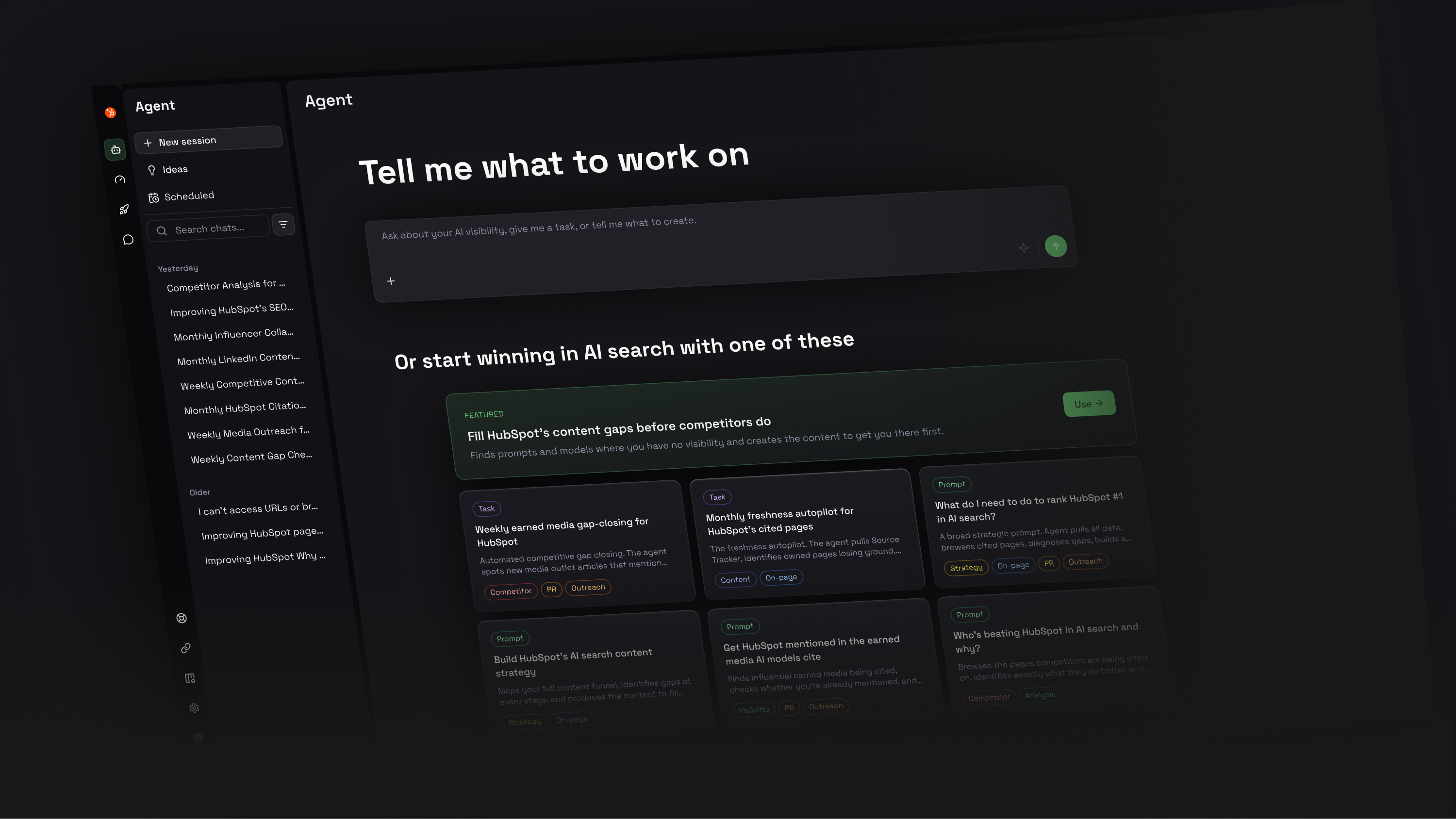
Nimt's published Agent interface. The company says the agent uses project-level visibility data to generate and prioritise work. Image source: Nimt.ai launch announcement.
The Slack interface is potentially valuable because it lets non-specialists request work without learning a complex analytics dashboard. It may also reduce the reporting bottleneck between an SEO or GEO specialist and a wider marketing team.
This is also the part of Nimt that requires the most careful trial. A good evaluation should check:
- Whether generated content includes traceable sources
- Whether factual claims survive editorial review
- Whether schema is valid and appropriate to the page
- Whether outreach is personalised rather than automated spam
- Whether Reddit drafts respect community rules and disclosure expectations
- Whether the agent proposes meaningful edits instead of generic SEO advice
- What approval controls exist before publishing or sending anything
- How data from connected services is stored and permissioned
The product's value depends less on whether it can generate text and more on whether its outputs are grounded in the account's evidence and safe to operationalise.
7. Integrations and reporting
Nimt advertises connections to more than 3,000 applications, including HubSpot, Canva, Figma, Notion, Google Drive, Gmail, WordPress, Mailchimp, Shopify, Google Analytics, Google Search Console, Reddit, and YouTube. It also lists a Data Studio integration on its pricing page.
That is strong integration breadth on paper. Buyers should verify whether a required integration is native, supplied through a third-party automation layer, or limited to basic triggers and actions. “Connects to” does not necessarily mean every service supports deep two-way synchronization.
What the Nimt.ai workflow could look like
A practical agency workflow could follow this sequence:
- Add the client's domain, competitors, market, language, and priority AI models.
- Import or generate prompts across awareness, research, comparison, and purchase intent.
- Collect a baseline for visibility, share of voice, rank, citations, and sentiment.
- Use Source Tracker to identify the pages and domains influencing important answers.
- Separate opportunities into owned content, technical fixes, digital PR, third-party mentions, and community work.
- Review Boost Actions and reject anything not supported by clear evidence.
- Ask the AI Search Agent to prepare a first draft or task plan.
- Apply human editorial, legal, brand, and community checks.
- Publish or launch the approved work.
- Track changes in the same prompt group over a long enough period to avoid mistaking answer volatility for a trend.
This closed loop is Nimt's clearest advantage. Many teams already have enough dashboards. The operational challenge is choosing the next action and completing it without losing the evidence that justified it.
Nimt.ai pricing in 2026
On 20 July 2026, Nimt's public page displayed:
| Plan | Public price | What was shown |
|---|---|---|
| Flex | €79 per month | 10,000 credits, three of eight models selected, 72 prompts per day, unlimited users, AI Search Agent, dashboard, integrations, and Data Studio integration |
| Enterprise | Custom annual contract | Eight models, unlimited tracked prompts, custom credits and coverage, onboarding, invoicing, and dedicated support |
Nimt also advertised €40 in free credits. The interface allowed currency selection, and the plan uses credits, so the effective cost depends on model selection, prompt count, tracking frequency, and agent usage.
The public pricing language is slightly confusing: the control references yearly billing while the supporting text says billed monthly and cancel anytime. Confirm billing term, renewal amount, unused-credit treatment, and cancellation conditions directly in checkout before purchasing.
Pricing should also be viewed in the context of a changing discipline. Our article on whether GEO is replacing SEO explains why most teams still need both conventional search foundations and AI-answer visibility work rather than treating them as substitutes.
The right way to evaluate value is not “Is €79 cheap?” It is:
Ask Nimt to estimate monthly credits for your actual scope. A low starting price is irrelevant if daily tracking across every required model rapidly changes the credit requirement.
Nimt.ai advantages
It connects diagnosis to execution
Nimt's product narrative is unusually coherent: prompts reveal visibility gaps, Source Tracker shows influential pages, Boost Actions prioritise work, and the agent helps execute it. That is more useful than presenting isolated charts without a path to action.
It treats third-party sources as part of the search strategy
AI recommendations are influenced by reviews, publications, comparisons, forums, and other external sources. Nimt's source-level approach reflects this reality and can help teams decide when the next step is content, PR, authority building, or community work.
Multi-model coverage reduces single-engine bias
Monitoring several AI experiences makes it easier to identify model-specific weaknesses and reduces the risk of treating one ChatGPT answer as a market-wide result.
Slack may improve adoption
An agent inside a familiar team environment could make AI visibility data accessible to content, PR, leadership, and client-service teams that would not routinely open a specialist dashboard.
Unlimited users can suit agencies
Nimt lists unlimited users on Flex and says agencies can add multiple clients. Teams should confirm workspace, client-separation, permission, and credit rules, but the public packaging is agency-friendly.
Nimt.ai limitations and open questions
Independent customer evidence is currently thin
Product Hunt showed one public review at the time of research. That review was positive, but one opinion cannot establish reliability, support quality, or long-term value. We found no sufficiently broad independent review base to justify a numeric rating.
The execution quality is not publicly proven at scale
Nimt's most important advantage is also the hardest claim to assess from marketing pages. Buyers need to test whether agent outputs are genuinely grounded, differentiated, and publishable after reasonable editing.
Credit pricing can make comparisons harder
Usage-based pricing is flexible, but it requires workload modelling. Compare the cost of an equivalent prompt set across the same models and frequency, not just the headline monthly price.
Attribution will remain imperfect
If share of voice improves after several content, PR, and technical tasks, the platform may show correlation without proving which intervention caused the change. AI providers can also change models and retrieval systems without notice.
Sensitive integrations require governance review
Connecting an agent to Gmail, Drive, WordPress, analytics, and other business systems creates legitimate questions about permissions, approval stages, retention, subprocessors, and least-privilege access. Review Nimt's privacy policy and terms, and request current security documentation where necessary.
Who should use Nimt.ai?
Nimt appears best suited to:
- Agencies managing AI visibility for several clients and needing repeatable research-to-action workflows
- Growth teams that want to connect brand recommendations in AI answers with content, PR, and technical work
- In-house marketing teams without a dedicated AEO or GEO specialist
- Brands in competitive categories where third-party comparisons and editorial sources influence recommendations
- Teams already using Slack that want visibility work to happen within an established collaboration channel
It may be a weaker fit for:
- Very small companies without enough brand demand or content capacity to act on the data
- Teams that only need an occasional snapshot rather than continuous monitoring
- Enterprises that require mature security evidence, complex permissions, and procurement controls before granting connected-system access
- Buyers seeking a long history of independently reviewed customer outcomes
- Teams expecting autonomous publishing with no editorial or compliance review
Nimt.ai alternatives
The most useful alternative depends on the job you are buying.
| If your priority is... | Consider... | Why |
|---|---|---|
| Enterprise AI visibility analytics | Profound | Often considered for large-team monitoring, reporting, and enterprise workflows |
| A focused AI search tracker | Peec AI | A simpler monitoring-first option for teams that want visibility data without a broad agent proposition |
| SEO plus AI visibility in one established suite | Semrush | Useful when the team already relies on conventional SEO research and reporting |
| AI visibility plus content-generation workflows | Writesonic | Relevant when content production and optimization are central to the buying decision |
| A free initial diagnostic | 1stpage Agency LLM Visibility Checker | Useful for defining prompts and baseline questions before paying for ongoing monitoring |
| Expert-led execution across citations and third-party authority | LLMentioned | Suitable when strategy and external authority work require human research, outreach, and quality control |
This is not a declaration that one product is universally better. Nimt should win a trial when its agent materially reduces the work between finding a gap and completing a high-quality intervention. A monitoring-first alternative should win when a team already has people and systems to execute the recommendations.
Is Nimt.ai worth it?
Nimt.ai is worth trialling if your team already believes AI recommendations affect discovery or buying decisions and you need more than a visibility dashboard. Its combination of multi-model monitoring, source analysis, prompt intent, competitor tracking, prioritised actions, and an execution agent addresses a real operational gap.
Before paying for continuous tracking, make sure the underlying pages are usable as evidence. The guide to citation-ready content for AI search covers the answer blocks, proof, structure, and qualification signals a monitoring platform should help you improve.
It is too early to call it a proven category leader based on public evidence alone. The product was launched in 2025, its major agent layer was announced in April 2026, and independent review volume remains limited. The sensible buying decision is a controlled pilot, not faith in a feature list.
Use the free credits to test one commercially important topic cluster. Give Nimt ten to twenty prompts across the funnel, inspect the sources it finds, and ask the agent to create three different deliverables. Score those deliverables for factual accuracy, source traceability, brand fit, originality, compliance, and editing time. Then compare the total cost with your current manual workflow.
Our final verdict
Nimt has one of the clearer propositions in the emerging AI visibility category: track how AI recommends the brand, diagnose the source gap, and use an agent to do the next piece of work.
The Source Tracker and prompt-intent workflow appear strategically sound. The Slack agent could improve adoption and shorten the path from insight to execution. Pricing is accessible enough for a focused pilot, although credit consumption needs to be modelled against a real prompt set.
The reason we are not assigning a score is simple. A credible review should not convert marketing claims and one third-party review into a precise rating. Nimt's decisive feature is its execution quality, and that requires authenticated, repeatable testing.
First-look recommendation: Put Nimt on the shortlist for agencies and growth teams that want both AI visibility measurement and execution. Run a narrow pilot and judge the product on the quality and governance of its agent outputs, not the polish of its dashboard.
Before starting a paid trial, run your site through our AI Citation Readiness Checker and browse the wider collection of AI search tools. This gives you a baseline for the technical and source gaps you want any platform to help solve.
If the broader objective is recommendation visibility rather than software selection, continue with how to make your brand show up in ChatGPT recommendations. It turns the same findings into a practical brand, content, and third-party authority plan.
Frequently asked questions
What does Nimt.ai do?
Nimt.ai tracks how AI systems mention, rank, cite, and describe a brand. It also provides an AI Search Agent intended to turn those findings into content, outreach, PR, citation, and technical actions.
Which AI models does Nimt.ai track?
Nimt publicly lists ChatGPT, ChatGPT Search, Copilot, Google AI Mode, Google AI Overviews, Perplexity, Gemini, and Claude. Availability and cost may depend on plan and model selection.
How much does Nimt.ai cost?
On 20 July 2026, Nimt displayed a Flex configuration at €79 per month for 10,000 credits with three of eight models selected. Enterprise pricing was custom. Check the live pricing and checkout terms because usage, currencies, and packaging can change.
Does Nimt.ai offer a free trial?
Nimt advertised €40 in free credits at the time of this review. Treat this as a pilot allowance and confirm whether a payment method or subscription selection is required.
Is Nimt.ai only a tracking tool?
No. Tracking is the foundation, but Nimt positions its AI Search Agent as the key differentiator. The agent is intended to create and coordinate work based on prompt, source, competitor, and visibility data.
Can agencies use Nimt.ai?
Yes. Nimt explicitly markets to agencies and lists unlimited users on its Flex plan. Agencies should verify client separation, account permissions, exports, white-label reporting, and how credits are shared across projects.
Is Nimt.ai better than Profound or Peec AI?
It depends on the workflow. Nimt's strongest argument is integrated execution through its agent. Profound or Peec may suit teams that prioritise monitoring or already have established execution resources. Compare all products using the same prompts, models, locations, and reporting window.
Can Nimt.ai guarantee better visibility in ChatGPT or Google AI Overviews?
No credible platform can guarantee recommendations across independent AI systems. Nimt can help identify patterns, sources, and actions, but model changes, retrieval behaviour, competition, and content quality remain outside any vendor's full control.
Was this Nimt.ai review hands-on?
No. This was a research-based first-look review using public product materials and third-party listings. We have stated that limitation throughout the article and have not assigned a numeric rating.

Tolu S.
Associate Director
Evidence-led product reviews and founder profiles for search, marketing, authority, and AI visibility teams.