Table of Contents
Peec AI is an AI search analytics platform that tracks how brands appear across ChatGPT, Google AI Mode, AI Overviews, Perplexity, Gemini, and Microsoft Copilot. It measures visibility, position, sentiment, share of voice, cited sources, and competitor performance, then uses an Actions layer to help teams decide what to improve.
Our short verdict is that Peec AI looks like one of the more mature self-serve choices for marketing teams and agencies that want dependable AI visibility monitoring without starting with an enterprise sales process. Its daily prompt tracking, source analysis, competitor intelligence, unlimited users, and approachable interface form a strong monitoring product. The key limitation is familiar across the category: measurement is clearer than causal attribution, and buyers still need skilled people to turn many findings into high-quality content, authority, PR, and technical work.
Peec is worth shortlisting when the primary job is answering: “Where does our brand appear in AI answers, why are competitors ahead, and which sources or pages should we work on next?” Teams expecting an autonomous system that completes every optimization should test the Actions workflow carefully rather than assuming analytics automatically becomes execution.
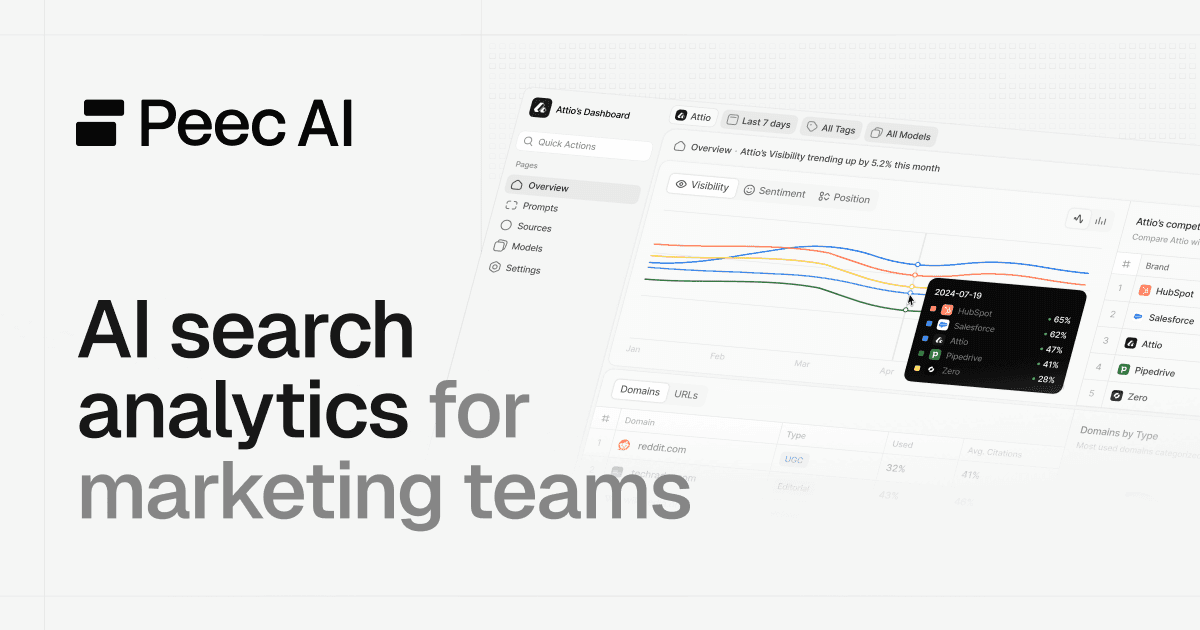
Peec AI markets its platform to in-house marketers and agencies measuring brand performance in AI search. Image source: Peec AI.
Peec AI at a glance
| Question | Answer |
|---|---|
| What is Peec AI? | AI search analytics and competitive visibility software |
| What does it track? | Visibility, position, sentiment, share of voice, sources, citations, prompts, and competitors |
| Which platforms are available? | Public plans list ChatGPT, AI Mode, AI Overviews, Copilot, Perplexity, and Gemini; Enterprise lists additional API-based models |
| Who is it best for? | SEO teams, content teams, marketing departments, and agencies |
| What is the starting price? | $95 per month for Starter at the time of review |
| Is there a trial? | Peec and its G2 listing advertise a seven-day free trial |
| Main strength | Polished daily monitoring with strong prompt, source, and competitor analysis |
| Main concern | Insights still require disciplined human execution and careful attribution |
| Review status | Public-evidence review, not an authenticated product test |
What is Peec AI?
Peec AI helps a team monitor the questions customers ask AI systems and measure whether its brand appears in the resulting answers. Instead of treating one ChatGPT response as proof, the platform repeatedly runs a defined prompt set and reports patterns over time.
The core metrics include:
- Visibility: How frequently a brand appears across tracked responses.
- Position: Where the brand appears when an answer recommends or lists options.
- Share of voice: How much presence the brand earns relative to competitors.
- Sentiment: Whether the answer frames the brand positively, negatively, or neutrally.
- Sources: Which domains and pages appear as citations or grounding material.
- Competitors: Which brands appear naturally, including companies outside a manually selected list.
This is different from conventional keyword rankings. A search result reports page positions; an AI answer can synthesize several sources, mention a brand without linking to it, and recommend a competitor even when the competitor's own website does not rank first. Our guide to LLM visibility versus SEO rankings explains why the two measurements should be used together rather than confused.
How we evaluated Peec AI
We assessed Peec against six buyer questions:
- Does it cover the AI experiences a marketing team needs?
- Does the prompt setup produce a meaningful commercial baseline?
- Can teams identify the sources influencing answers?
- Does competitor analysis reveal useful opportunities?
- Are the recommended actions specific enough to execute?
- Does pricing scale sensibly with prompts, projects, countries, and models?
Public evidence is stronger than it is for many newer GEO tools. G2 showed 11 reviews and a 4.9 rating when checked, with recurring praise for usability and support. That is a useful signal, but still a small sample. Vendor-written product descriptions and submitted customer outcomes on the same listing should be separated from independently authored review feedback.
Peec AI's main features
Daily multi-model prompt tracking
Peec's public brand plans let users select three models and track prompts daily. Starter includes 50 prompts, Pro 150, and Advanced 350. The listed standard model choices are ChatGPT, Google AI Mode, AI Overviews, Microsoft Copilot, Perplexity, and Gemini.
Enterprise expands coverage with Claude Sonnet 4, GPT-5 Search, DeepSeek, Qwen, and Mistral through API-based options. Because model availability and product names change quickly, buyers should confirm whether each engine uses a consumer interface, search-enabled mode, API response, or another retrieval method. Those differences can materially change the answer.
Daily tracking is useful when teams need trend data rather than screenshots. It also creates cost and interpretation responsibilities. More prompts do not automatically produce better insight. A good prompt set should represent awareness, research, comparison, objection, and purchase intent across the markets the business actually serves.
Before buying continuous tracking, use the free LLM Visibility Checker to identify the questions and competitors worth monitoring.
Visibility, position, sentiment, and share of voice
Peec turns AI answers into metrics that can be compared over time. These measures answer different questions:
- Visibility shows whether the brand appears at all.
- Position shows how prominently it appears.
- Sentiment shows how it is described.
- Share of voice shows whether competitors own more of the conversation.
No single number should become the campaign objective. A high visibility score can include irrelevant prompts. A positive sentiment score can hide weak visibility on purchase questions. A strong share of voice can still fail to produce qualified visits or leads. The best reporting connects these metrics to tagged prompt groups and business outcomes.
Peec's own sentiment guide recommends combining quantitative tracking with qualitative analysis of response language. That is sensible: a score highlights where to investigate, while the original response explains why the score moved.
Sources and citation-gap analysis
Source analysis is one of Peec's most valuable capabilities. It is designed to show which domains AI systems cite, which sources influence competitor visibility, and where a tracked brand lacks coverage.
Peec refers to especially influential domains as Power Sources. A team can use this view to distinguish several jobs:
- Improve an owned page already being cited.
- Create a missing comparison or explanatory page.
- Earn inclusion in an independent list or review.
- Correct outdated third-party information.
- Participate appropriately in a relevant community discussion.
- Strengthen technical accessibility and answer structure.
This prevents a common mistake: treating every visibility problem as an on-site content problem. Our guide to why competitors appear in AI answers while another brand does not shows how third-party sources, comparisons, publishers, and communities create the wider evidence environment.
Peec also acknowledges an important limitation: paywalled or heavily JavaScript-dependent material may not be accessible to AI systems that rely on retrievable HTML. A source can be authoritative to humans and still be difficult for an answer engine to use.
Competitor intelligence
Peec compares visibility, sentiment, position, and share of voice against competitors at prompt and topic level. Its public documentation indicates that naturally appearing competitors can be surfaced beyond a team's predefined list.
That matters because the market a brand thinks it competes in may differ from the options an AI assistant recommends. Unexpected competitors can expose category confusion, regional alternatives, substitute products, or stronger third-party positioning.
The value comes from moving beyond a leaderboard. Teams should identify:
- Which prompt clusters competitors win.
- Which cited sources support those wins.
- Whether the competitor's advantage comes from owned content or external authority.
- Which gap is realistically addressable.
- What change will be measured after execution.
Actions module
Peec's G2 product description says the Actions module turns monitoring data into a focused queue, including opportunities involving Reddit conversations, owned-page optimization, and content gaps.
This is a useful direction because dashboards frequently leave teams with a large diagnosis and no prioritised next step. The decisive test is specificity. A useful action should identify the prompt, evidence, affected source or page, intended change, effort, owner, and measurement window.
We would test whether Actions consistently recommends work tied to observed evidence or sometimes falls back to generic GEO advice. We would also check how Reddit opportunities are framed. Community participation must respect rules, disclose affiliations where required, and contribute genuine value rather than automate promotional replies.
For owned-page actions, how to optimize a website for AI search provides a practical standard for prompt mapping, citation readiness, source proof, answer structure, and retesting.
Multi-country tracking and agency workflows
Starter includes one project and one country. Pro includes two projects and three countries per project. Advanced includes five projects, three countries per project, multi-country functionality, and Looker Studio integration. Enterprise lists unlimited projects and countries, API access, SSO, MCP integration, custom onboarding, and dedicated support.
All public brand tiers list unlimited users, which is attractive for cross-functional teams. Agencies should compare the separate agency pricing, client separation, reporting, permissions, prompt allocation, and project limits before assuming the brand plans fit a multi-client operation.
Reporting and integrations
Looker Studio appears on Advanced, while API and MCP access are listed for Enterprise. This creates a sensible distinction between using Peec as its own analytics workspace and integrating visibility data into wider reporting or automated systems.
During a trial, verify export fields, historical retention, tag behaviour, country and model filters, scheduled reports, and whether citations include the precise response and capture time needed for auditability.
A practical Peec AI workflow
An effective trial could look like this:
- Choose one product category, one country, and three supported models.
- Create 30 to 50 prompts across awareness, comparison, purchase, and objection intent.
- Add known competitors but allow the platform to surface unexpected ones.
- Collect a baseline for visibility, position, sentiment, share of voice, and sources.
- Tag prompts by topic and commercial intent.
- Identify three prompt clusters where competitors lead.
- Inspect the pages and domains cited in those answers.
- Select one owned-content, one external-authority, and one technical action.
- Record execution dates and avoid changing too many variables at once.
- Compare the same prompt groups over a meaningful window and connect changes to referral sessions, conversions, or leads where possible.
This workflow tests whether Peec improves decisions, not merely whether its dashboard is attractive.
Peec AI pricing in 2026
Peec's public pricing and AI instructions showed the following brand plans on 20 July 2026:
| Plan | Monthly price | Prompts | Models | Projects | Countries per project |
|---|---|---|---|---|---|
| Starter | $95 | 50 | Choose 3 | 1 | 1 |
| Pro | $245 | 150 | Choose 3 | 2 | 3 |
| Advanced | $495 | 350 | Choose 3 | 5 | 3 |
| Enterprise | Custom | Unlimited | Expanded model set | Unlimited | Unlimited |
Annual billing was advertised at approximately 15% lower than monthly pricing. Standard tiers include daily tracking and unlimited users. Advanced adds multi-country functionality and Looker Studio. Enterprise adds broader model access, custom tracking, API, MCP, SSO, onboarding, and dedicated support.
Check Peec's live pricing before purchasing. Confirm whether prices exclude tax, how annual cancellation works, whether model changes affect existing projects, and how prompts are counted when reused across countries or engines.
Price should be compared using the same workload. A $95 plan is inexpensive only if 50 prompts, three models, one market, and one project answer the business question. A team that needs several countries or clients may quickly move to a higher tier.
Peec AI advantages
Strong self-serve positioning
Peec provides transparent standard pricing, a free trial, and a product designed for relatively quick setup. Independent G2 feedback is limited but consistently positive about usability and support.
Useful source intelligence
Citation gaps and Power Sources help connect visibility loss to specific domains and pages. This is more actionable than a top-line share-of-voice chart.
Clear competitor analysis
Prompt-level comparisons can show where competitors win and help teams avoid broad, unfocused optimization programs.
Unlimited users
Unlimited seats on public plans make it easier to involve SEO, content, PR, leadership, and client teams without pricing every stakeholder as a separate user.
Appropriate reporting path
Looker Studio on Advanced and API/MCP options on Enterprise provide a route from self-serve analytics to more integrated operations.
Peec AI limitations and open questions
It remains monitoring-led
Actions may improve prioritisation, but much of the difficult work still requires human research, writing, technical implementation, outreach, and judgment. Buyers should not confuse a recommendation queue with completed optimization.
Attribution is inherently uncertain
AI providers change models, retrieval, and interfaces. A visibility change after a campaign does not prove one article or mention caused it. Pair Peec with analytics and maintain an intervention log.
Standard plans include only three selected models
Three models may be sufficient for a focused program but not a broad global measurement strategy. Confirm whether selected models can be changed and how historical comparisons behave afterward.
Costs rise with scope
Multi-country, multi-project, high-prompt programs move beyond the entry price. Agencies should model the cost per client and prompt set using the dedicated agency plans.
Independent evidence is encouraging but still limited
Eleven G2 reviews provide more signal than one or two testimonials, but not enough to treat the displayed rating as universal proof. Vendor-submitted case-study metrics require independent validation and context.
Who should use Peec AI?
Peec appears best for:
- In-house SEO and content teams establishing daily AI visibility reporting.
- Agencies that need prompt, source, and competitor evidence for client strategy.
- Growth teams that want a self-serve product rather than enterprise-only procurement.
- Brands operating in categories where comparisons and third-party sources influence recommendations.
- Teams that can execute content, PR, community, and technical work after finding a gap.
It may be a weaker fit for:
- Small businesses needing only an occasional snapshot.
- Teams expecting autonomous end-to-end execution.
- Enterprises requiring every model and deep integrations on a low-cost standard plan.
- Buyers unwilling to maintain a deliberate prompt taxonomy.
- Organizations that cannot connect visibility metrics to broader commercial reporting.
Peec AI alternatives
| Buyer priority | Alternative | Reason to compare |
|---|---|---|
| Enterprise-scale analytics and research | Profound | Strong enterprise positioning and extensive AI visibility workflows |
| Monitoring plus an execution-agent proposition | Nimt.ai | Promises to produce content, citations, outreach, and technical work from tracking data |
| Lower-cost entry and GEO auditing | Otterly AI | Often considered by smaller teams seeking accessible monitoring and audits |
| Broad enterprise brand control | Scrunch AI | Relevant for organizations managing complex brand presentation across AI systems |
| SEO suite plus AI visibility | Semrush | Useful for teams consolidating conventional SEO and AI visibility reporting |
| Free baseline | LLM Visibility Checker | Helps define prompts and gaps before continuous monitoring |
| Human-led authority execution | LLMentioned | Connects source gaps to researched third-party mentions and authority work |
The right comparison uses identical prompts, countries, engines, and dates. Do not compare one vendor's broad visibility percentage with another vendor's differently defined score.
Is Peec AI worth it?
Peec AI is worth trialling for teams that need repeatable AI search measurement and have the capacity to act on the findings. Starter offers a credible entry point for one brand and market, while Pro and Advanced suit larger prompt sets and reporting needs.
Its strongest value is not a single score. It is the ability to connect prompt performance, competitors, cited sources, and actions in one workflow. The platform becomes less valuable when a company tracks hundreds of questions without an owner or budget for the resulting work.
Use the trial to test the full cycle. Create a commercially meaningful prompt set, identify one real source gap, complete an intervention, and measure both AI visibility and business outcomes. If Peec shortens that cycle and improves prioritisation, its price is easier to justify.
Before testing, review what citation-ready content means for AI search so you can judge whether the platform's recommendations improve the evidence quality of your pages rather than simply adding more text.
Our final verdict
Peec AI appears to be a strong, mature monitoring-first option in a crowded AI visibility market. Transparent pricing, daily tracking, unlimited users, prompt-level metrics, source intelligence, and competitor analysis make it particularly credible for self-serve marketing and agency teams.
The Actions layer improves the path from observation to decision, but buyers should test its specificity and keep human control over publishing, community participation, technical changes, and outreach. No platform can guarantee inclusion in independent AI answers.
First-look recommendation: Shortlist Peec when reliable tracking, source diagnosis, and team-friendly reporting matter more than fully autonomous execution. Start with one market and a disciplined prompt set, then expand only after the data changes decisions.
For the broader strategy beyond tool selection, see how to make your brand appear in ChatGPT recommendations.
Frequently asked questions
What does Peec AI do?
Peec AI tracks how brands appear across AI search and answer platforms. It measures visibility, position, sentiment, share of voice, sources, citations, and competitor performance, then provides actions intended to improve weak areas.
How much does Peec AI cost?
On 20 July 2026, brand pricing started at $95 per month for Starter. Pro was $245, Advanced $495, and Enterprise custom. Verify current pricing and annual terms directly with Peec.
Does Peec AI offer a free trial?
Peec and its G2 profile advertised a seven-day free trial at the time of review. Confirm current payment-method and cancellation requirements during signup.
Which AI models does Peec track?
Standard pricing listed ChatGPT, Google AI Mode, AI Overviews, Microsoft Copilot, Perplexity, and Gemini, with three models selected per standard plan. Enterprise listed additional models and API-based coverage.
Is Peec AI suitable for agencies?
Yes. Peec markets directly to agencies and has separate agency pricing. Verify project limits, client permissions, reporting, branding, countries, and prompt allocation against the size of the client portfolio.
Is Peec AI better than Profound?
Peec is likely to appeal more to self-serve and price-conscious teams, while Profound is strongly positioned toward enterprise use. The decision should be based on model coverage, data methodology, reporting, integrations, support, and total cost for the same workload.
Can Peec improve ChatGPT visibility automatically?
Peec can identify opportunities and recommend actions, but it cannot guarantee visibility. Teams still need to complete and quality-control content, authority, PR, technical, and community work.
Was this Peec AI review hands-on?
No. This is a research-based first-look review using current public product evidence and third-party review listings. We did not access an authenticated Peec workspace and therefore did not assign a numeric score.

Tolu S.
Associate Director
Evidence-led product reviews and founder profiles for search, marketing, authority, and AI visibility teams.