Table of Contents
- Airspeed at a glance
- What Airspeed does
- How we evaluated Airspeed
- Main capabilities
- Integrations, privacy and governance
- Airspeed pricing in 2026
- Advantages
- Limitations and open questions
- Who should use Airspeed?
- A practical Airspeed pilot
- Buyer and security checklist
- Alternatives
- Final verdict
- Frequently asked questions
Airspeed is an AI sales platform that listens to revenue calls, captures methodology fields such as MEDDIC, updates CRM records, drafts follow-ups, supports forecasting and scores conversations against coaching rubrics. It describes itself as the “commercial brain” for revenue teams.
Our short verdict is that Airspeed is worth considering when call intelligence is trapped in recordings and representatives still duplicate it manually into CRM, email and forecast systems. Turning conversations into structured, approved action can save time and improve data completeness. The key risk is silent automation: an inaccurate summary or field update can spread into the forecast, coaching and customer follow-up unless evidence and approval are designed well.
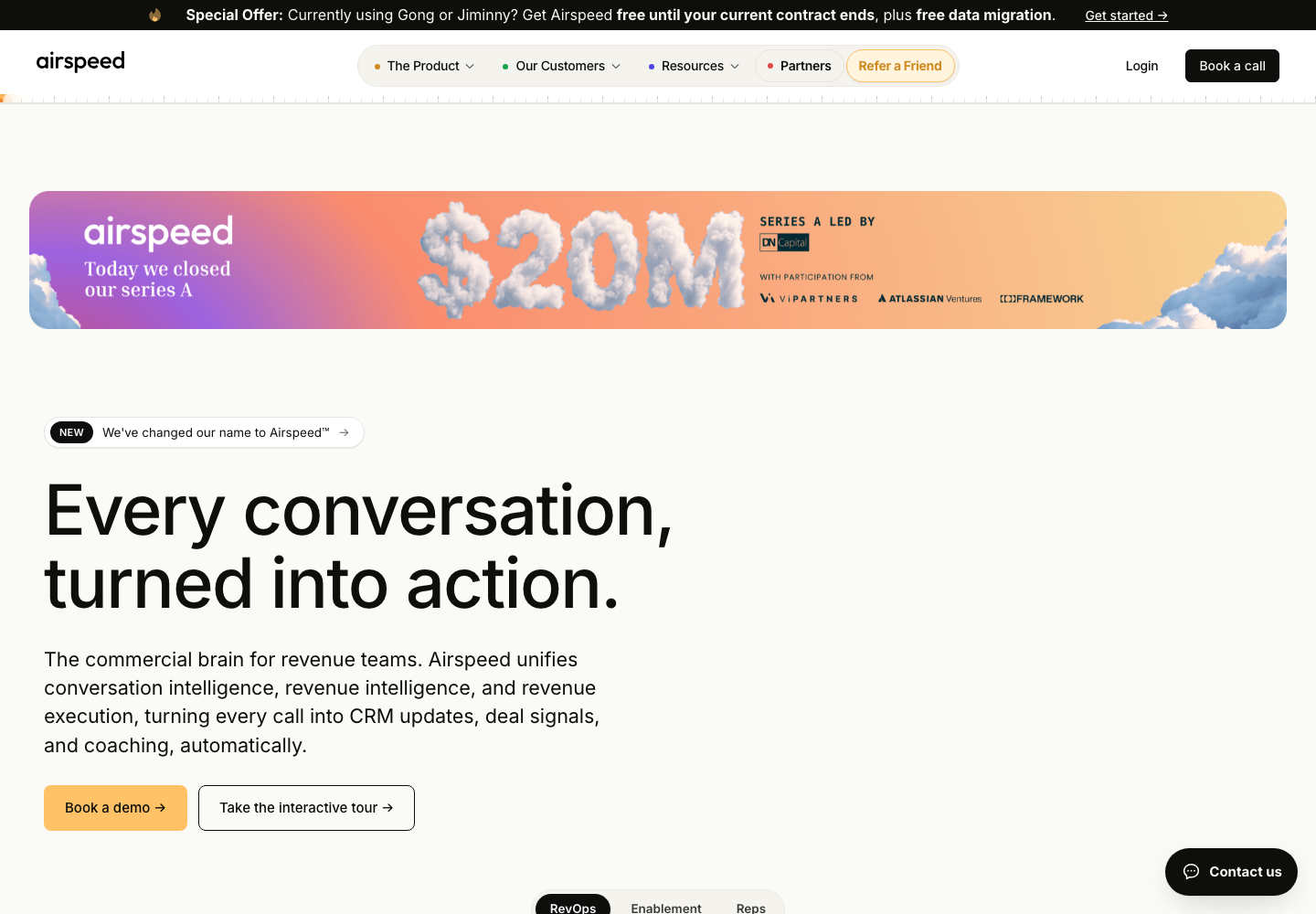
Airspeed focuses on post-call execution rather than transcription alone. Source: Airspeed.
Airspeed at a glance
| Question | Answer |
|---|---|
| What is it? | AI conversation and revenue workflow software |
| Core jobs | Notes, CRM writes, follow-ups, forecasting and coaching |
| Best for | B2B revenue teams with significant call volume |
| Pricing | Contact sales |
| Main strength | Converts call evidence into operational action |
| Main concern | Extraction and CRM-write accuracy require control |
What Airspeed does
Airspeed ingests sales conversations and extracts structured context. Public materials mention automatic MEDDIC field completion, follow-up drafting, deal-board and forecast support, coaching scores and agents that ask for approval before external action.
This is broader than recording and transcription. The value comes when one call can update the opportunity, prepare the next email, inform the manager and improve forecast evidence without several manual passes.
How we evaluated Airspeed
We would test a stratified set of real calls:
- Compare transcripts across accents, noise and technical vocabulary.
- Score every extracted field against human-labelled truth.
- Separate explicit evidence from model inference.
- Test drafts for promises, dates, pricing and unsupported claims.
- Validate CRM writes, duplicates, permissions and rollback.
- Compare forecast and coaching signals with manager judgment.
- Measure hours saved after review and exception work.
Airspeed publishes a customer claim of 17 hours saved per representative per month and payback within two months. That may be achievable in some workflows, but buyers should reproduce the calculation using their own call volume and fully loaded labour.
Main capabilities
Call capture and structured extraction
The first job is converting conversation into an accurate transcript, summary and sales-methodology fields. MEDDIC data should link back to the exact recording segment so a representative can verify economic buyer, decision criteria, process, pain and champion evidence.
Avoid allowing “not discussed” to become a guessed answer. Confidence thresholds and null values preserve CRM integrity better than confident fabrication.
CRM automation
Automated updates can eliminate repetitive administration and improve forecast coverage. Configure a field ownership map before enabling writes. Start with suggestions, then allow low-risk fields after accuracy is proven. High-impact changes—amount, stage, close date and next step—should retain approval and audit history.
Follow-up drafting
Airspeed drafts follow-ups from the call. This can shorten response time and keep commitments visible. Require evidence for commercial terms, deadlines and product claims. A human should remain responsible for tone, negotiation and promises.
Forecast and deal intelligence
Conversation evidence can reveal missing stakeholders, weak next steps and risk that CRM snapshots hide. Managers should compare Airspeed's signals with realised deal outcomes over several cycles and watch for bias toward talk patterns rather than commercial substance.
Coaching
Calls can be scored against a team's rubric, reducing manager preparation. A useful rubric is observable and role-specific. Representatives should be able to inspect evidence and challenge a score; otherwise automated coaching can undermine trust.
Integrations, privacy and governance
Conversation data may contain personal information, pricing, strategy and customer confidential material. Validate recording consent, notices, regional storage, retention, deletion, subprocessors, model-training policy, SSO, roles and export.
Agent approvals should show the proposed action and supporting transcript before anything is sent or written. The system also needs graceful behaviour when a CRM is unavailable or a call contains several opportunities.
Airspeed pricing in 2026
Airspeed uses a demo-led sales process and did not expose a complete public price table when checked. Request a quote that defines licensed users, recorded hours, storage, CRM environments, integrations, implementation, AI-agent usage, support and overages.
Calculate price against current call-recording, conversation-intelligence, note-taking and coaching tools that Airspeed could replace. The economic case should include representative time saved, manager capacity, CRM completeness and improved forecast decisions.
Advantages
- Connects notes, CRM, follow-up and coaching instead of stopping at transcripts.
- Methodology extraction can improve opportunity consistency.
- Approval-first agents reduce some automation risk.
- Shared call intelligence can help sales, RevOps and management.
Limitations and open questions
- Public pricing transparency is limited.
- Accuracy varies with audio, vocabulary and sales process.
- Incorrect CRM writes can influence several downstream systems.
- Recording and AI processing require careful consent and security review.
- Vendor-reported time savings need independent reproduction.
Who should use Airspeed?
Airspeed fits B2B teams with high call volume, a defined methodology, an established CRM and measurable administrative burden. It is less useful for teams with few calls, inconsistent opportunity processes or no owner for CRM governance.
A practical Airspeed pilot
Select 50 to 100 calls across representatives, stages, outcomes, accents and audio conditions. Have trained reviewers label transcripts, summaries, commitments, next steps and every CRM field Airspeed is expected to populate. Keep the labels hidden during processing, then calculate precision and recall by field rather than one blended accuracy score.
Not every error carries the same cost. A misspelled competitor is different from an incorrect price, close date or customer commitment. Define “must be exact” fields, minimum confidence and which values must remain blank when not explicitly discussed. Reviewers should be able to jump from each extracted fact to its recording timestamp.
Run the first CRM phase in suggestion mode. Measure acceptance, edits and rejection reasons, then enable carefully selected fields for automatic writing. Simulate an integration outage, duplicate contact, opportunity merge and call involving several deals. Confirm queues retry safely and do not overwrite newer human changes.
For follow-ups, compare time-to-send and edit distance with the existing process. Check that promised actions, dates, names and attachments match the conversation. For coaching, ask managers and representatives to score the usefulness and fairness of evidence—not simply whether the automated rubric produced a number.
Buyer and security checklist
Ask Airspeed to define supported meeting and telephony systems, CRM objects, custom fields, languages, recording ownership, retention and export. Request security documentation for encryption, subprocessors, model providers, customer-data training, SSO, roles, audit logs, incident response and regional storage.
Commercially, model every recorded user and hour, implementation, storage, integrations, agent actions and support. Establish success thresholds in the contract or pilot plan: hours saved, field accuracy, CRM completeness, representative adoption, faster follow-up and forecast improvement. Those measures keep the evaluation tied to revenue operations rather than transcript volume.
Alternatives
| Alternative | Consider it when |
|---|---|
| Gong | A mature enterprise conversation and revenue-intelligence suite is required |
| Clari Copilot | Conversation intelligence must connect closely to forecasting |
| Avoma | Meetings, notes and coaching need an accessible all-in-one workflow |
| Fathom | Lightweight meeting notes and follow-ups are sufficient |
| Attention | CRM automation and sales methodology extraction are the main priorities |
Final verdict
Airspeed targets a valuable transition from recorded conversation to completed revenue work. We would pilot it on a labelled call sample and begin with suggested CRM updates. Scale should depend on field-level accuracy, representative adoption, reversible actions and measurable time saved—not the attractiveness of an automatically completed dashboard.
Frequently asked questions
What is Airspeed's official website?
The verified sales AI product reviewed here uses goairspeed.com, not airspeed.so.
What does Airspeed automate?
It supports call notes, CRM updates, follow-up drafts, methodology fields, forecasting and coaching workflows.
Does Airspeed publish pricing?
No complete public table was available when checked; buyers need a quote.
Was this Airspeed review hands-on?
No. We did not connect a CRM or process a controlled call corpus.

Tolu S.
Associate Director
Evidence-led product reviews and founder profiles for search, marketing, authority, and AI visibility teams.