Table of Contents
- Parasail at a glance
- What does Parasail offer?
- How we evaluated Parasail
- Main Parasail capabilities
- Parasail pricing in 2026
- Advantages
- Limitations and open questions
- Who should use Parasail?
- Production diligence checklist
- Security and reliability considerations
- Parasail alternatives
- Final verdict
- Frequently asked questions
Parasail is an AI inference cloud for running open and custom models through serverless endpoints, dedicated GPU deployments and discounted batch processing. It uses an OpenAI-compatible API, so developers can often test it without redesigning their application interface.
Our short verdict is that Parasail is worth evaluating when an AI-native product needs more model and infrastructure flexibility than a closed-model API provides, but does not want to operate its own GPU fleet. Its strongest proposition is not simply low token prices. It is the ability to use serverless, dedicated and batch modes, deploy specialised Hugging Face models, and tune the cost, latency and quality trade-off. The risk is that a long pricing table can distract from the metrics that determine production success: availability, tail latency, throughput, output quality, regional coverage and support under load.
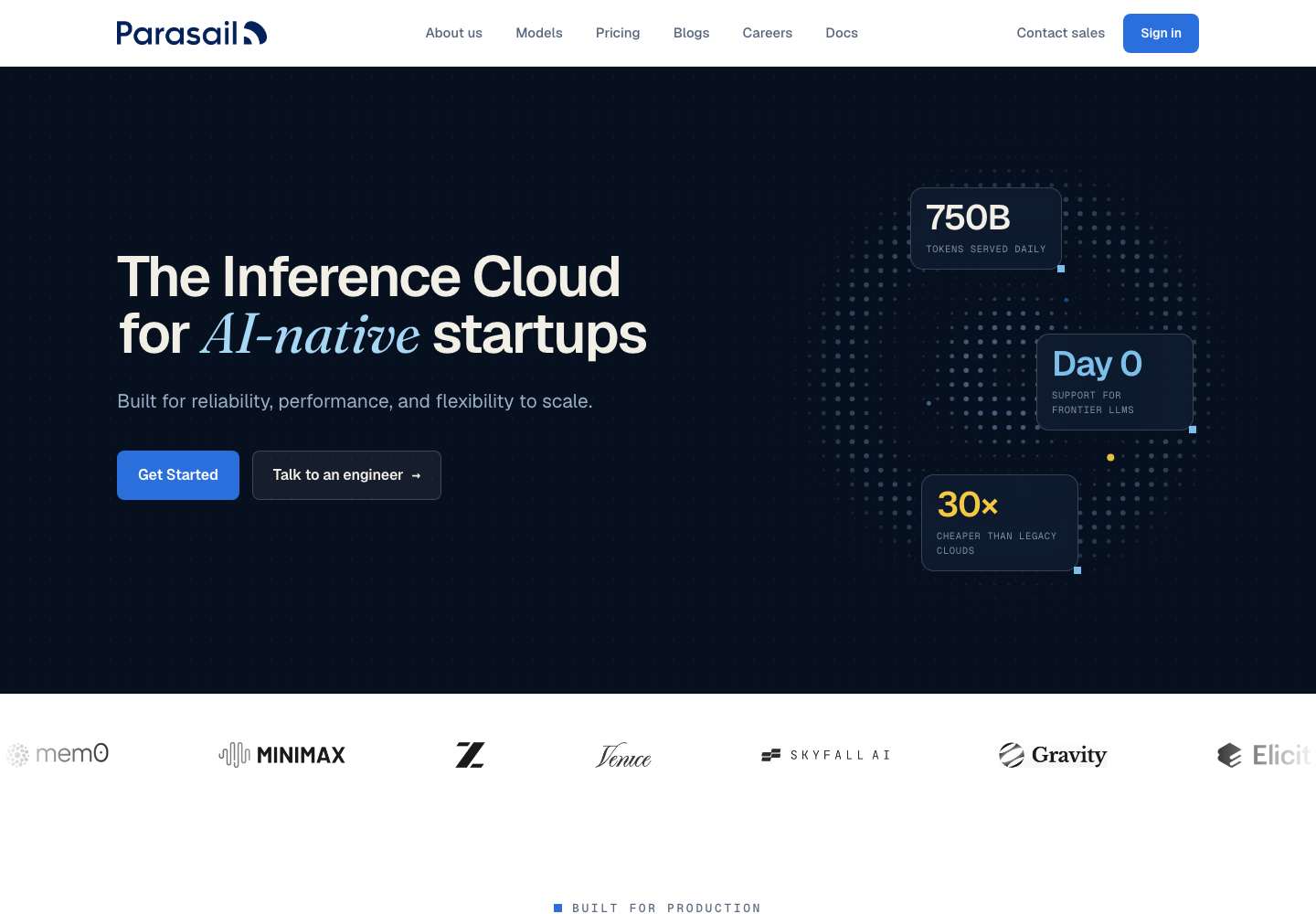
Parasail markets reliability, performance and flexible scaling rather than a single-model API. Source: Parasail.
Parasail at a glance
| Question | Answer |
|---|---|
| What is it? | Managed cloud inference for open, specialised and custom AI models |
| Deployment modes | Serverless, dedicated GPU and batch |
| API | OpenAI-compatible endpoints |
| Best for | AI product teams with meaningful inference workloads |
| Pricing | Per-token serverless and batch; hourly dedicated GPU rates |
| Main strength | Model and deployment flexibility without full self-hosting |
| Main concern | Real cost and reliability depend on the exact workload |
What does Parasail offer?
Serverless endpoints charge for tokens and remove most capacity management. Dedicated deployments give a team reserved GPU instances, autoscaling controls and support for private or custom Hugging Face models. Batch accepts asynchronous jobs at a discount when real-time responses are unnecessary.
Parasail says its global fleet spans multiple data centres, regions and current-generation chip classes. It also advertises optimisation against a customer's speed, quality and cost targets, plus spend commitments that can move across models rather than locking a buyer to one GPU configuration.
The product supports chat completions, text completions, embeddings, multimodal workloads and tool calling on compatible models. Documentation shows an OpenAI-style client configured with Parasail's base URL and API key. This reduces switching friction, although differences in model behaviour, parameters, context limits, safety and tool-call formatting still require application testing.
How we evaluated Parasail
We used six production questions:
- Can the required model and precision be deployed without hidden substitutions?
- Are median and tail latency acceptable at expected concurrency?
- Does autoscaling preserve availability during bursts?
- What is the complete cost per successful task, not merely per token?
- Are data handling, retention, regions and zero-data-retention terms suitable?
- Can engineers diagnose failures with useful logs, metrics and human support?
Parasail reports 750 billion tokens served daily and a fleet across 26 data centres and 15 regions. Those are vendor claims. A buyer should request the definition, observation period and service-level evidence relevant to its deployment.
Main Parasail capabilities
Serverless inference
Serverless is the fastest route to trying supported models. It suits variable traffic, prototypes and products that do not need a reserved configuration. Rates are separated into input, output and, where supported, cache-read tokens.
The right comparison replays the same evaluation set against every candidate. Measure quality, time to first token, tokens per second, p95 and p99 latency, error rate, rate-limit behaviour and cost. A cheaper model that needs more retries or produces more unusable answers can cost more per business outcome.
Dedicated endpoints
Dedicated instances provide greater control over model, hardware and scaling. Documentation says public and private Hugging Face models and LoRA adapters can be deployed when compatible. This is useful for fine-tunes, specialised modalities and workloads that need predictable capacity.
Confirm cold-start behaviour, minimum running capacity, GPU availability, scale-down rules, deployment time, upgrades, rollback and failure recovery. Parasail documents a default quota of four GPUs across Batch and Dedicated, with a request process for increases.
Batch processing
Batch is designed for evaluations, synthetic data, embeddings and other asynchronous work. Documentation describes a 50% discount relative to equivalent serverless pricing, with additional cache effects and precision adjustments.
Batch value depends on completion time and retry semantics. Test very large files, partial failures, cancellation, result ordering, observability and spend controls before moving a critical offline pipeline.
Model portability
Parasail promotes access to open models and the ability to run custom models. Portability can reduce dependence on a single closed provider, but an OpenAI-compatible transport does not make model outputs interchangeable. Prompts, tool schemas, safety behaviour and evaluation thresholds may need per-model tuning.
Our AI token and API cost calculator can model input, output and volume assumptions before a benchmark.
Parasail pricing in 2026
Parasail publishes a changing model-by-model table. When checked, examples ranged from very low-cost embedding and small-model endpoints to materially higher rates for larger reasoning models. Serverless is billed per million input and output tokens; Dedicated is billed by GPU-hour; Batch is priced below comparable real-time processing.
New accounts are charged when accumulated usage reaches a $25 threshold, according to the pricing page. Buyers should confirm minimum commitments, failed-request charges, caching rules, storage, data transfer, regional premiums and enterprise support.
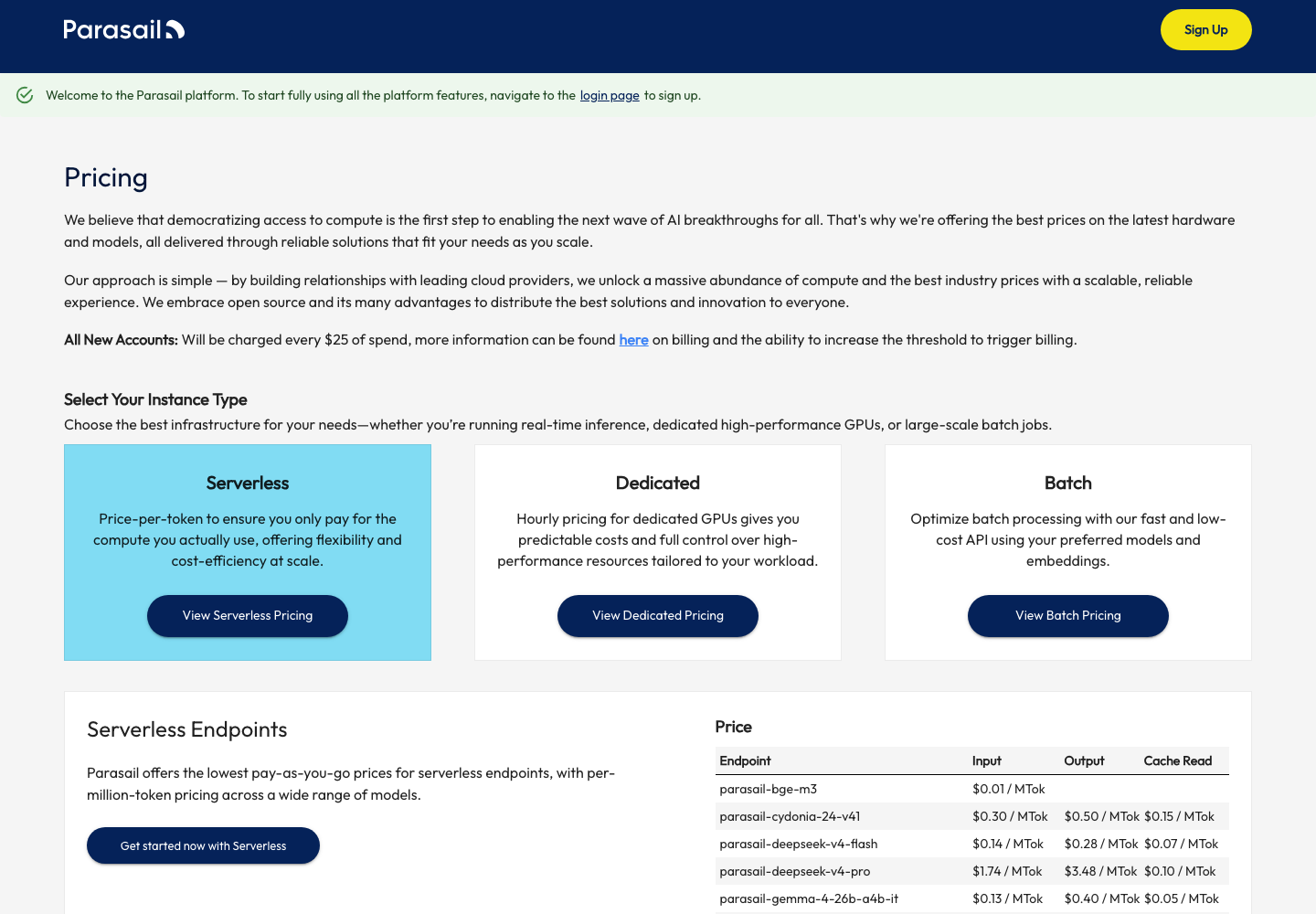
Parasail's live table varies by model and can change quickly. Check current pricing before estimating a workload.
Advantages
- Multiple deployment modes cover prototypes, production APIs and offline jobs.
- OpenAI compatibility lowers initial integration effort.
- Open and custom-model support reduces single-vendor dependence.
- Published usage rates make initial modelling possible.
- Dedicated engineering support is part of the enterprise-facing proposition.
Limitations and open questions
- Vendor savings claims require workload-specific benchmarking.
- The model catalogue and prices change frequently.
- Compatibility does not guarantee equivalent outputs.
- Default GPU quotas may constrain an immediate scale test.
- Infrastructure flexibility adds model-selection and evaluation responsibility.
Who should use Parasail?
Parasail fits AI-native SaaS businesses, inference-heavy developer products, model evaluation teams, synthetic-data pipelines and companies deploying specialised open models. It is less compelling for a small application satisfied with one hosted model, or a team without the engineering capacity to evaluate and observe multiple deployments.
Production diligence checklist
Before signing a commitment, give Parasail a representative workload rather than a synthetic “hello world” test. The evaluation set should include short and long prompts, structured output, tool calls, peak concurrency, sensitive edge cases and the failure modes your application already sees. Run the same set at several times of day and retain raw request IDs so outliers can be investigated with support.
Request written service definitions for uptime, maintenance, rate limits, capacity reservation and incident response. Ask whether the SLA covers the gateway, model workers and region you intend to use, and which credits or remedies apply. Confirm zero-data-retention availability, encryption, subprocessors, audit evidence, private networking, secrets management and whether prompts or outputs are used for model improvement.
Cost controls should include project-level budgets, alerts, key rotation, quotas and exportable usage. Model the effect of verbose outputs, retries, speculative requests, caching and traffic bursts. Dedicated deployments should be compared with utilisation assumptions rather than an always-on ideal. For batch work, calculate the value of completion time and operational simplicity as well as the per-token discount.
Finally, rehearse exit. Export deployment configuration, prompts, evaluation sets and telemetry; keep the application abstraction compatible with another provider; and confirm how private weights and stored data are deleted. Portability is a practical process, not merely an API format.
Security and reliability considerations
AI infrastructure sits directly in the application data path. Teams should classify every prompt type, remove unnecessary personal or confidential data and define human review for high-impact outputs. Parasail's terms explicitly warn that generated output can be incorrect, so application-level validation remains the customer's responsibility.
Observability should separate provider latency from model generation time and application processing. Track time to first token, completion latency, cancellation, malformed structured output, safety refusals and model-version changes. A release process should pin versions where possible and run regression evaluations before moving traffic to a new endpoint.
Parasail alternatives
| Alternative | Consider it when |
|---|---|
| Together AI | A broad managed open-model cloud and fine-tuning ecosystem is required |
| Fireworks AI | Fast serverless inference and model optimisation are central |
| DeepInfra | Straightforward usage-based access to many models is preferred |
| Baseten | Production deployment tooling and custom model serving dominate |
| Modal | Python-native serverless compute flexibility matters beyond inference |
Final verdict
Parasail has a credible position between closed APIs and self-managed GPUs. We would shortlist it for a controlled benchmark using a real prompt distribution and traffic shape. The winning result should combine quality, p99 latency, recovery, engineering effort and cost per accepted output—not merely the cheapest line in a token table.
Frequently asked questions
Is Parasail an AI model?
No. Parasail is infrastructure for serving many open, specialised and custom models, although its catalogue includes Parasail-named endpoints.
Is Parasail OpenAI compatible?
Its documentation provides OpenAI-compatible endpoints and client examples. Model-specific behaviour still needs testing.
How is Parasail priced?
Serverless and batch are usage-based, while dedicated deployments use GPU-hour pricing. Rates depend on model and configuration.
Was this Parasail review hands-on?
No. It is a public-evidence review without a controlled inference benchmark.

Tolu S.
Associate Director
Evidence-led product reviews and founder profiles for search, marketing, authority, and AI visibility teams.