Short answer
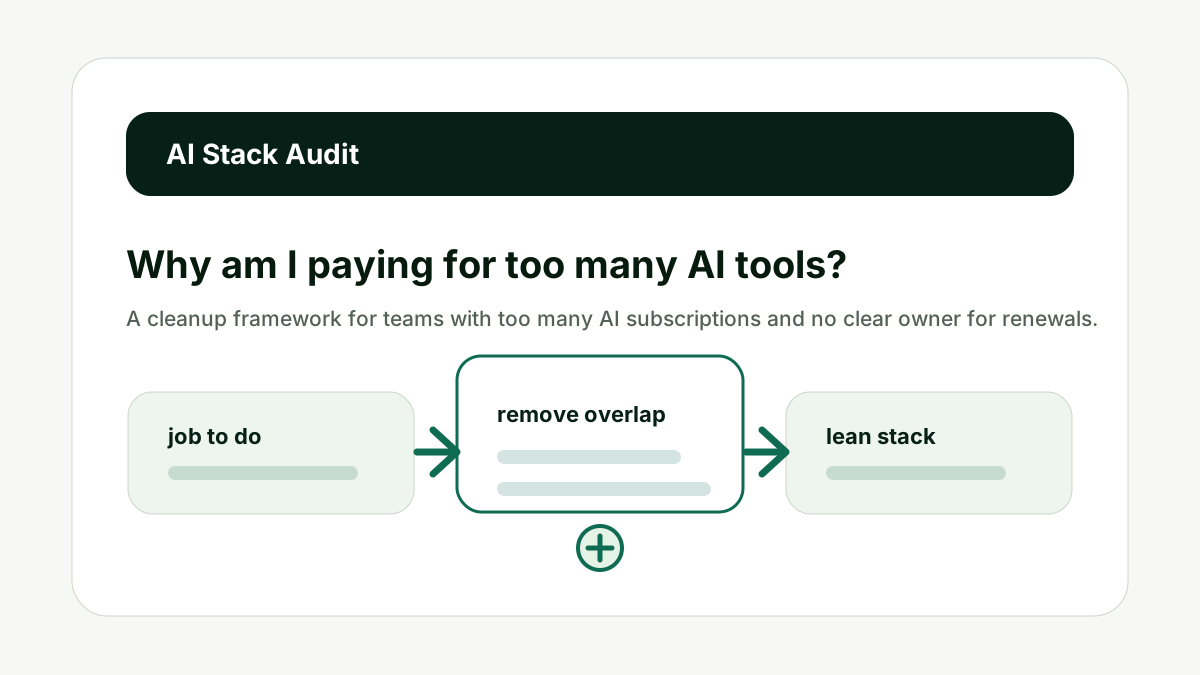
You are probably paying for too many AI tools because teams bought around hype, departments purchased separately, use cases overlap, seats were never reviewed, and nobody owns the AI stack. Fix it with a workflow inventory, usage review, duplicate-tool audit, and renewal owner.
AI products change quickly, so treat this as a decision framework. Always validate the current feature set, data terms, and pricing directly with the provider before making a paid or production decision.
Reader question
"Why am I paying for too many AI tools?"
Use the AI Tool Chooser to rebuild the stack around actual workflows instead of keeping every tool that entered the business.
Table of Contents
I am going to answer this like an operator choosing tools for repeatable business work, not like a leaderboard of model brands.
The common mistake is starting with the tool and then hunting for uses. A better approach starts with the job, the data, the source needs, the review process, and the budget.
Here is the framework I would use for a team has accumulated AI subscriptions across marketing, sales, operations, and product.
Inventory Everything
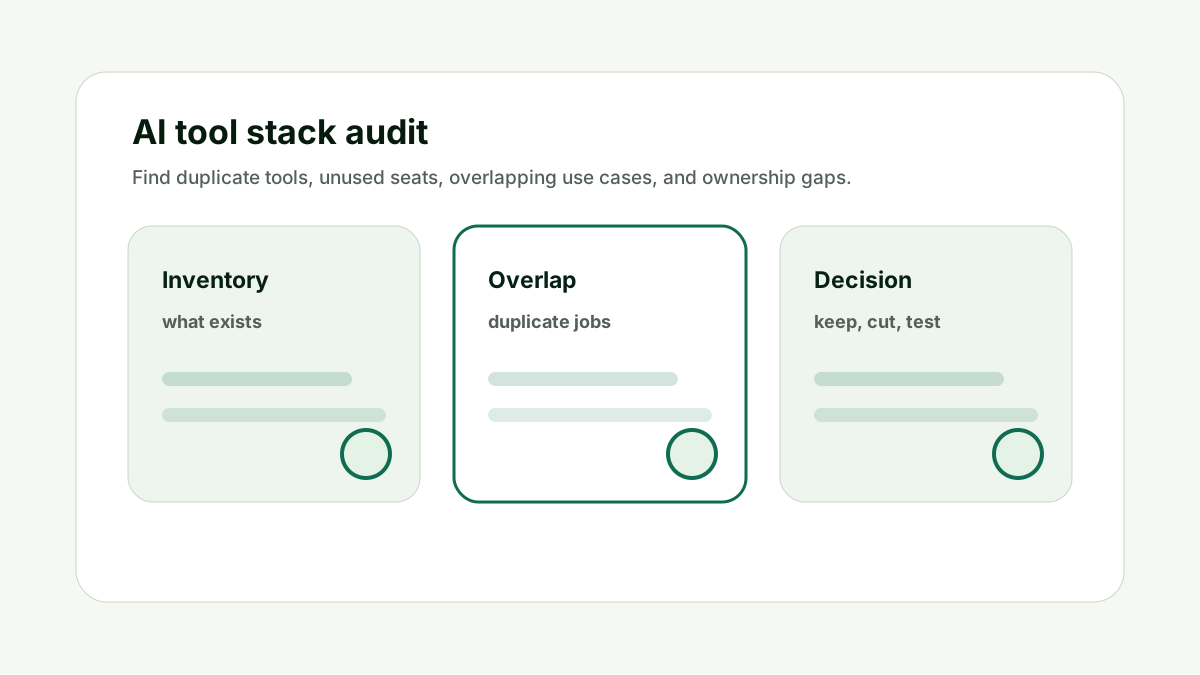
You cannot fix tool sprawl without seeing the whole stack. That is why the first decision is not vendor selection. The first decision is whether the workflow needs discovery, synthesis, drafting, automation, code, compliance, or reporting.
List every AI subscription, account owner, department, seat count, monthly cost, renewal date, and main use case. Include browser tools, writing tools, coding tools, research tools, and AI features inside existing software.
Do not audit only the obvious standalone tools. The cleaner approach is to score the workflow before scoring the product. A tool that looks weaker in a demo may be the better choice if it matches your data, team habits, and review process.
For Why am I paying for too many AI tools?, keep the buying question practical: what job is repeated often enough to deserve a tool, what quality level is acceptable, and who reviews the final output?
This prevents AI stack decisions from becoming a collection of personal preferences. It turns the choice into an operating decision that can be tested, documented, and revisited.
If the decision still feels unclear, run the workflow through the tool chooser, test one real task, and only then decide whether the tool belongs in the core stack or in an experiment bucket.
Inventory Everything keeps AI selection tied to a real workflow instead of a vague product preference.
Map Use Cases
The same tool can be valuable in one workflow and wasteful in another. That is why the first decision is not vendor selection. The first decision is whether the workflow needs discovery, synthesis, drafting, automation, code, compliance, or reporting.
Connect each tool to a real recurring task. If nobody can name the workflow, owner, and outcome, the tool is a candidate for cancellation or a short retest.
Do not keep a subscription because someone might use it someday. The cleaner approach is to score the workflow before scoring the product. A tool that looks weaker in a demo may be the better choice if it matches your data, team habits, and review process.
For Why am I paying for too many AI tools?, keep the buying question practical: what job is repeated often enough to deserve a tool, what quality level is acceptable, and who reviews the final output?
This prevents AI stack decisions from becoming a collection of personal preferences. It turns the choice into an operating decision that can be tested, documented, and revisited.
If the decision still feels unclear, run the workflow through the tool chooser, test one real task, and only then decide whether the tool belongs in the core stack or in an experiment bucket.
Map Use Cases keeps AI selection tied to a real workflow instead of a vague product preference.
Find Overlap
Duplicate subscriptions usually hide under different names. That is why the first decision is not vendor selection. The first decision is whether the workflow needs discovery, synthesis, drafting, automation, code, compliance, or reporting.
One department may use one assistant for research, another for writing, and another for the same task inside a project-management app. Group tools by job to reveal overlap.
Do not compare tools by product category only; compare them by the work they perform. The cleaner approach is to score the workflow before scoring the product. A tool that looks weaker in a demo may be the better choice if it matches your data, team habits, and review process.
For Why am I paying for too many AI tools?, keep the buying question practical: what job is repeated often enough to deserve a tool, what quality level is acceptable, and who reviews the final output?
This prevents AI stack decisions from becoming a collection of personal preferences. It turns the choice into an operating decision that can be tested, documented, and revisited.
If the decision still feels unclear, run the workflow through the tool chooser, test one real task, and only then decide whether the tool belongs in the core stack or in an experiment bucket.
Find Overlap keeps AI selection tied to a real workflow instead of a vague product preference.
Check Actual Usage
Paid seats are not the same as active usage. That is why the first decision is not vendor selection. The first decision is whether the workflow needs discovery, synthesis, drafting, automation, code, compliance, or reporting.
Review logins, outputs, team feedback, and the number of workflows completed. A tool used once a month by one person should not be priced like a core operating system.
Do not let unused seats renew automatically. The cleaner approach is to score the workflow before scoring the product. A tool that looks weaker in a demo may be the better choice if it matches your data, team habits, and review process.
For Why am I paying for too many AI tools?, keep the buying question practical: what job is repeated often enough to deserve a tool, what quality level is acceptable, and who reviews the final output?
This prevents AI stack decisions from becoming a collection of personal preferences. It turns the choice into an operating decision that can be tested, documented, and revisited.
If the decision still feels unclear, run the workflow through the tool chooser, test one real task, and only then decide whether the tool belongs in the core stack or in an experiment bucket.
Check Actual Usage keeps AI selection tied to a real workflow instead of a vague product preference.
Assign an AI Stack Owner
Tool sprawl persists when nobody owns the decision. That is why the first decision is not vendor selection. The first decision is whether the workflow needs discovery, synthesis, drafting, automation, code, compliance, or reporting.
Give one person authority to approve new AI tools, review renewals, maintain usage rules, and remove overlap. This does not need to be a full-time role, but it must be explicit.
Do not leave AI buying decisions scattered across every card holder. The cleaner approach is to score the workflow before scoring the product. A tool that looks weaker in a demo may be the better choice if it matches your data, team habits, and review process.
For Why am I paying for too many AI tools?, keep the buying question practical: what job is repeated often enough to deserve a tool, what quality level is acceptable, and who reviews the final output?
This prevents AI stack decisions from becoming a collection of personal preferences. It turns the choice into an operating decision that can be tested, documented, and revisited.
If the decision still feels unclear, run the workflow through the tool chooser, test one real task, and only then decide whether the tool belongs in the core stack or in an experiment bucket.
Assign an AI Stack Owner keeps AI selection tied to a real workflow instead of a vague product preference.
Set a Review Cycle
AI tools change too quickly for annual-only review. That is why the first decision is not vendor selection. The first decision is whether the workflow needs discovery, synthesis, drafting, automation, code, compliance, or reporting.
Review the stack monthly during active experimentation, then quarterly once stable. Keep a small sandbox budget for tests, but separate experiments from core tools.
Do not turn every experiment into a permanent subscription. The cleaner approach is to score the workflow before scoring the product. A tool that looks weaker in a demo may be the better choice if it matches your data, team habits, and review process.
For Why am I paying for too many AI tools?, keep the buying question practical: what job is repeated often enough to deserve a tool, what quality level is acceptable, and who reviews the final output?
This prevents AI stack decisions from becoming a collection of personal preferences. It turns the choice into an operating decision that can be tested, documented, and revisited.
If the decision still feels unclear, run the workflow through the tool chooser, test one real task, and only then decide whether the tool belongs in the core stack or in an experiment bucket.
Set a Review Cycle keeps AI selection tied to a real workflow instead of a vague product preference.
How This Fits the Wider AI Workflow
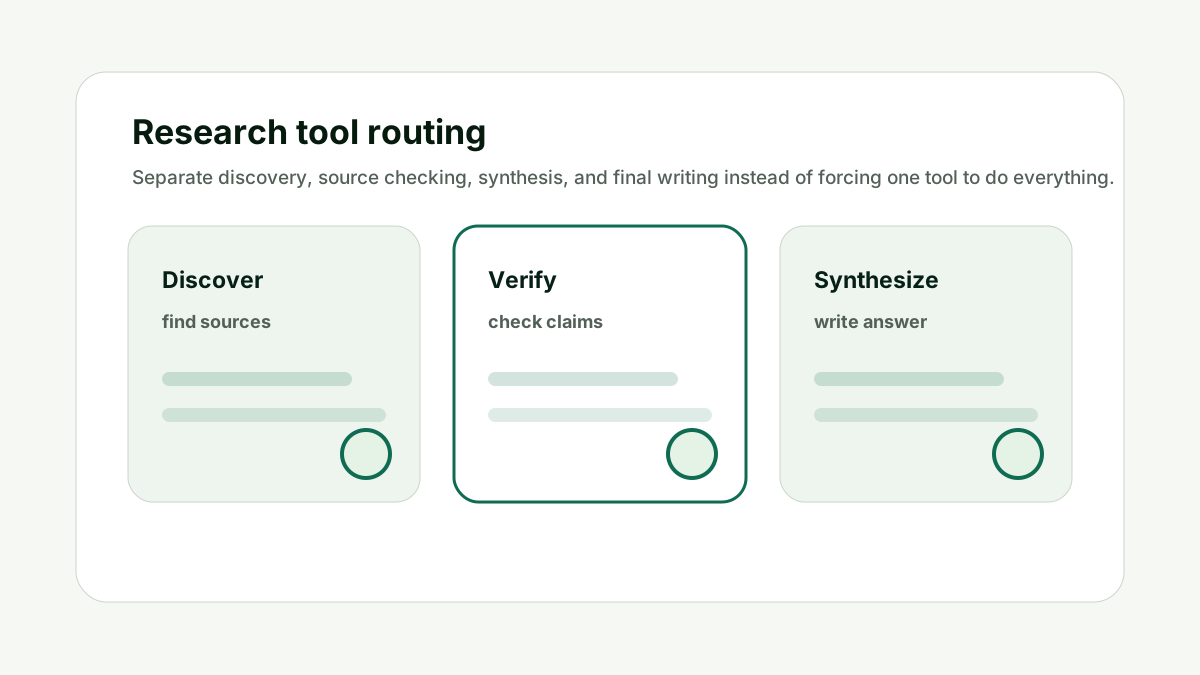
The useful way to think about Why am I paying for too many AI tools? is that AI tool selection is a routing problem. A team needs to know whether the task belongs in chat, search, coding, automation, analytics, or a search-visibility workflow.
Official product pages such as ChatGPT, Claude, Gemini, and Perplexity are useful starting points, but they cannot decide your operating model for you.
Use the AI Tool Chooser when the question is tool fit. Use the AI Token & API Cost Calculator when API spend is the risk. Use the Prompt Length / Context Window Checker when the tool choice is really a prompt-size or output-room problem.
For marketing and AI search workflows, pair tool selection with the GEO / LLM SEO Planner or LLM Visibility Checker only when visibility work is actually part of the campaign.
The goal is a stack that is small enough to govern and strong enough to handle the work. That usually means fewer tools, clearer use cases, and a review cycle that keeps experiments from becoming permanent costs.
A Simple Worked Example
A growing agency finds six AI subscriptions across three departments. Two are used daily, two are used occasionally, and two are leftovers from experiments.
The team maps each tool to a workflow. One handles content drafting, one handles research, and one coding assistant is only needed by the technical operator.
They cancel unused seats, keep one research tool, keep one writing workflow, and set a quarterly review date.
The stack becomes smaller without becoming less capable.
Practical action checklist
- List every AI tool and renewal date.
- Map each tool to a recurring workflow.
- Identify duplicate use cases.
- Review active usage, not just seat count.
- Assign one stack owner.
- Separate experiments from core tools.
What I Would Do Next
Create a one-page AI tool inventory.
Mark each tool keep, cut, retest, or consolidate.
Rebuild the final stack around the workflows that remain.
Conclusion
Why am I paying for too many AI tools? matters because AI tools are now operating choices, not just software preferences. The wrong stack creates cost, review burden, and messy workflows.
The practical answer is to route each job to the tool type that fits it, test with real work, and keep only the subscriptions that improve a repeated workflow.
A small, governed AI stack usually beats a crowded stack that nobody owns.
FAQ
How many AI tools should a small business have?
Enough to cover real workflows without duplicate subscriptions. The number depends on use cases, not company size alone.
Should I cancel every rarely used AI tool?
Not always. Keep rarely used tools only if they solve a high-value occasional workflow.
Who should own the AI stack?
A senior operator, marketing lead, product lead, or founder who can connect usage, cost, risk, and workflow quality.
How often should I audit AI subscriptions?
Quarterly is a practical default once experimentation slows down.

Adam O'neil
1stpage Editorial Team
Our editorial team writes practical guides for agencies, founders, publishers, and search teams building durable organic authority through better content, cleaner links, and smarter positioning.