Table of Contents
- Profound at a glance
- What is Profound?
- How we evaluated Profound
- Core Profound features
- A practical Profound trial workflow
- Profound pricing in 2026
- Profound advantages
- Limitations and unresolved questions
- Who should use Profound?
- Profound alternatives
- Is Profound worth it?
- Final verdict
- Frequently asked questions
Profound is a enterprise answer engine optimization platform built for enterprise marketing, communications, SEO, and digital intelligence teams. Its public proposition focuses on measuring and improving how brands appear when people use generative search and AI assistants.
Our short verdict is that Profound appears to be one of the broadest enterprise-oriented AEO platforms, with unusually deep prompt-demand data, answer monitoring, agent analytics, and workflow agents. Its most useful role is to replace isolated screenshots and guesses with a repeatable view of prompts, answers, competitors, citations, and the work that follows.
The main reservation is that its most differentiated coverage and governance features sit above the entry tier, while annual billing and prompt limits make workload modelling essential. Like every platform in this young category, it can observe and prioritise signals but cannot guarantee that an independent model will mention, cite, or recommend a brand.
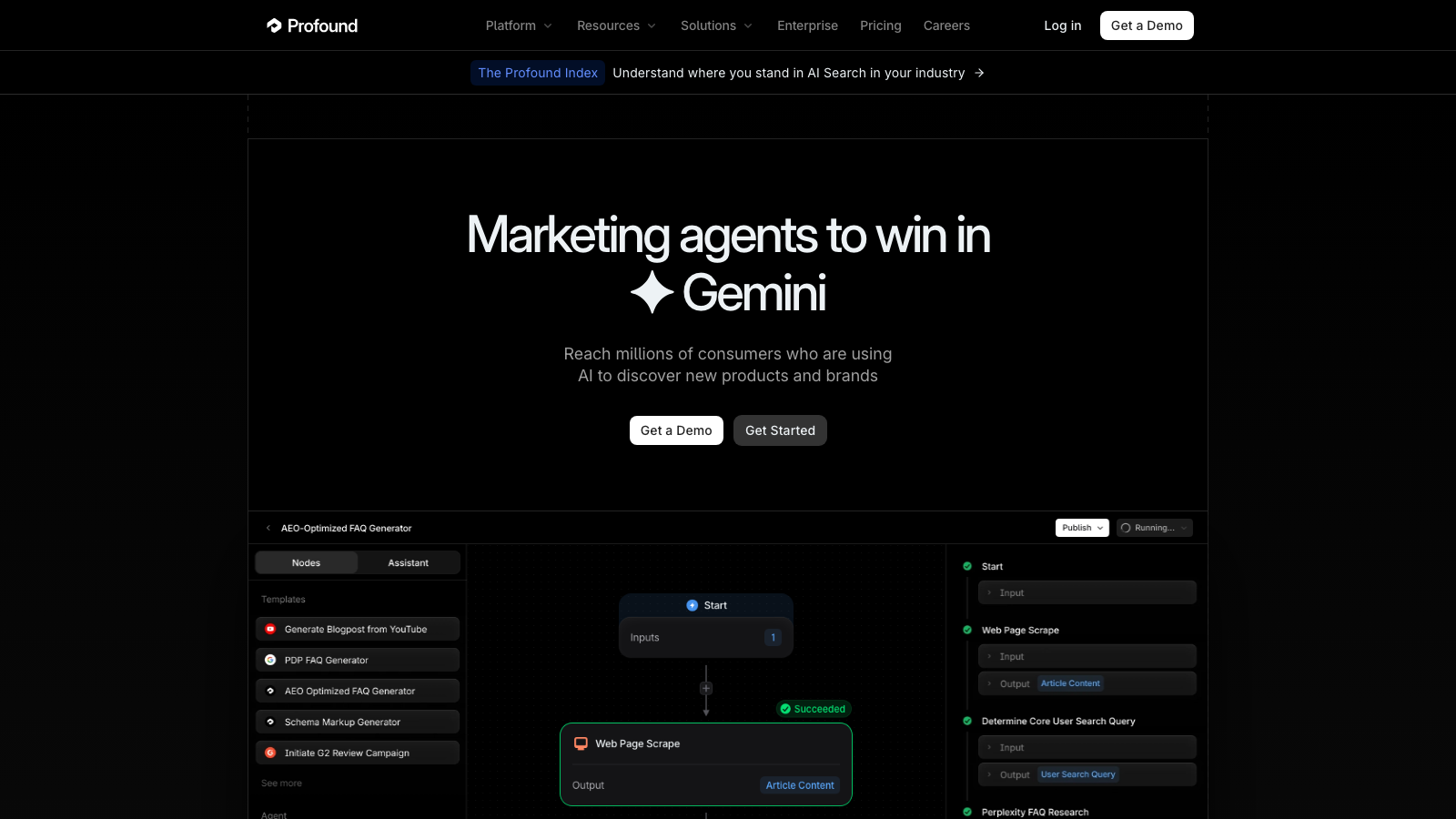
Authentic homepage capture from tryprofound.com, recorded 2026-07-20. This is vendor presentation evidence, not an authenticated product test.
Profound at a glance
| Question | Answer |
|---|---|
| What is it? | enterprise answer engine optimization platform |
| Best for | enterprise marketing, communications, SEO, and digital intelligence teams |
| Public platform coverage | ChatGPT, Perplexity, Claude, Gemini, Google AI Overviews, Copilot, Grok, Amazon Rufus, Meta AI, and DeepSeek, with plan-dependent access |
| Starting price | $99 per month, billed annually, for Starter |
| Trial or free access | No general free trial confirmed on the public pricing page |
| Main strength | Prompt-demand intelligence goes beyond manually invented tracking lists. |
| Main concern | Starter tracks only ChatGPT and one seat, so its headline price does not represent broad multi-engine use. |
| Review status | Public-evidence first look; no authenticated test |
What is Profound?
Profound belongs to the emerging AEO and GEO software category. These products repeatedly submit buyer-style prompts to AI systems, capture the answers, and turn brand mentions, citations, sentiment, recommendation position, and competitor presence into trend data.
This is not the same as conventional rank tracking. An AI answer can combine many sources, mention a company without linking, and change wording between runs. Our explanation of LLM visibility versus SEO rankings shows why organisations need both measurements rather than treating one as a replacement for the other.
The platform's usefulness therefore depends on four things: representative prompts, transparent collection methods, answer-level evidence, and an operating process that turns gaps into content, technical improvements, product facts, PR, or third-party authority.
How we evaluated Profound
We used a buyer-oriented framework rather than scoring the quality of the marketing site. We asked whether the public evidence answers these questions:
- Does the product monitor the AI experiences relevant to its intended customers?
- Can a team inspect the responses and sources behind summary metrics?
- Does it expose competitor and citation gaps that lead to specific work?
- Can findings connect to analytics, leads, pipeline, or another business outcome?
- Are pricing, usage limits, governance, and support clear enough to forecast total cost?
- Is there enough independent evidence to support a numeric verdict?
The final answer to question six is no. That is why this article has no star score. Vendor pages establish capabilities and terms, but they do not reproduce a controlled buyer test.
Core Profound features
Prompt Volumes
Uses licensed, double-opt-in panel data to estimate what people ask AI systems, helping teams choose prompts using demand rather than intuition alone. Profound says the dataset covers more than 1.3 billion conversations with weekly rolling updates. This is a vendor methodology claim and should be validated against the buyer’s category.
The buyer test is practical: capture the underlying prompt or task, inspect the evidence, assign an owner, complete one controlled change, and retest. A feature is valuable only when it improves a decision or reduces the time between diagnosis and a defensible action.
Answer Engine Insights
Tracks visibility, sentiment, citations, competitors, and answer-level evidence across supported consumer AI experiences. This is the core monitoring layer for discovering where a brand is absent or misrepresented.
The buyer test is practical: capture the underlying prompt or task, inspect the evidence, assign an owner, complete one controlled change, and retest. A feature is valuable only when it improves a decision or reduces the time between diagnosis and a defensible action.
Agent Analytics
Monitors AI crawler activity and AI-referred traffic so technical teams can connect bot access, discoverability, and downstream sessions. It is valuable where server-side evidence matters more than another dashboard score.
The buyer test is practical: capture the underlying prompt or task, inspect the evidence, assign an owner, complete one controlled change, and retest. A feature is valuable only when it improves a decision or reduces the time between diagnosis and a defensible action.
Agents, Ask Profound, and FactCheck
Adds assisted analysis and execution. Ask Profound answers questions against account data, while FactCheck compares claims in AI answers with an approved knowledge base and source URLs. Buyers should test permissions, review gates, and how evidence is cited.
The buyer test is practical: capture the underlying prompt or task, inspect the evidence, assign an owner, complete one controlled change, and retest. A feature is valuable only when it improves a decision or reduces the time between diagnosis and a defensible action.
A practical Profound trial workflow
A useful evaluation should test a complete decision cycle:
- Select one product, country, audience, and commercially meaningful topic.
- Build 30 to 50 prompts across discovery, comparison, objections, and purchase intent.
- Add known competitors while recording unexpected brands that appear naturally.
- Collect a baseline across two or three engines before changing anything.
- Group prompts by intent and inspect the original answers behind every headline metric.
- Identify one owned-page gap, one technical issue, and one third-party citation opportunity.
- Complete a controlled intervention with an owner and publication date.
- Retest the same prompt group and compare AI visibility with referral visits and conversions.
- Document what did not move as carefully as what improved.
Before paying for a large prompt allowance, the free LLM Visibility Checker can help establish which prompts and competitors deserve continuous monitoring.
Profound pricing in 2026
Pricing was checked on 2026-07-20. Plans, included models, credits, and billing terms can change, so verify the live offer before purchasing.
| Plan | Price | Publicly described scope |
|---|---|---|
| Starter | $99/mo, annual | 50 prompts; ChatGPT; 1 seat; daily tracking; 100 agent credits |
| Growth | $399/mo, annual | 100 prompts; 3 engines; 3 seats; exports; 400 agent credits |
| Enterprise | Custom | Up to 10 engines; multiple companies; API; SSO/SAML; dedicated support |
The headline price is not the total cost. Model the number of brands, markets, prompts, engines, repetitions, seats, integrations, and months of history required for the same workload. Ask whether prompt edits reset history, whether model changes are allowed, how credits are consumed, and whether tax or annual commitments apply.
Profound advantages
- Prompt-demand intelligence goes beyond manually invented tracking lists.
- Monitoring, crawler analytics, research, and action workflows live in one platform.
- Enterprise security features include SOC 2 Type II, SSO, and role-based access controls.
These strengths matter only when the team can act on them. If a source gap shows that competitors win through trusted third-party coverage, publishing another owned blog post may not solve it. Our analysis of why competitors appear in AI answers explains how owned content and external corroboration work together.
Limitations and unresolved questions
- Starter tracks only ChatGPT and one seat, so its headline price does not represent broad multi-engine use.
- Prompt-volume and opportunity models are proprietary; teams should test their relevance in niche and regional markets.
- Attribution from an AI answer to pipeline remains probabilistic unless analytics and CRM instrumentation are mature.
During procurement, request a live answer trace, sampling explanation, retention policy, export example, data-processing terms, cancellation rules, and a demonstration using your own category. Ask the vendor to separate observed data from predicted opportunity scores and generated recommendations.
Who should use Profound?
Profound is most credible for enterprise marketing, communications, SEO, and digital intelligence teams that can maintain a prompt taxonomy and execute content, technical, analytics, and authority work. It is a weaker fit for small teams needing occasional snapshots or a low-cost multi-engine tracker.
The internal owner matters more than the dashboard. A useful program needs somebody accountable for prompt design, evidence review, action prioritisation, and commercial reporting. Without that loop, recurring monitoring becomes an expensive collection of changing percentages.
Profound alternatives
| Buyer priority | Alternative | Why compare it |
|---|---|---|
| Polished self-serve monitoring | Peec AI | Transparent tiers, daily tracking, source analysis, and agency positioning |
| Related product profile | Review in this collection | Compare price, execution depth, platform coverage, and governance |
| Another category option | Next review | Useful for testing a different balance of analytics and action |
| Monitoring plus autonomous execution | Nimt.ai | Compare how far the platform moves from diagnosis into delivery |
| Human-led authority execution | LLMentioned | Relevant when source gaps require researched external mentions and placements |
Run competing tools against identical prompts, dates, countries, and engines. Their visibility scores are not interchangeable when sampling and definitions differ.
Is Profound worth it?
Profound is worth shortlisting when its particular workflow matches the organisation's operating model and the price can be justified by better decisions, not just more data. The best proof is a pilot that starts with one commercial topic and ends with a measured intervention.
Do not approve a platform because it finds that a brand is invisible; a manual check can often reveal that. Approve it when it consistently explains where the gap comes from, helps the team choose the next action, preserves evidence for review, and connects progress to qualified demand.
Content recommendations should also be judged for citation quality. Our guide to citation-ready content for AI search provides a standard for structure, evidence, clear claims, and source accessibility.
Final verdict
Profound has a credible place in the AI visibility market because one of the broadest enterprise-oriented AEO platforms, with unusually deep prompt-demand data, answer monitoring, agent analytics, and workflow agents. The strongest buyers will use it as a decision system inside a broader search, content, product, analytics, and digital PR program.
The unresolved issue is its most differentiated coverage and governance features sit above the entry tier, while annual billing and prompt limits make workload modelling essential. A scoped pilot, clear baseline, written methodology questions, and human review are the appropriate next steps.
First-look recommendation: Shortlist Profound if its strongest feature maps to an urgent business job. Compare it with at least two alternatives using the same prompt set before making an annual commitment.
For execution beyond software, our guide to making a brand appear in ChatGPT recommendations explains the combined role of owned evidence, third-party corroboration, technical access, and ongoing testing.
Frequently asked questions
What does Profound do?
Profound is enterprise answer engine optimization platform. It helps enterprise marketing, communications, SEO, and digital intelligence teams understand and improve brand representation in AI-generated answers.
How much does Profound cost?
The public starting position checked on 2026-07-20 was $99 per month, billed annually, for Starter. Confirm current billing, usage allowances, add-ons, tax, and cancellation terms directly with the vendor.
Does Profound offer a free trial?
No general free trial confirmed on the public pricing page. Confirm whether signup requires payment details and what happens to data after the trial.
Which AI platforms does Profound monitor?
Public materials describe ChatGPT, Perplexity, Claude, Gemini, Google AI Overviews, Copilot, Grok, Amazon Rufus, Meta AI, and DeepSeek, with plan-dependent access. Ask the vendor to confirm the exact model version, interface, country, language, and collection method used for each engine.
Can Profound guarantee ChatGPT recommendations?
No. A platform can monitor answers, identify patterns, and recommend work, but independent AI systems control their outputs. Any guarantee should be treated cautiously.
Is Profound suitable for agencies?
Potentially. Agencies should verify client separation, workspaces, permissions, reporting, exports, white labelling, prompt allocation, and cost across the intended portfolio.
Was this Profound review hands-on?
No. This is a research-based first-look review using public evidence. We did not access an authenticated workspace and do not assign a numeric score.

Tolu S.
Associate Director
Evidence-led product reviews and founder profiles for search, marketing, authority, and AI visibility teams.