Table of Contents
- The review in 30 seconds
- Why OpenCrawl exists
- The part I like most
- What OpenCrawl appears to do well
- The catch
- OpenCrawl pricing: what the numbers actually mean
- What makes me cautious about security and control
- What looks strong—and what still needs proving
- How I would test OpenCrawl
- OpenCrawl alternatives
- Who should actually use OpenCrawl?
- The funding context
- Final verdict
- Frequently asked questions
An agent cannot answer from data it cannot reliably collect. The awkward work is often upstream of retrieval: finding the right sources, surviving site changes, extracting PDFs or video, refreshing the collection and carrying citations into the final answer. OpenCrawl wants to own that entire data path.
OpenCrawl is managed crawling, multimodal processing and hosted search infrastructure for AI agents.
My short take: OpenCrawl is worth a pilot when difficult external or multimodal data is blocking an agent product. Give it a small collection with known answers, frequent changes and hostile formats, then score coverage, freshness, citations and cost before outsourcing the whole retrieval layer.
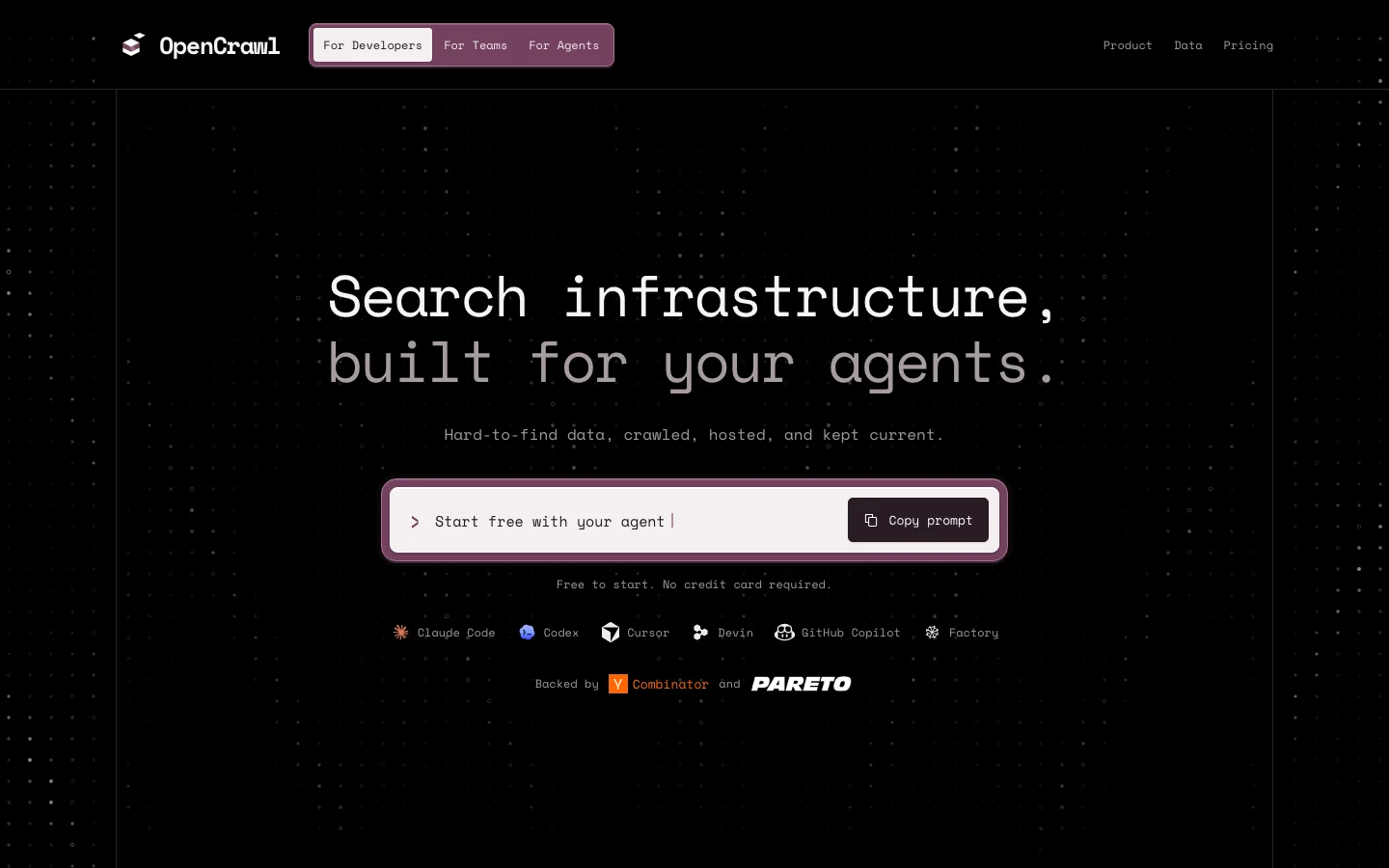
This is OpenCrawl's real first-party homepage, captured on 27 October 2026—not a generated product mock-up.
The review in 30 seconds
| The question | My answer |
|---|---|
| What is it? | managed crawling, multimodal processing and hosted search infrastructure for AI agents |
| What is the interesting part? | The source-linked result is the strongest design choice. |
| What would I test first? | A team defines 50 known-answer questions across HTML pages, a scanned PDF, one video and a source that changes daily. |
| What is the biggest concern? | A managed crawler becomes a supply chain for the product’s knowledge. |
| How much does it cost? | Free to start; Scale adds prepaid usage from a $10 top-up with no subscription; Enterprise uses a custom annual agreement |
| Who should shortlist it? | agent and search teams that need fresh, cited data from changing web portals, PDFs, geospatial sources, audio or video without maintaining every collector |
Why OpenCrawl exists
Product teams frequently assemble separate crawlers, OCR, transcription, chunking, vector storage and search APIs. OpenCrawl builds custom collectors, processes multimodal sources and hosts hybrid search so the same dataset can serve internal coding agents and customer-facing products.
In practical terms, it is trying to help teams:
- Design and operate custom crawlers around a product brief
- Extract text and evidence from web, PDF, audio, video and other sources
- Refresh collections on a schedule
- Provide BM25 and vector retrieval with rank fusion
- Return source-linked chunks through MCP, CLI, SDK and API interfaces
The part I like most
The source-linked result is the strongest design choice. URLs, page references and timestamps travel with retrieved chunks, which gives an agent a better chance of showing evidence and lets a reviewer inspect freshness instead of accepting an untraceable passage.
That is the idea that earns OpenCrawl a place on a shortlist. The rest of the evaluation is about whether the implementation can support it without creating a new operational problem.
What OpenCrawl appears to do well
Custom collection design
OpenCrawl says an agent can describe the required data while its service identifies sources and builds collectors. Require an explicit source manifest, inclusion and exclusion rules, expected fields, legal basis and acceptance set so the brief becomes a testable contract.
Multimodal processing
The product lists OCR, transcription and frame-text extraction for scanned documents, audio and video. Evaluate representative low-quality files, tables, timestamps, speaker attribution and page anchors. Retrieval quality cannot recover text that extraction lost.
Hybrid cited search
OpenCrawl combines BM25 and vector retrieval and returns URLs, pages and timestamps. Test exact identifiers, semantic questions, ambiguous names, contradictory sources and no-answer behaviour, then check every citation against the original.
Freshness and scheduled refresh
Managed refresh is valuable when sources change frequently. Record update frequency, detection lag, deletion propagation, partial failures and whether historical versions remain queryable. A “fresh” label needs a timestamp and an observed service level.
Agent and product interfaces
Collections can be reached through MCP, CLI, SDK and API. Review authentication, collection scope, pagination, rate limits, provenance fields, export and the separation between a developer’s internal tools and customer-facing application traffic.
The catch
A managed crawler becomes a supply chain for the product’s knowledge. If a source changes, access is revoked or extraction quietly degrades, search can remain responsive while the dataset becomes wrong. The product needs measurable freshness, coverage and deletion behaviour—not just successful queries.
That does not make the product a bad choice. It identifies the exact claim the pilot needs to prove. A polished demonstration is useful for learning the interface; it is not evidence that the difficult cases work.
OpenCrawl pricing: what the numbers actually mean
OpenCrawl currently gives new accounts $25 of one-time usage plus $10 of non-rolling free usage each month, with no card or automatic paid upgrade. Scale uses prepaid top-ups starting at $10, with no monthly subscription, seat or crawler fee. Usage is shared across collection, processing, search and advanced research. The homepage says paid usage will open with a published rate card, so production buyers should obtain unit prices and budgets for text, document pages, media minutes, retrieval and research before committing.
The published price is only the beginning of the cost. I would also model implementation, usage, storage, integrations, human review and the work required when something fails. When model or API consumption matters, the AI Token and API Cost Calculator can help turn expected volume into a range rather than a guess.
What makes me cautious about security and control
OpenCrawl hosts collected datasets and may process copyrighted, private or regulated source material. Its current public homepage explains source controls but does not expose a mature security or privacy evidence centre. Before production, confirm encryption, tenancy, credentials, robots and contractual collection rules, deletion, retention, regions, subprocessors, incident response, access logs, exports and whether Enterprise supports private networking or customer-controlled storage.
I would request the current security pack and map every credential, data type, automated action and deletion path before production access. The important question is not whether the vendor has a security page; it is whether the purchased plan and proposed architecture satisfy the team's real boundary.
What looks strong—and what still needs proving
What looks strong:
- Combines collection, processing and search instead of exposing only a crawler
- Supports difficult multimodal sources and cited results
- MCP, CLI, SDK and API paths cover internal and embedded use
- Free allowance and no automatic upgrade reduce trial risk
What still needs proving:
- The public paid rate card is not yet complete
- Public security, privacy and compliance evidence is limited
- Crawler reliability depends on changing third-party sources
- The customer must resolve collection rights and source terms
This is the useful dividing line between marketing and a buying decision. The strengths explain why the product is interesting. The unresolved points determine whether it is safe and economical for this particular team.
How I would test OpenCrawl
A team defines 50 known-answer questions across HTML pages, a scanned PDF, one video and a source that changes daily. It records expected evidence and deliberately edits or removes source material. Reviewers score collection coverage, extraction accuracy, retrieval relevance, citation correctness, refresh lag, deletion propagation and spend per successful answer.
I would include normal work, edge cases and known failures, then record completion, serious errors, human corrections, latency and full cost. Preserve the same input set so another product can be tested on equal terms. The AI Tool Chooser can help turn those requirements into a consistent shortlist before the pilot starts.
OpenCrawl alternatives
| Consider | When it makes more sense |
|---|---|
| Firecrawl | general web extraction and developer APIs are the main requirement |
| Exa | web-scale neural search and research APIs matter more than custom datasets |
| Tavily | agent-focused web search with a simple hosted API is sufficient |
| Unstructured | document parsing and transformation are the primary bottleneck |
| A custom crawl and retrieval stack | the source set is strategic enough to justify direct operational control |
The feature labels may look similar, but the operating model can be completely different. Test the closest two options on the same work rather than comparing screenshots and plan names.
If the shortlist is already becoming another stack of overlapping subscriptions, our guide to why companies pay for too many AI tools explains the consolidation questions to ask. For a broader selection framework, which AI tool should I use for my business? separates useful fit from feature-count noise.
For adjacent examples, read our Airweave review and The Context Company review.
Who should actually use OpenCrawl?
OpenCrawl makes the most sense for agent and search teams that need fresh, cited data from changing web portals, PDFs, geospatial sources, audio or video without maintaining every collector.
It is a weaker fit for teams indexing a small stable internal corpus, buyers requiring mature public compliance documentation or use cases without clear rights to collect the source data. In that situation, a narrower product, an existing platform feature or a better manual process may solve the problem with less integration and governance work.
Software solves an operating problem; it does not automatically make a SaaS company discoverable. Teams that also need buyers and AI answer engines to find their product can review our AEO and AI visibility service as a separate acquisition decision.
The funding context
OpenCrawl is listed by Y Combinator in the Fall 2026 batch. YC’s standard deal invests $500,000 in accepted companies. We did not find a company-confirmed cumulative funding total, so this review records the accelerator investment minimum only.
Funding can help a company build the expensive parts of the product. It does not establish reliability, security or customer fit, so it is context—not part of the verdict.
Final verdict
OpenCrawl combines several painful jobs—source discovery, custom crawling, multimodal extraction and cited hybrid search—behind a developer-facing service. Its free allowance and no-subscription usage model make exploration easy. The open questions are operational: rate-card maturity, crawler resilience, source rights, access controls, deletion and the completeness of its public security evidence.
My recommendation: OpenCrawl is worth a pilot when difficult external or multimodal data is blocking an agent product. Give it a small collection with known answers, frequent changes and hostile formats, then score coverage, freshness, citations and cost before outsourcing the whole retrieval layer.
Frequently asked questions
What is OpenCrawl?
OpenCrawl builds and operates custom data collectors, processes multimodal sources and hosts cited hybrid search for AI agents.
How much does OpenCrawl cost?
Accounts start with $25 in one-time usage and $10 of free monthly usage. Scale uses prepaid top-ups from $10, while Enterprise is custom.
Does OpenCrawl provide citations?
OpenCrawl says search results carry source URLs, page references and timestamps with the retrieved chunks.
How much funding has OpenCrawl raised?
OpenCrawl is a Fall 2026 YC company and passes YC’s $500,000 standard investment threshold. We did not find a company-confirmed cumulative total.
Was this OpenCrawl review hands-on?
No. This is a research-based first-look review using official public evidence. We did not test an authenticated OpenCrawl workspace or connect production data.
Did OpenCrawl pay for inclusion?
No disclosed commercial relationship or payment influenced this review, and no numeric rating was assigned.

Tolu S.
Operations Lead, AI Search & GEO
Leads operations for AI search visibility and generative engine optimization (GEO) campaigns.