Table of Contents
- The review in 30 seconds
- Why The Context Company exists
- The part I like most
- What The Context Company appears to do well
- The catch
- The Context Company pricing: what the numbers actually mean
- What makes me cautious about security and control
- What looks strong—and what still needs proving
- How I would test The Context Company
- The Context Company alternatives
- Who should actually use The Context Company?
- The funding context
- Final verdict
- Frequently asked questions
Once an AI agent reaches production, nobody can read every conversation it has. That means the most expensive failures can repeat quietly across hundreds of sessions before a dashboard average looks unusual. The Context Company is trying to turn that unread conversation pile into a prioritized backlog.
The Context Company is production observability, pattern detection and improvement software for AI agents.
My short take: The Context Company is a strong shortlist candidate for teams with enough production traffic to overwhelm manual review. Use a labelled holdout set and make the platform prove that its patterns are both accurate and more actionable than the analytics you already have.
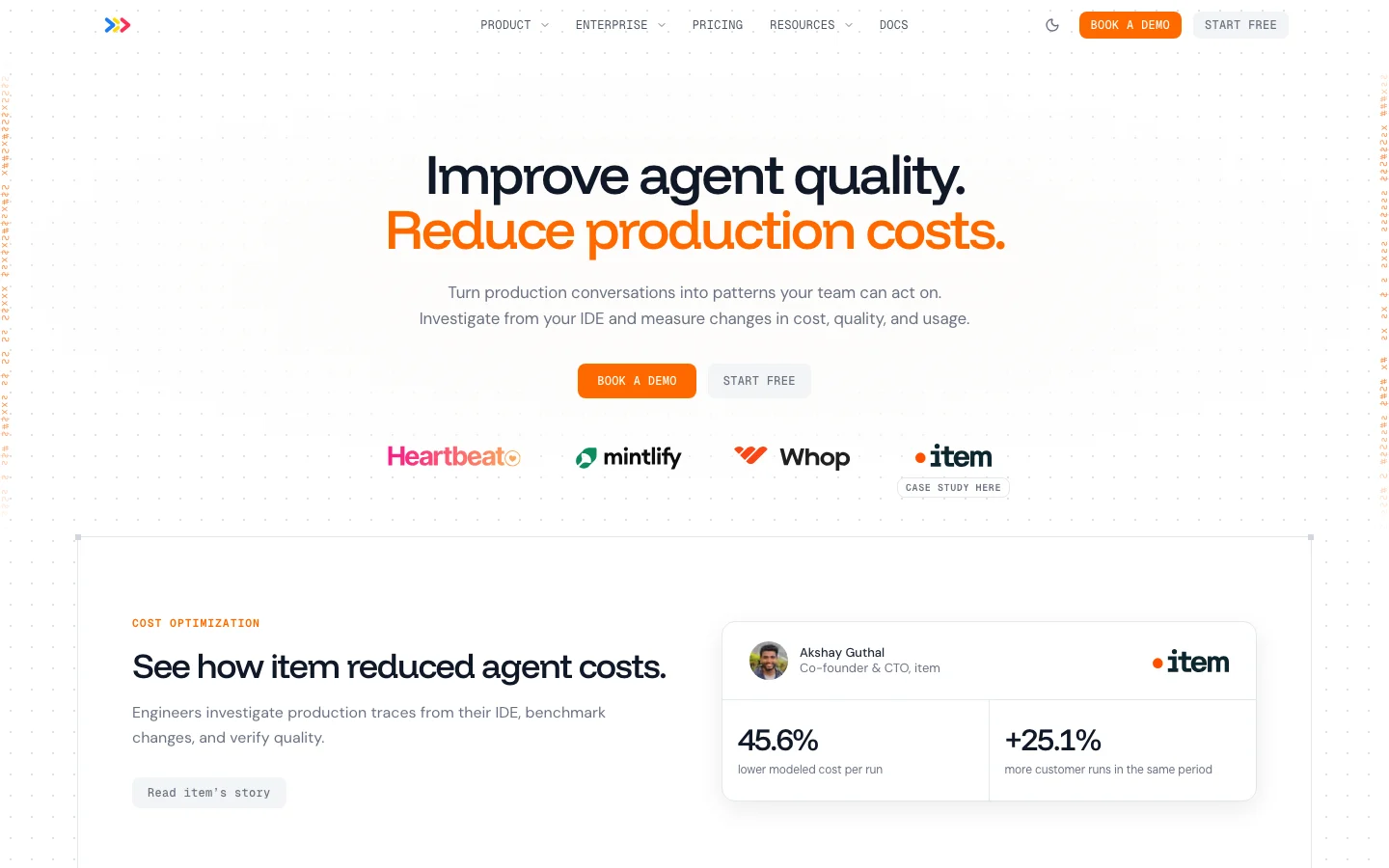
This is The Context Company's real first-party homepage, captured on 27 October 2026—not a generated product mock-up.
The review in 30 seconds
| The question | My answer |
|---|---|
| What is it? | production observability, pattern detection and improvement software for AI agents |
| What is the interesting part? | The product connects the pattern back to the trace. |
| What would I test first? | A support-agent team sends a representative production sample, defines three known failure categories and keeps a human-labelled holdout set. |
| What is the biggest concern? | Generated patterns can be persuasive and still be unstable. |
| How much does it cost? | Developer free; Pro $400/month including 25,000 runs; Enterprise custom |
| Who should shortlist it? | AI product and engineering teams operating customer-facing agents with enough production volume to reveal repeated failure and demand patterns |
Why The Context Company exists
Raw traces tell an engineer what happened in one run. Product and support teams need to know what keeps happening, which accounts are affected and whether a fix changed the outcome. The Context Company groups production conversations into patterns and keeps the underlying evidence attached.
In practical terms, it is trying to help teams:
- Capture and search production agent runs and sessions
- Group repeated failures, behaviours and user needs into patterns
- Investigate supporting traces from a dashboard or IDE
- Send alerts and recaps into engineering and product workflows
- Measure cost, quality and usage before and after a change
The part I like most
The product connects the pattern back to the trace. A summary such as “customers struggle with scheduling” is only useful if an engineer can open the supporting conversations and tool calls, identify the cause and measure the result after a change.
That is the idea that earns The Context Company a place on a shortlist. The rest of the evaluation is about whether the implementation can support it without creating a new operational problem.
What The Context Company appears to do well
Pattern and topic detection
The platform groups production conversations into recurring behaviours and topics. Reviewers should compare those clusters with a human-labelled sample, check whether small high-severity failures are hidden by volume and track how patterns change when taxonomy or agent behaviour shifts.
Trace-level investigation
Patterns link back to conversations and tool calls, and the company describes MCP access from an IDE. This can shorten diagnosis if engineers can retrieve the decisive evidence without broad production-data exposure. Test provenance, filtering, redaction and access boundaries.
Reports and alerts
The product can send Slack alerts, daily recaps and reports connected to supporting runs. Teams should define which pattern, severity, account and confidence thresholds warrant interruption, then measure alert precision and time to resolution.
Cost and quality measurement
The Context Company positions before-and-after benchmarking as part of the fix workflow. Buyers should freeze comparable cohorts, account for model and traffic changes, and separate modelled cost reductions from realised invoice or margin effects.
Enterprise controls
The Enterprise tier can include HIPAA support and BAAs, edge PII redaction, SSO, SLAs, custom retention and residency. These are scoped commercially, so regulated buyers should confirm exact architecture and contract terms rather than infer inclusion from the marketing list.
The catch
Generated patterns can be persuasive and still be unstable. A cluster may merge different failures, overlook a rare high-severity incident or change when traffic shifts. Human validation is not optional, especially before a pattern becomes roadmap priority.
That does not make the product a bad choice. It identifies the exact claim the pilot needs to prove. A polished demonstration is useful for learning the interface; it is not evidence that the difficult cases work.
The Context Company pricing: what the numbers actually mean
The Developer plan is free and shows the latest 1,000 runs with seven-day history, core observability, search and basic MCP access. Pro costs $400 per month, includes 25,000 runs and charges $0.001 per additional run; it adds automatic patterns and topics, natural-language investigation, Slack alerts, recaps and unlimited history. Enterprise is custom and can add volume pricing, compliance controls, onboarding and dedicated support. Confirm payload-size assumptions and what counts as a run.
The published price is only the beginning of the cost. I would also model implementation, usage, storage, integrations, human review and the work required when something fails. When model or API consumption matters, the AI Token and API Cost Calculator can help turn expected volume into a range rather than a guess.
What makes me cautious about security and control
Production conversations may contain personal, financial, health and account data. Decide whether PII must be removed before transmission or through the vendor’s enterprise edge-redaction option. Verify authentication, tenant isolation, role design, retention, residency, model providers, training policy, deletion, audit logs and the data exposed through MCP or Slack.
I would request the current security pack and map every credential, data type, automated action and deletion path before production access. The important question is not whether the vendor has a security page; it is whether the purchased plan and proposed architecture satisfy the team's real boundary.
What looks strong—and what still needs proving
What looks strong:
- Public pricing and a useful free tier support a genuine pilot
- Moves beyond trace storage into patterns tied to supporting evidence
- Connects engineering, product and customer-success views of agent behaviour
- Usage overage pricing is explicitly stated on the public page
What still needs proving:
- Pattern quality and actionability require human validation
- The $400 Pro floor may be high for low-volume early products
- Enterprise security and compliance terms are custom-scoped
- Before-and-after cost claims can be confounded by traffic and model changes
This is the useful dividing line between marketing and a buying decision. The strengths explain why the product is interesting. The unresolved points determine whether it is safe and economical for this particular team.
How I would test The Context Company
A support-agent team sends a representative production sample, defines three known failure categories and keeps a human-labelled holdout set. The platform identifies patterns and topics, engineers inspect the cited traces through the dashboard or IDE, and one prompt or tool fix is deployed. The team compares quality, cost and failure rate on matched traffic before expanding coverage.
I would include normal work, edge cases and known failures, then record completion, serious errors, human corrections, latency and full cost. Preserve the same input set so another product can be tested on equal terms. The AI Tool Chooser can help turn those requirements into a consistent shortlist before the pilot starts.
The Context Company alternatives
| Consider | When it makes more sense |
|---|---|
| Sentrial | assertions, prompt experiments and code-level failure diagnosis lead the decision |
| Langfuse | open-source tracing, prompt management and evaluation are the priority |
| Arize Phoenix | open-source observability and evaluation fit the engineering stack |
| Braintrust | dataset-led evaluation and release gates are more important than production clustering |
| Existing warehouse analytics | the team can model conversations and feedback reliably with internal data tooling |
The feature labels may look similar, but the operating model can be completely different. Test the closest two options on the same work rather than comparing screenshots and plan names.
If the shortlist is already becoming another stack of overlapping subscriptions, our guide to why companies pay for too many AI tools explains the consolidation questions to ask. For a broader selection framework, which AI tool should I use for my business? separates useful fit from feature-count noise.
For adjacent examples, read our Bluejay review and Sentrial review.
Who should actually use The Context Company?
The Context Company makes the most sense for AI product and engineering teams operating customer-facing agents with enough production volume to reveal repeated failure and demand patterns.
It is a weaker fit for pre-launch teams without representative conversations or buyers that only need low-level tracing and already have reliable analysis workflows. In that situation, a narrower product, an existing platform feature or a better manual process may solve the problem with less integration and governance work.
Software solves an operating problem; it does not automatically make a SaaS company discoverable. Teams that also need buyers and AI answer engines to find their product can review our AEO and AI visibility service as a separate acquisition decision.
The funding context
The Context Company is listed by Y Combinator in the Fall 2025 batch. YC’s standard deal invests $500,000 in every accepted company. We did not find a company-confirmed cumulative funding total, so this review labels the funding evidence as the YC standard investment minimum only.
Funding can help a company build the expensive parts of the product. It does not establish reliability, security or customer fit, so it is context—not part of the verdict.
Final verdict
The Context Company is a strong shortlist candidate for teams that already run conversational agents in production and need to turn large trace volumes into prioritised product and engineering work. Its free tier and public $400 Pro plan make evaluation unusually concrete. The key buying test is whether its generated patterns are stable, actionable and more useful than existing traces, feedback and analytics after human validation.
My recommendation: The Context Company is a strong shortlist candidate for teams with enough production traffic to overwhelm manual review. Use a labelled holdout set and make the platform prove that its patterns are both accurate and more actionable than the analytics you already have.
Frequently asked questions
What does The Context Company do?
It monitors production AI-agent conversations and traces, groups recurring patterns and topics, and helps teams investigate and measure fixes.
How much does The Context Company cost?
Developer was free, Pro was $400 per month including 25,000 runs, and Enterprise was custom when checked on 27 October 2026.
Does The Context Company support MCP?
Yes. Its public pricing material describes MCP access to runs and sessions on Developer and broader pattern and insight access on paid plans.
How much funding has The Context Company raised?
It is a Fall 2025 YC company and passes YC’s $500,000 standard investment threshold. We did not find a company-confirmed cumulative total.
Was this The Context Company review hands-on?
No. This is a research-based first-look review using official public evidence. We did not test an authenticated The Context Company workspace or connect production data.
Did The Context Company pay for inclusion?
No disclosed commercial relationship or payment influenced this review, and no numeric rating was assigned.

Tolu S.
Operations Lead, AI Search & GEO
Leads operations for AI search visibility and generative engine optimization (GEO) campaigns.