Table of Contents
- The review in 30 seconds
- Why Bluejay exists
- The part I like most
- What Bluejay appears to do well
- The catch
- Bluejay pricing: what the numbers actually mean
- What makes me cautious about security and control
- What looks strong—and what still needs proving
- How I would test Bluejay
- Bluejay alternatives
- Who should actually use Bluejay?
- The funding context
- Final verdict
- Frequently asked questions
A voice agent can sound excellent in a demo and still fall apart the first time a customer interrupts, changes direction or asks for something the script did not anticipate. Bluejay is designed to find those failures before—and after—the agent reaches production.
Bluejay is testing, monitoring and improvement software for voice and chat AI agents.
My short take: Bluejay belongs on the shortlist for teams running customer-facing voice or chat agents at meaningful volume. Start with the conversations your current agent handles worst, not the polished demo flows, and make Bluejay prove that its scores match human judgment.
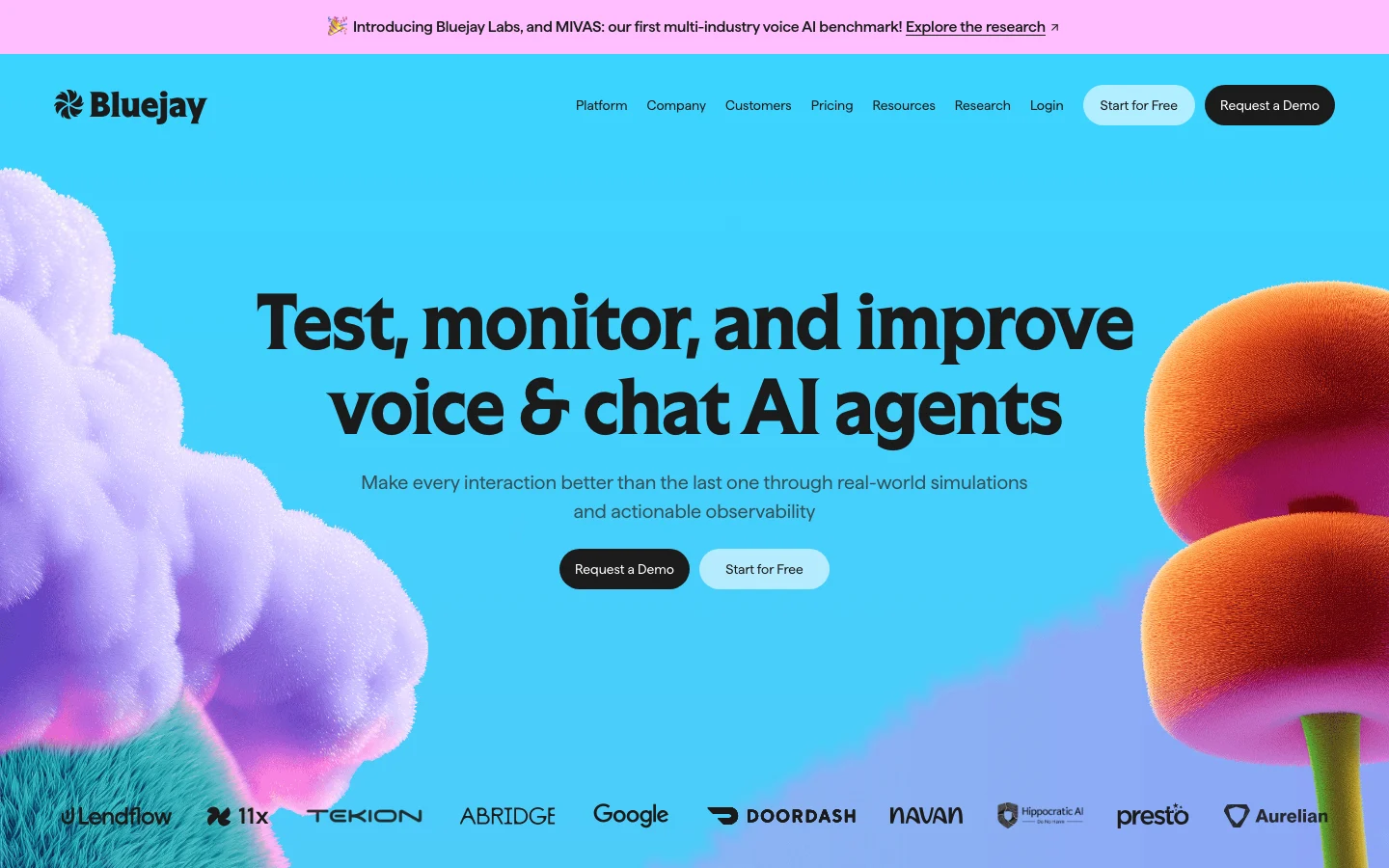
This is Bluejay's real first-party homepage, captured on 27 October 2026—not a generated product mock-up.
The review in 30 seconds
| The question | My answer |
|---|---|
| What is it? | testing, monitoring and improvement software for voice and chat AI agents |
| What is the interesting part? | The strongest idea is putting simulation and production monitoring in one feedback loop. |
| What would I test first? | A voice-agent team selects ten high-volume intents and five high-risk failures, generates varied personas and runs a baseline simulation suite. |
| What is the biggest concern? | A library of more than 70 metrics can create the appearance of rigor without guaranteeing it. |
| How much does it cost? | Pay-as-you-go from $0/month plus usage; Growth $500/month; Scale $1,000/month; Enterprise custom |
| Who should shortlist it? | product, QA and engineering teams testing customer-facing voice or chat agents before and after production release |
Why Bluejay exists
Conversational agents are difficult to test because the same intent can arrive through different wording, accents, timing and emotional states. Traditional test scripts cover deterministic paths; Bluejay tries to generate realistic conversations, score them and carry the same evaluation logic into production monitoring.
In practical terms, it is trying to help teams:
- Generate realistic voice and chat simulation scenarios
- Run regression, red-team and load tests before release
- Evaluate production conversations with standard and custom metrics
- Trace failures, tool calls and behavioural changes
- Connect testing to CI/CD, alerts and improvement workflows
The part I like most
The strongest idea is putting simulation and production monitoring in one feedback loop. A failure discovered in a real conversation can become a regression case, and a pre-release metric can continue watching the live agent after deployment.
That is the idea that earns Bluejay a place on a shortlist. The rest of the evaluation is about whether the implementation can support it without creating a new operational problem.
What Bluejay appears to do well
Simulation testing
Bluejay publicly describes lifelike digital humans, personas, automated test generation, tool-call testing, regression testing, red teaming and scheduled or CI/CD runs. A useful evaluation includes accents, interruptions, silence, transfers, tool failures, ambiguous requests and adversarial prompts—not only the clean happy path.
Production monitoring
The platform evaluates live conversation data, traces tool calls and supports dashboards, reports and threshold alerts. Teams should compare detected failures with a human-labelled sample and measure false negatives and false positives separately; an attractive aggregate score can hide serious failures in one intent.
Metrics and improvement workflow
Bluejay advertises more than 70 metrics plus custom metrics. Each metric needs an operational definition, labelled examples and an owner. Improvement claims should be verified by replaying the same test set after a change and checking that gains do not trade off against latency, cost or another critical intent.
Integrations and developer workflow
The public plan comparison includes APIs, webhooks, SDKs, CLI, MCP and CI/CD integrations. Evaluate whether test definitions, results and evidence can be versioned, exported and enforced as a release gate rather than living only in a separate dashboard.
Security and regulated use
Bluejay states that it is SOC 2 Type II, supports signed BAAs and DPAs on paid plans, publishes subprocessors, encrypts data and does not train models on customer data. Buyers should obtain the reports and agreements applicable to their plan and verify retention, redaction and regional-processing requirements.
The catch
A library of more than 70 metrics can create the appearance of rigor without guaranteeing it. Every important metric still needs labelled examples, a clear definition and evidence that it catches serious failures without flooding the team with false alarms.
That does not make the product a bad choice. It identifies the exact claim the pilot needs to prove. A polished demonstration is useful for learning the interface; it is not evidence that the difficult cases work.
Bluejay pricing: what the numbers actually mean
Bluejay’s Pay-as-you-go plan starts at $0 per month plus usage and included $25 in starting credits when checked. It listed up to 25 concurrent simulations, unlimited seats and agents, 14-day retention and self-serve onboarding. Growth was $500 per month with higher concurrency, 30-day retention, included simulation and monitoring allowances, signed BAA/DPA terms and standard RBAC. Scale was $1,000 per month with higher allowances, load testing, 90-day retention and weekly success calls. Enterprise was custom. The pricing page notes that estimates vary with model, metrics and configuration, so validate credit burn on representative conversations.
The published price is only the beginning of the cost. I would also model implementation, usage, storage, integrations, human review and the work required when something fails. When model or API consumption matters, the AI Token and API Cost Calculator can help turn expected volume into a range rather than a guess.
What makes me cautious about security and control
Because production conversations can contain personal, financial or health information, verify the exact ingestion path, redaction timing, model providers, zero-retention configuration, subprocessor regions, deletion behaviour and access controls. Bluejay’s security page provides useful claims, but the purchased plan and signed documents govern the actual commitment.
I would request the current security pack and map every credential, data type, automated action and deletion path before production access. The important question is not whether the vendor has a security page; it is whether the purchased plan and proposed architecture satisfy the team's real boundary.
What looks strong—and what still needs proving
What looks strong:
- Combines pre-release simulation with post-release monitoring
- Public self-serve and paid pricing reduces commercial ambiguity
- Unlimited seats and agents avoid a per-user testing tax
- Published security and compliance details support initial diligence
What still needs proving:
- Usage depends on conversation minutes, models, metrics and configuration
- Vendor case-study claims need reproduction in the buyer’s workflows
- Metric libraries can create false confidence without labelled validation
- Enterprise identity controls and custom SLAs require the custom tier
This is the useful dividing line between marketing and a buying decision. The strengths explain why the product is interesting. The unresolved points determine whether it is safe and economical for this particular team.
How I would test Bluejay
A voice-agent team selects ten high-volume intents and five high-risk failures, generates varied personas and runs a baseline simulation suite. Reviewers label outcome correctness, policy compliance, tool use, latency and escalation. After deployment, the same metrics run on a sampled production stream, with alerts linked to traces and confirmed failures added back to the regression set.
I would include normal work, edge cases and known failures, then record completion, serious errors, human corrections, latency and full cost. Preserve the same input set so another product can be tested on equal terms. The AI Tool Chooser can help turn those requirements into a consistent shortlist before the pilot starts.
Bluejay alternatives
| Consider | When it makes more sense |
|---|---|
| Langfuse | general LLM tracing, prompt management and evaluation are the priority |
| Arize Phoenix | open-source observability and evaluation fit the engineering workflow |
| Braintrust | dataset-driven evals and CI quality gates lead the decision |
| Maxim AI | a broad agent evaluation and observability suite is required |
| A custom evaluation harness | the agent set is narrow and the team can maintain labelled tests internally |
The feature labels may look similar, but the operating model can be completely different. Test the closest two options on the same work rather than comparing screenshots and plan names.
If the shortlist is already becoming another stack of overlapping subscriptions, our guide to why companies pay for too many AI tools explains the consolidation questions to ask. For a broader selection framework, which AI tool should I use for my business? separates useful fit from feature-count noise.
For adjacent examples, read our PolyAI review and Parloa review.
Who should actually use Bluejay?
Bluejay makes the most sense for product, QA and engineering teams testing customer-facing voice or chat agents before and after production release.
It is a weaker fit for teams running only low-volume internal prototypes or organisations that need general LLM tracing without conversational simulation. In that situation, a narrower product, an existing platform feature or a better manual process may solve the problem with less integration and governance work.
Software solves an operating problem; it does not automatically make a SaaS company discoverable. Teams that also need buyers and AI answer engines to find their product can review our AEO and AI visibility service as a separate acquisition decision.
The funding context
Bluejay’s official company page states that it raised a $4 million seed round. The accessible company material did not provide a complete dated funding ledger and participant list during this review, so the amount is labelled as a company statement requiring final round-detail verification rather than a calculated cumulative total.
Funding can help a company build the expensive parts of the product. It does not establish reliability, security or customer fit, so it is context—not part of the verdict.
Final verdict
Bluejay offers an unusually complete public proposition for teams operating customer-facing voice and chat agents: pre-release simulations, production monitoring and iterative improvement share one platform and one usage model. Public pricing and self-serve access improve evaluability, but buyers still need to reproduce vendor case-study outcomes, inspect metric quality and model usage at realistic conversation volume.
My recommendation: Bluejay belongs on the shortlist for teams running customer-facing voice or chat agents at meaningful volume. Start with the conversations your current agent handles worst, not the polished demo flows, and make Bluejay prove that its scores match human judgment.
Frequently asked questions
What is Bluejay?
Bluejay is a platform for simulating, monitoring and improving customer-facing voice and chat AI agents.
How much does Bluejay cost?
Pay-as-you-go started at $0 per month plus usage, Growth at $500 per month and Scale at $1,000 per month when checked on 27 October 2026.
Does Bluejay support production monitoring?
Yes. Its public product and pricing pages include production conversation monitoring, traces, dashboards, alerts and custom metrics.
How much funding has Bluejay raised?
Bluejay’s company page states a $4 million seed round. We did not find enough first-party detail to label that amount as a fully reconstructed cumulative total.
Was this Bluejay review hands-on?
No. This is a research-based first-look review using official public evidence. We did not test an authenticated Bluejay workspace or connect production data.
Did Bluejay pay for inclusion?
No disclosed commercial relationship or payment influenced this review, and no numeric rating was assigned.

Tolu S.
Operations Lead, AI Search & GEO
Leads operations for AI search visibility and generative engine optimization (GEO) campaigns.