Table of Contents
- The review in 30 seconds
- Why Hyperspell exists
- The part I like most
- What Hyperspell appears to do well
- The catch
- Hyperspell pricing: what the numbers actually mean
- What makes me cautious about security and control
- What looks strong—and what still needs proving
- How I would test Hyperspell
- Hyperspell alternatives
- Who should actually use Hyperspell?
- The funding context
- Final verdict
- Frequently asked questions
The smartest agent in the world is still the new employee who joined five minutes ago. It does not know the project history, the decision hidden in Slack or why the CRM disagrees with the planning document. Hyperspell wants to give it that organisational memory.
Hyperspell is permission-aware company context and memory infrastructure for AI agents.
My short take: Hyperspell is worth piloting when several agents keep rediscovering the same company context. Build the test around restricted documents, contradictory sources and recently changed decisions. The absence of public pricing means commercial clarity should be part of that first conversation.
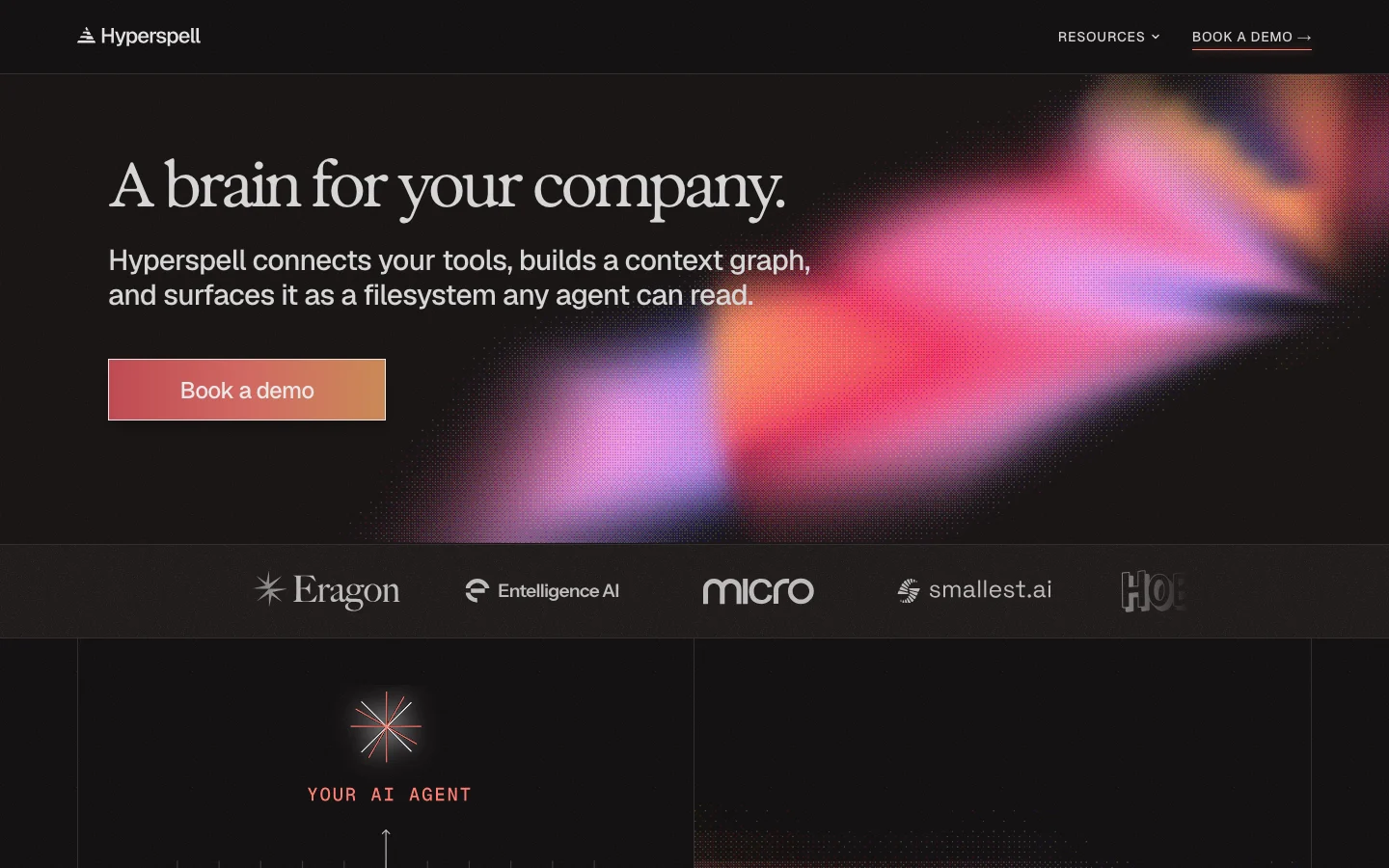
This is Hyperspell's real first-party homepage, captured on 27 October 2026—not a generated product mock-up.
The review in 30 seconds
| The question | My answer |
|---|---|
| What is it? | permission-aware company context and memory infrastructure for AI agents |
| What is the interesting part? | The product is not limited to retrieving fragments for one assistant. |
| What would I test first? | An internal-support team connects Slack, Notion and Google Drive to a sandbox tenant, then creates a labelled set of questions about active projects, historical decisions and restricted material. |
| What is the biggest concern? | Continuous learning sounds useful until the system learns the wrong thing. |
| How much does it cost? | Demo-led; no public rate card found |
| Who should shortlist it? | engineering and AI platform teams building several agents that need current, permission-aware context from many company systems |
Why Hyperspell exists
Company knowledge is not a folder of clean documents. It is a moving network of people, projects, conversations and decisions. Hyperspell connects those systems and presents a permission-aware context graph that different agents can read through common interfaces.
In practical terms, it is trying to help teams:
- Connect company systems without maintaining every ingestion pipeline
- Synthesize documents and conversations into linked organisational context
- Expose current memory to different agents through a common interface
- Preserve source traceability and inherited permissions
- Update agent context as people, projects and decisions change
The part I like most
The product is not limited to retrieving fragments for one assistant. Its more ambitious idea is a shared company brain that several agents can use, with facts connected to sources and permissions inherited from the original systems.
That is the idea that earns Hyperspell a place on a shortlist. The rest of the evaluation is about whether the implementation can support it without creating a new operational problem.
What Hyperspell appears to do well
Permission-aware context graph
Hyperspell describes a live model of people, projects and decisions rather than a collection of isolated text chunks. Buyers should test whether the graph resolves conflicting names, stale decisions, deleted content and cross-system identity while preventing context from crossing source permissions.
More than 50 connectors
The company lists Slack, Gmail, Google Drive, Notion, Linear, Jira, Salesforce, HubSpot, GitHub and other sources. Connector count is useful only when the required fields, attachments, threads, deletions, incremental changes and permission models work reliably for the buyer’s own tenant.
Any-source, any-agent interfaces
Public material says the context can be surfaced like a filesystem and accessed through a universal API and SDK. Teams should validate latency, provenance, filtering, rate limits and behaviour when a connector or upstream source is temporarily unavailable.
Continuous learning
Hyperspell says relevant answers and conversations reinforce future context. That can improve usefulness, but it creates governance questions: which interaction becomes memory, who can correct it, how feedback is scoped and how an incorrect or sensitive memory is removed.
Security posture
Hyperspell publicly states SOC 2 certification and GDPR compliance and says OAuth permissions are inherited. Buyers should request the applicable audit report and verify subprocessors, encryption, regional processing, deletion, audit logs, incident terms and whether agent write-back follows the same permission boundary.
The catch
Continuous learning sounds useful until the system learns the wrong thing. Buyers need to know which interactions become memory, who can correct them and how an outdated or sensitive inference is removed everywhere it appears.
That does not make the product a bad choice. It identifies the exact claim the pilot needs to prove. A polished demonstration is useful for learning the interface; it is not evidence that the difficult cases work.
Hyperspell pricing: what the numbers actually mean
Hyperspell used a Book a demo route and did not publish a complete rate card when checked. Ask for pricing by connected source, indexed item, query, token, agent, workspace and user. Separate implementation, custom connectors, re-indexing, retention, environments, support and overages. Request a representative consumption model using the buyer’s document count and query volume rather than a generic platform quote.
The published price is only the beginning of the cost. I would also model implementation, usage, storage, integrations, human review and the work required when something fails. When model or API consumption matters, the AI Token and API Cost Calculator can help turn expected volume into a range rather than a guess.
What makes me cautious about security and control
A company context layer can index email, chat, CRM, documents and code, making permission fidelity the central control. Verify OAuth scopes, tenant separation, source ACL propagation, service accounts, deletion timing, employee offboarding, prompt-injection handling, export, memory correction and whether customer data trains shared models. Test restricted documents with users and agents that should and should not retrieve them.
I would request the current security pack and map every credential, data type, automated action and deletion path before production access. The important question is not whether the vendor has a security page; it is whether the purchased plan and proposed architecture satisfy the team's real boundary.
What looks strong—and what still needs proving
What looks strong:
- Focuses on reusable company context rather than one agent application
- Broad connector coverage can reduce repeated integration work
- Source traceability and permission inheritance are part of the public proposition
- SOC 2 and GDPR statements support an initial security review
What still needs proving:
- No complete public pricing was found
- Public claims do not establish retrieval accuracy or permission fidelity in a buyer tenant
- Continuous learning needs explicit correction and deletion governance
- Detailed retention, residency and administrative controls require direct diligence
This is the useful dividing line between marketing and a buying decision. The strengths explain why the product is interesting. The unresolved points determine whether it is safe and economical for this particular team.
How I would test Hyperspell
An internal-support team connects Slack, Notion and Google Drive to a sandbox tenant, then creates a labelled set of questions about active projects, historical decisions and restricted material. Two agents query the same context. Reviewers score answer accuracy, freshness, cited sources, permission enforcement and correction behaviour after a source document changes or is deleted.
I would include normal work, edge cases and known failures, then record completion, serious errors, human corrections, latency and full cost. Preserve the same input set so another product can be tested on equal terms. The AI Tool Chooser can help turn those requirements into a consistent shortlist before the pilot starts.
Hyperspell alternatives
| Consider | When it makes more sense |
|---|---|
| Glean | a mature enterprise-search application and employee-facing experience are required |
| Airweave | open-source retrieval infrastructure and transparent entry pricing matter more |
| LlamaIndex | the team wants to assemble its own indexing and agent context layer |
| Dust | a packaged enterprise agent platform is more important than a standalone context layer |
| A custom RAG pipeline | the source set is narrow and internal ownership is strategically justified |
The feature labels may look similar, but the operating model can be completely different. Test the closest two options on the same work rather than comparing screenshots and plan names.
If the shortlist is already becoming another stack of overlapping subscriptions, our guide to why companies pay for too many AI tools explains the consolidation questions to ask. For a broader selection framework, which AI tool should I use for my business? separates useful fit from feature-count noise.
For adjacent examples, read our Airweave review and Sourcebot review.
Who should actually use Hyperspell?
Hyperspell makes the most sense for engineering and AI platform teams building several agents that need current, permission-aware context from many company systems.
It is a weaker fit for small teams with one stable knowledge source or buyers that need transparent self-serve pricing and a fully documented deployment model before engaging sales. In that situation, a narrower product, an existing platform feature or a better manual process may solve the problem with less integration and governance work.
Software solves an operating problem; it does not automatically make a SaaS company discoverable. Teams that also need buyers and AI answer engines to find their product can review our AEO and AI visibility service as a separate acquisition decision.
The funding context
Hyperspell is listed by Y Combinator in the Fall 2025 batch. YC’s published standard deal is $500,000 for accepted companies. We did not find a company-confirmed cumulative funding total in the reviewed primary sources, so the article records the YC accelerator minimum without presenting it as total funding.
Funding can help a company build the expensive parts of the product. It does not establish reliability, security or customer fit, so it is context—not part of the verdict.
Final verdict
Hyperspell is worth a structured pilot for teams whose agents repeatedly lack company context spread across documents, conversations and operational systems. Its public proposition combines 50-plus connectors, permission inheritance, source traceability and agent-neutral interfaces. The main barriers to a desk-based buying decision are the absence of public pricing and limited public detail about retention, deployment and administrative controls.
My recommendation: Hyperspell is worth piloting when several agents keep rediscovering the same company context. Build the test around restricted documents, contradictory sources and recently changed decisions. The absence of public pricing means commercial clarity should be part of that first conversation.
Frequently asked questions
What is Hyperspell?
Hyperspell is a permission-aware company context and memory layer that connects business systems and makes their context available to AI agents.
How much does Hyperspell cost?
Hyperspell did not publish a complete rate card when checked on 27 October 2026. Pricing requires a vendor conversation.
Which data sources does Hyperspell support?
Hyperspell says it has more than 50 connectors, including Slack, Gmail, Google Drive, Notion, Linear, Jira, Salesforce, HubSpot and GitHub.
How much funding has Hyperspell raised?
Hyperspell is a Fall 2025 YC company and therefore passes YC’s $500,000 standard investment threshold. We did not find a company-confirmed cumulative total.
Was this Hyperspell review hands-on?
No. This is a research-based first-look review using official public evidence. We did not test an authenticated Hyperspell workspace or connect production data.
Did Hyperspell pay for inclusion?
No disclosed commercial relationship or payment influenced this review, and no numeric rating was assigned.

Tolu S.
Operations Lead, AI Search & GEO
Leads operations for AI search visibility and generative engine optimization (GEO) campaigns.