Table of Contents
- The review in 30 seconds
- Why Sourcebot exists
- The part I like most
- What Sourcebot appears to do well
- The catch
- Sourcebot pricing: what the numbers actually mean
- What makes me cautious about security and control
- What looks strong—and what still needs proving
- How I would test Sourcebot
- Sourcebot alternatives
- Who should actually use Sourcebot?
- The funding context
- Final verdict
- Frequently asked questions
Coding agents are very good at editing the files they can see. The trouble starts when the answer lives in another repository, an older migration or a service the local checkout never included. Sourcebot wants to give both engineers and agents that missing view.
Sourcebot is self-hosted code search and code-context software for humans and AI agents.
My short take: Sourcebot is a strong trial for engineering teams whose developers and agents repeatedly search across many repositories. Test permission changes and citation accuracy first. If a fully open future roadmap is non-negotiable, resolve the v6 licensing question before standardising on it.
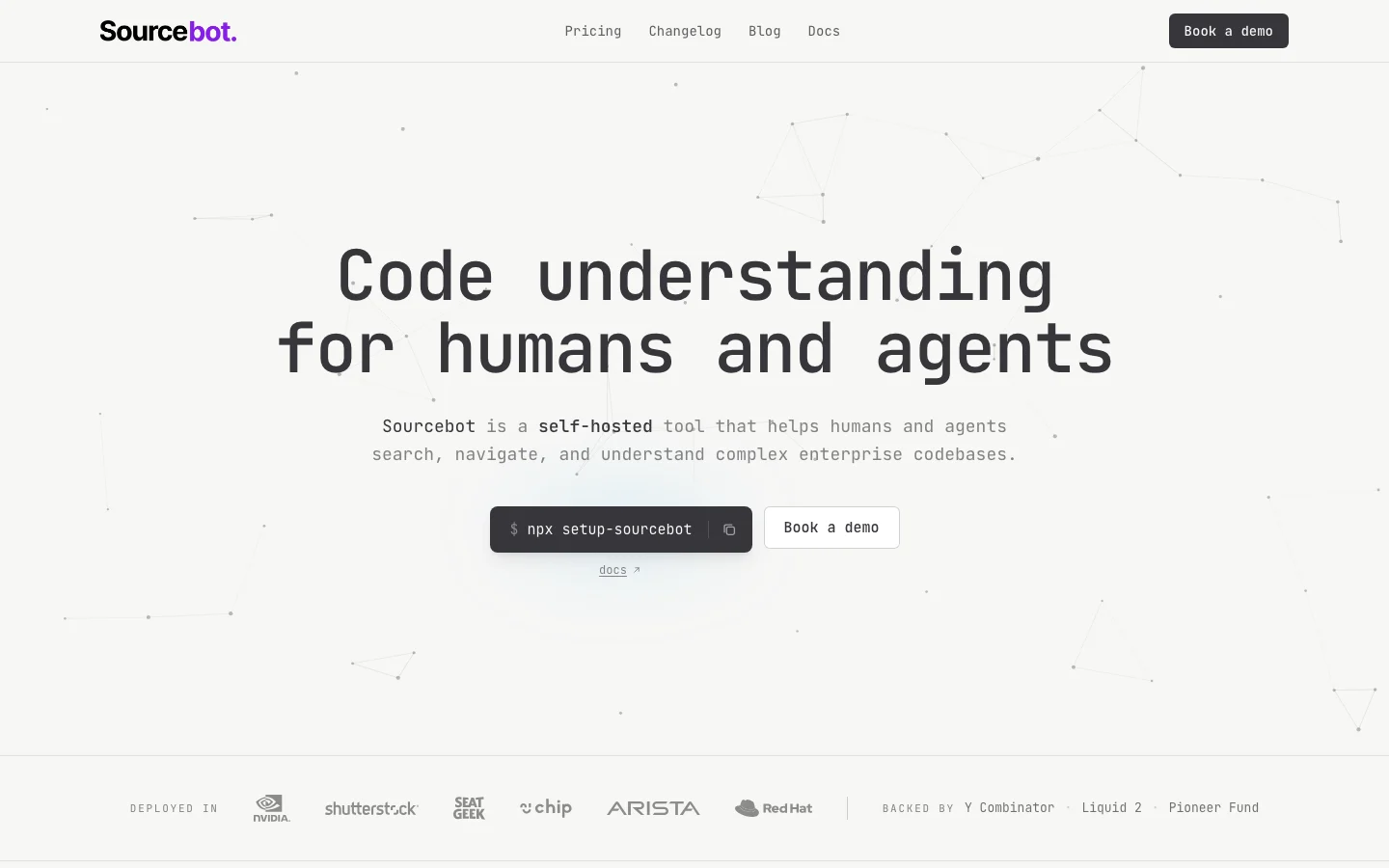
This is Sourcebot's real first-party homepage, captured on 27 October 2026—not a generated product mock-up.
The review in 30 seconds
| The question | My answer |
|---|---|
| What is it? | self-hosted code search and code-context software for humans and AI agents |
| What is the interesting part? | The combination of self-hosting and MCP access is the most convincing part. |
| What would I test first? | An engineering team indexes a representative set of repositories, then gives developers and one coding agent the same ten architecture and migration questions. |
| What is the biggest concern? | The licensing story changed. |
| How much does it cost? | Basic free for up to 5 users; Pro $20 per user per month; Enterprise custom |
| Who should shortlist it? | engineering teams with many repositories, complex code ownership and coding agents that need governed cross-repository context |
Why Sourcebot exists
Large engineering organisations do not have one codebase. They have hundreds of repositories, uneven documentation and years of architectural decisions spread across history and ownership boundaries. Sourcebot creates a searchable cross-repository layer and exposes it to people and agents.
In practical terms, it is trying to help teams:
- Search code, symbols, history and branches across repositories
- Answer codebase questions with cited repository context
- Give coding agents governed retrieval through MCP and APIs
- Preserve code inside a self-hosted environment
- Synchronize repository permissions and manage enterprise access
The part I like most
The combination of self-hosting and MCP access is the most convincing part. Code context can stay inside the customer environment while approved coding agents retrieve more than the current workspace contains.
That is the idea that earns Sourcebot a place on a shortlist. The rest of the evaluation is about whether the implementation can support it without creating a new operational problem.
What Sourcebot appears to do well
Cross-repository code search
Sourcebot combines regex, symbol and filtered search with file navigation, Git history and blame. Test indexing speed, branch coverage, monorepos, generated code, large binary exclusions and permission changes against the repositories that create today’s search bottleneck.
Ask Sourcebot
The conversational layer can answer questions across repositories and connected systems with inline evidence. Reviewers should open every cited file, test unknown-answer behaviour and check whether the system distinguishes current production code from examples, deprecated branches and documentation.
Agent context through MCP
Sourcebot exposes code search and context to coding agents through MCP and REST interfaces. This can extend an agent beyond the local workspace, but it also creates a powerful read boundary. Scope repositories, service identities and tool permissions narrowly, and log what every agent retrieved.
Self-hosted deployment
The product is designed to run in the customer’s infrastructure as a container. That can keep repositories and indexes on-premises, subject to the selected plan and network configuration. Buyers remain responsible for sizing, availability, backups, updates and outbound-traffic policy.
Administration and enterprise controls
Pro adds permission syncing, organisation management and analytics; Enterprise adds SCIM, audit logs, dedicated support, SLAs, a custom MSA and offline licensing. Verify how quickly repository and identity changes propagate into search and cached answers.
The catch
The licensing story changed. Sourcebot moved future v6 development to a private repository in October 2026. The product may still be a good purchase, but teams choosing it for an open-source roadmap need to reassess portability and vendor dependence using the current terms.
That does not make the product a bad choice. It identifies the exact claim the pilot needs to prove. A polished demonstration is useful for learning the interface; it is not evidence that the difficult cases work.
Sourcebot pricing: what the numbers actually mean
Sourcebot’s Basic plan was free for up to five users and included code search, SSO, code navigation, Ask Sourcebot, REST API and MCP when checked. Pro was $20 per user per month and added unlimited users, permission syncing, organisation management and analytics. Enterprise pricing was custom and added SCIM, audit logs, dedicated support, SLAs, a custom MSA and offline licensing. Buyers should also model compute, storage, index growth, LLM usage and internal operations for self-hosting.
The published price is only the beginning of the cost. I would also model implementation, usage, storage, integrations, human review and the work required when something fails. When model or API consumption matters, the AI Token and API Cost Calculator can help turn expected volume into a range rather than a guess.
What makes me cautious about security and control
Self-hosting can keep repositories, queries and AI inputs inside the buyer’s environment, but privacy depends on network, model and telemetry choices. Review the current privacy notice, service-ping behaviour, LLM provider configuration, permission synchronization, cached results and deletion paths. Air-gapped buyers should confirm the offline licence and support model in writing.
I would request the current security pack and map every credential, data type, automated action and deletion path before production access. The important question is not whether the vendor has a security page; it is whether the purchased plan and proposed architecture satisfy the team's real boundary.
What looks strong—and what still needs proving
What looks strong:
- Self-hosting addresses a central code-confidentiality requirement
- The free tier includes useful search and agent-context capabilities for five users
- Pro pricing is public and easy to model by team size
- MCP and REST interfaces make context available to several coding-agent workflows
What still needs proving:
- Future v6 development moved to a private repository in October 2026
- Self-hosting creates infrastructure and upgrade responsibility
- Answer quality depends on indexing, repository hygiene and model configuration
- Enterprise audit and offline-licence requirements need a custom contract
This is the useful dividing line between marketing and a buying decision. The strengths explain why the product is interesting. The unresolved points determine whether it is safe and economical for this particular team.
How I would test Sourcebot
An engineering team indexes a representative set of repositories, then gives developers and one coding agent the same ten architecture and migration questions. Reviewers measure search latency, citation accuracy, permission leakage and the time required to reach the decisive code. The agent receives read-only MCP access first; write or ticket actions stay outside scope until retrieval is trustworthy.
I would include normal work, edge cases and known failures, then record completion, serious errors, human corrections, latency and full cost. Preserve the same input set so another product can be tested on equal terms. The AI Tool Chooser can help turn those requirements into a consistent shortlist before the pilot starts.
Sourcebot alternatives
| Consider | When it makes more sense |
|---|---|
| Sourcegraph | a mature enterprise code-intelligence platform and broader workflow suite are required |
| GitHub code search | the organisation is GitHub-centred and native search is sufficient |
| Grep.app or Livegrep | fast literal or regex search matters more than AI answers and governance |
| Glean | company-wide knowledge retrieval beyond source code is the primary problem |
| A local coding-agent index | the relevant context is limited to one repository or workspace |
The feature labels may look similar, but the operating model can be completely different. Test the closest two options on the same work rather than comparing screenshots and plan names.
If the shortlist is already becoming another stack of overlapping subscriptions, our guide to why companies pay for too many AI tools explains the consolidation questions to ask. For a broader selection framework, which AI tool should I use for my business? separates useful fit from feature-count noise.
For adjacent examples, read our Tessl review and Speakeasy review.
Who should actually use Sourcebot?
Sourcebot makes the most sense for engineering teams with many repositories, complex code ownership and coding agents that need governed cross-repository context.
It is a weaker fit for small teams whose code fits comfortably in one repository or buyers requiring a fully open-source roadmap. In that situation, a narrower product, an existing platform feature or a better manual process may solve the problem with less integration and governance work.
Software solves an operating problem; it does not automatically make a SaaS company discoverable. Teams that also need buyers and AI answer engines to find their product can review our AEO and AI visibility service as a separate acquisition decision.
The funding context
Sourcebot is listed by Y Combinator in the Fall 2025 batch and names YC, Liquid 2 and Pioneer Fund as backers. YC’s published standard deal is $500,000 for accepted companies. We did not find a company-confirmed cumulative funding total, so the funding label is “YC standard investment minimum only,” not “$500,000 total raised.”
Funding can help a company build the expensive parts of the product. It does not establish reliability, security or customer fit, so it is context—not part of the verdict.
Final verdict
Sourcebot is a strong candidate for engineering organisations that need fast cross-repository search and want coding agents to retrieve context beyond a local checkout. Its self-hosted deployment, free five-user tier and $20-per-user Pro plan make evaluation straightforward. The material caveat is licensing: Sourcebot moved future v6 development to a private repository in October 2026, so buyers should assess portability and vendor dependence using the current terms rather than older open-source descriptions.
My recommendation: Sourcebot is a strong trial for engineering teams whose developers and agents repeatedly search across many repositories. Test permission changes and citation accuracy first. If a fully open future roadmap is non-negotiable, resolve the v6 licensing question before standardising on it.
Frequently asked questions
What is Sourcebot?
Sourcebot is self-hosted software for searching, navigating and asking questions across enterprise codebases, with APIs and MCP access for agents.
How much does Sourcebot cost?
Basic was free for up to five users, Pro was $20 per user per month and Enterprise was custom when checked on 27 October 2026.
Is Sourcebot open source?
Earlier releases were open source, but Sourcebot announced that future development from v6 would take place in a private repository. Buyers should assess the current licence and distribution terms.
How much funding has Sourcebot raised?
Sourcebot is YC-backed and therefore passes the $500,000 YC standard-deal threshold, but we did not find a company-confirmed cumulative total.
Was this Sourcebot review hands-on?
No. This is a research-based first-look review using official public evidence. We did not test an authenticated Sourcebot workspace or connect production data.
Did Sourcebot pay for inclusion?
No disclosed commercial relationship or payment influenced this review, and no numeric rating was assigned.

Tolu S.
Operations Lead, AI Search & GEO
Leads operations for AI search visibility and generative engine optimization (GEO) campaigns.