fact_checkResearch-based first look
Table of ContentsOpenClose
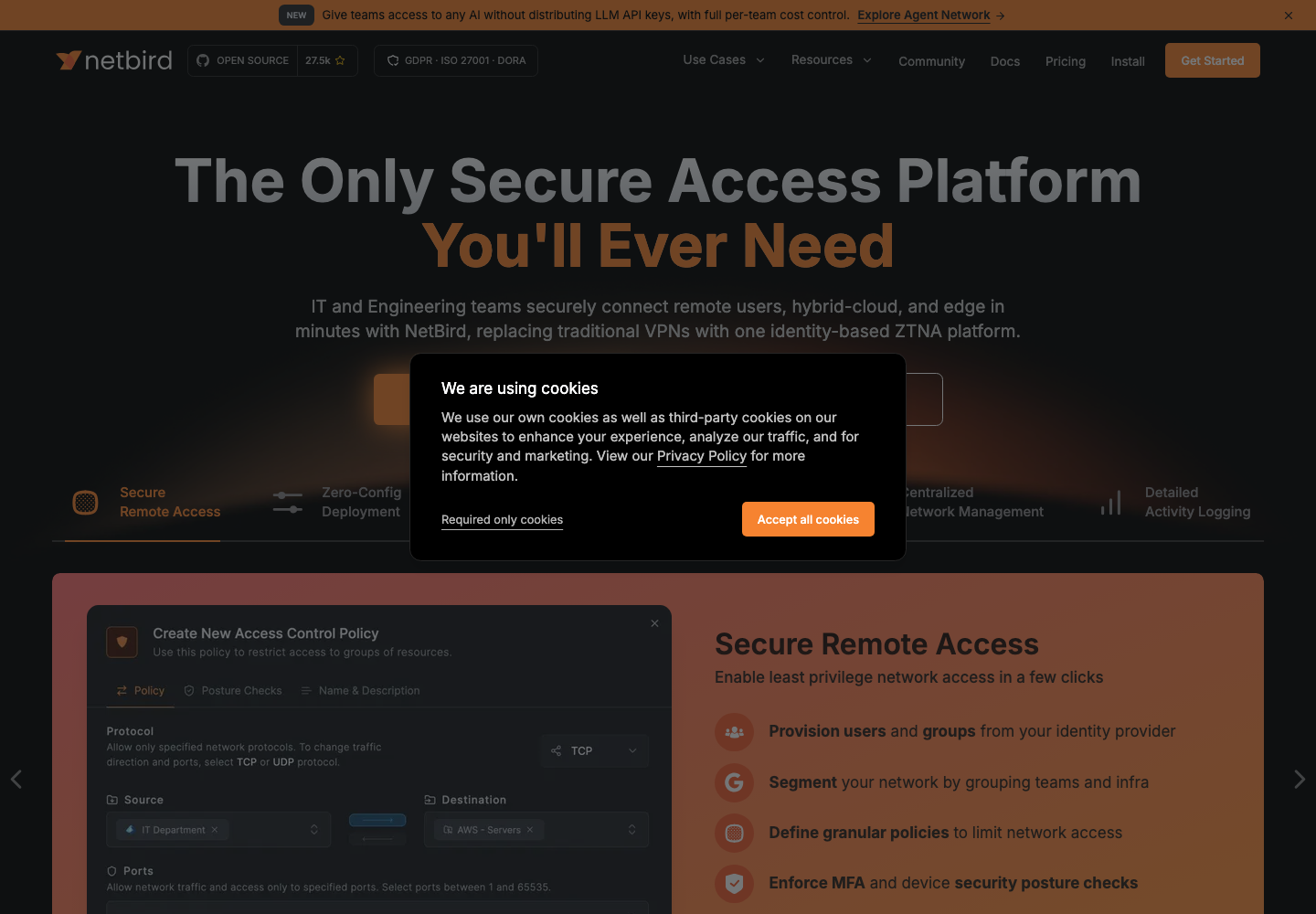
- NetBird at a glance
- What NetBird is designed to do
- The part I like most
- Core features and buyer value
- The catch
- NetBird pricing in 2026
- Who should use NetBird?
- How I would test NetBird
- NetBird alternatives
- Related reading for this decision
- My final verdict
- Frequently asked questions
NetBird at a glance
| Question | Answer |
|---|
| What is it? | open-source zero-trust networking and secure remote access software |
| Best for | technical teams connecting distributed users, infrastructure, private services and sites through zero-trust network access |
| Less suitable for | organisations needing a fully outsourced managed security service or advanced application-layer controls beyond network access |
| Pricing | Sales-led unless stated otherwise below |
| Review access | Public-evidence first look; no authenticated workspace |
| Main buying test | Prove accurate, governed outcomes on representative work |
What NetBird is designed to do
The product is designed around five buyer jobs:
- Create encrypted peer-to-peer connectivity with WireGuard
- Control access through users, groups and network policies
- Connect private networks and sites through routes
- Apply device approval and posture requirements
- Choose managed cloud or self-hosted control infrastructure
The part I like most
Identity-aware network access with an open-source option is a combination I would take seriously for a VPN replacement.
- Transparent public cloud pricing and free tier
- Open-source software and a self-hosting route
- WireGuard offers a well-understood encrypted transport
- Usage-based billing charges for active rather than merely synced users
Core features and buyer value
WireGuard-based network
NetBird builds encrypted connectivity over WireGuard and coordinates peers through a management plane. Buyers should test direct and relayed paths, latency, MTU behaviour and connectivity behind restrictive NAT and firewalls.
Identity and access controls
SSO, MFA, groups and policies let teams express who can reach which resources. Review default access, rule conflicts, service identities and what happens when the identity provider is unavailable.
Routes, DNS and site connectivity
Network routes and private DNS support access to resources that cannot run a peer directly. Test overlapping networks, DNS split-horizon, route failover and the blast radius of a routing peer.
Device posture and integrations
Business features include device approval, posture checks and MDM or EDR controls. Confirm supported signals and how quickly revoked or non-compliant devices lose access.
Cloud and self-hosting
The managed service reduces control-plane operations, while self-hosting offers more infrastructure control. Self-hosting also transfers upgrades, availability, database backup and support responsibility to the buyer.
The catch
An encrypted route does not replace application authorisation, and self-hosting moves operating responsibility to the team.
- Networking edge cases still require skilled troubleshooting
- Self-hosting creates operational responsibility
- Network access does not replace application authorisation
- Machine-heavy and user-heavy estates can have very different economics
NetBird pricing in 2026
Pricing evidence was recorded on 20 July 2026. The figures and plan descriptions below are historical research, not a newly verified quote. Confirm current terms with NetBird before budgeting.
NetBird’s public cloud pricing lists Free at $0 for up to five users and 100 machines, Team at $6 per active user monthly, Business at $12, and custom Enterprise. Team and Business include a 100-machine base plus ten machines per paid user; additional machines are listed at $0.50 monthly. Verify currency, taxes, active-user definitions and current self-hosted commercial terms.
Who should use NetBird?
NetBird is best suited to technical teams connecting distributed users, infrastructure, private services and sites through zero-trust network access.
It is less suitable for organisations needing a fully outsourced managed security service or advanced application-layer controls beyond network access.
How I would test NetBird
For NetBird, my proposed test would use this scenario rather than begin with a production rollout:
An engineer needs access to a private database. NetBird authenticates the user, checks approved device posture, applies a least-privilege policy, resolves the private name and creates an encrypted route. Logs show the connection, while removal from the identity group revokes future access.
NetBird alternatives
| Alternative | Consider it when |
|---|
| Tailscale | A polished WireGuard mesh and broad ecosystem are preferred |
| Cloudflare Zero Trust | Application access, web gateway and a global edge need one vendor |
| ZeroTier | Virtual networking and layer-two-style use cases dominate |
| Teleport | Audited access to servers, Kubernetes and databases is central |
| Traditional VPN | Existing network architecture and appliance controls are sufficient |
Before adding NetBird to a shortlist, I would write down the job, the current alternative and the evidence needed to justify a change. Our guide to a requirements-first approach to choosing AI tools.
For NetBird, I would also count the existing tools, review time and operating work that remain after adoption. Our guide to a framework for reviewing overlapping software costs.
I would use the AI Tool Chooser to organise the shortlist around requirements before a vendor discussion. It does not replace the product-specific, technical or professional validation described for NetBird.
For related engineering buying decisions, I would also read our Adapter Labs review and Blocks review. These are adjacent evaluations, not a claim that every product replaces NetBird.
My final verdict
I would put NetBird on a conditional shortlist for technical teams connecting distributed users, infrastructure, private services and sites through zero-trust network access.
An encrypted route does not replace application authorisation, and self-hosting moves operating responsibility to the team.
Frequently asked questions
Is NetBird open source?
Yes. NetBird provides open-source components and both managed and self-hosted deployment paths.
How much does NetBird cost?
The public cloud plans list Free, $6 Team, $12 Business and custom Enterprise pricing per active user monthly.
Is NetBird a VPN?
It can replace many VPN use cases, but it is designed as identity-aware zero-trust networking over WireGuard.
Was this NetBird review hands-on?
No. It is a research-based first look using official public evidence. No authenticated workspace or production integration was tested.
Did NetBird pay for inclusion?
No commercial relationship was disclosed for this review, and no rating was assigned.

Tolu S.
Operations Lead, AI Search & GEO
Leads operations for AI search visibility and generative engine optimization (GEO) campaigns.