Table of Contents
- The review in 30 seconds
- Why Airweave exists
- The part I like most
- What Airweave appears to do well
- The catch
- Airweave pricing: what the numbers actually mean
- What makes me cautious about security and control
- What looks strong—and what still needs proving
- How I would test Airweave
- Airweave alternatives
- Who should actually use Airweave?
- The funding context
- Final verdict
- Frequently asked questions
Most AI-agent demos look impressive right up until the agent needs to know something that happened inside your company yesterday. Then the real work begins: connectors, permissions, synchronization and deciding which version of the truth the agent should trust. Airweave is built for that unglamorous part.
Airweave is open-source context retrieval infrastructure for AI agents.
My short take: Shortlist Airweave if your team is rebuilding the same data connections for several agents. Do not choose it because the connector count looks impressive. Give it your messiest three sources and see whether it still tells the truth.
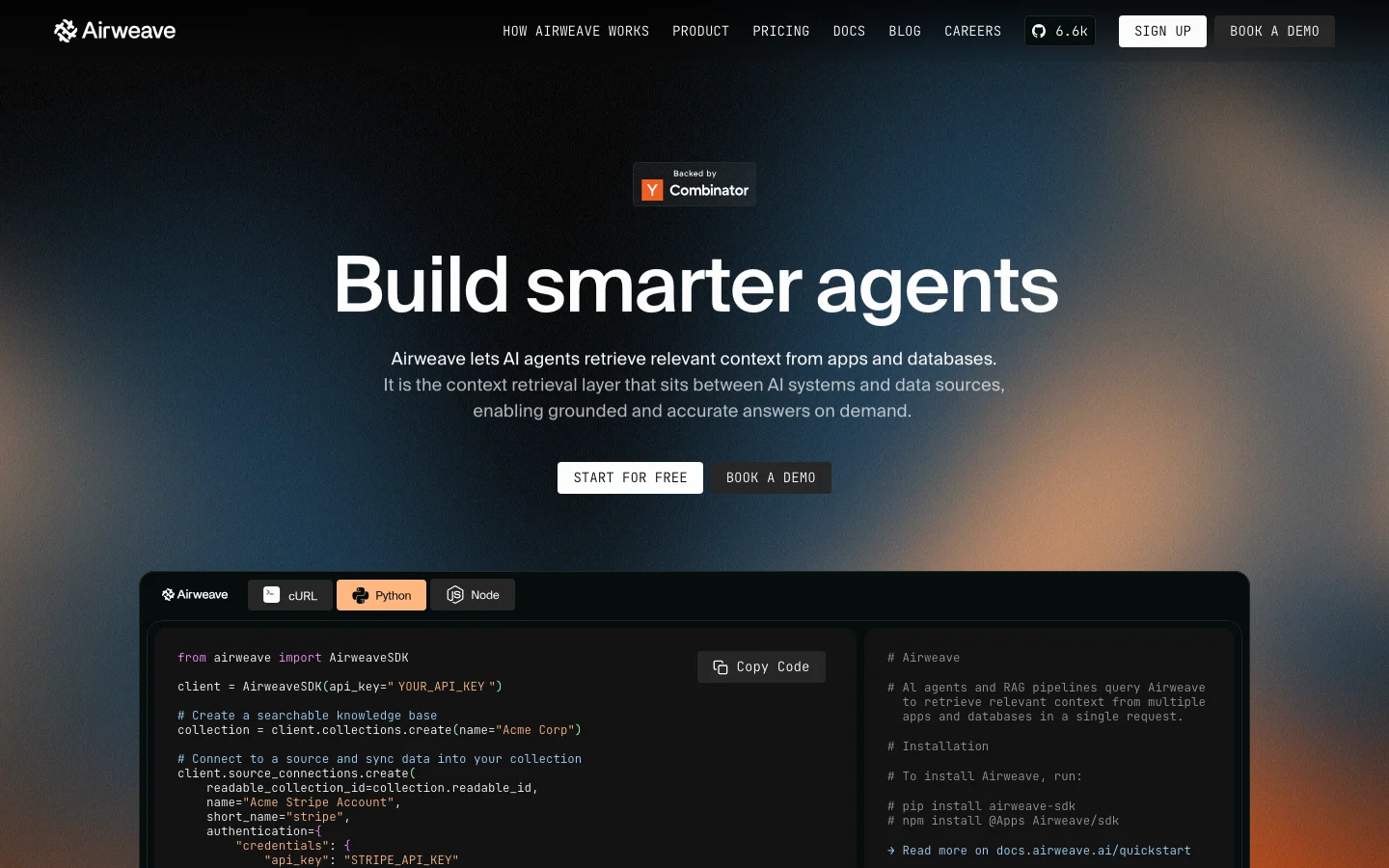
This is Airweave's real first-party homepage, captured on 27 October 2026—not a generated product mock-up.
The review in 30 seconds
| The question | My answer |
|---|---|
| What is it? | open-source context retrieval infrastructure for AI agents |
| What is the interesting part? | Airweave treats connectors as reusable infrastructure instead of a feature checklist inside one chatbot. |
| What would I test first? | A support-agent team creates one collection, connects Zendesk, Slack and Google Drive, then asks a hidden set of known-answer questions. |
| What is the biggest concern? | Retrieval quality is the whole product. |
| How much does it cost? | Developer is free; Pro starts at $16 per month; Startup starts at $239 per month; Enterprise is custom |
| Who should shortlist it? | developers and AI platform teams building agents or RAG applications that need reusable retrieval across multiple business systems |
Why Airweave exists
The model is rarely the hardest part of an internal AI product. The harder problem is getting current, permitted information from many changing systems into the model at the right moment. Airweave sits between those sources and the application so several agents can share one retrieval foundation.
In practical terms, it is trying to help teams:
- Connect agents to SaaS applications, databases and document stores
- Normalize changing source data into searchable entities
- Keep retrieved context current through incremental synchronization
- Expose unified search through APIs, SDKs and agent tooling
- Offer hosted, embedded or self-hosted connection workflows
The part I like most
Airweave treats connectors as reusable infrastructure instead of a feature checklist inside one chatbot. If a company is building support, sales and research agents, connecting Slack or Google Drive once is much more sensible than rebuilding authorization and ingestion three times.
That is the idea that earns Airweave a place on a shortlist. The rest of the evaluation is about whether the implementation can support it without creating a new operational problem.
What Airweave appears to do well
Connectors and source synchronization
Airweave documents connectors for productivity systems, cloud storage, developer tools, CRM, email, calendars, support systems and payments. Each connector handles authentication, extraction, entity mapping and incremental sync. The buyer test is whether permissions, deletions, attachments, pagination and source-specific edge cases survive that abstraction.
Unified context retrieval
Collections let applications search across connected sources through one layer. This can remove bespoke ingestion work, but retrieval should be evaluated with a labelled question set that includes current facts, conflicting records, permission boundaries and information that has just changed at the source.
Airweave Connect
The hosted embeddable widget lets a product expose connection and reauthentication flows without building every OAuth interface. Short-lived session tokens, collection scoping, origin validation and restricted integration lists are useful controls; buyers should still validate tenant isolation and credential lifecycle in their own architecture.
Open-source and self-hosted deployment
Airweave can be self-hosted, which can improve deployment control and code inspection. Self-hosting also transfers upgrade, backup, secret management, monitoring and incident responsibilities. Compare the managed and self-hosted paths on total engineering cost, not licence price alone.
Developer interfaces and framework fit
Public material shows Python and Node SDKs plus compatibility with agent and workflow stacks. Test the interfaces your application will actually use, including error handling, rate limits, retries, provenance fields and behaviour when a connector is partially unavailable.
The catch
Retrieval quality is the whole product. A large connector catalogue does not prove that moved files, deleted permissions, conflicting records and partial sync failures behave correctly. If the retrieval layer confidently returns stale context, the agent produces a polished wrong answer.
That does not make the product a bad choice. It identifies the exact claim the pilot needs to prove. A polished demonstration is useful for learning the interface; it is not evidence that the difficult cases work.
Airweave pricing: what the numbers actually mean
Airweave publishes monthly and annual plans. At the time of verification, Developer was free with 10 source connections, 50 queries per month and 50,000 synced entities. Pro was $16 per month with 50 connections, 500 queries, 100,000 entities and two team members. Startup was $239 per month with 1,000 connections, 5,000 queries, one million entities and ten members. Enterprise used custom limits and could add on-premises deployment, SSO, RBAC and SLAs. Confirm whether listed prices are monthly-billed rates and how overages, storage, model use and custom connectors are charged.
The published price is only the beginning of the cost. I would also model implementation, usage, storage, integrations, human review and the work required when something fails. When model or API consumption matters, the AI Token and API Cost Calculator can help turn expected volume into a range rather than a guess.
What makes me cautious about security and control
Airweave may hold credentials and index sensitive business content, so map source permissions into retrieval tests. Verify encryption, secret storage, credential rotation, tenant isolation, deletion propagation, audit logs, subprocessors and whether each result preserves source identity and access context. For self-hosting, define who patches the deployment and monitors failed syncs.
I would request the current security pack and map every credential, data type, automated action and deletion path before production access. The important question is not whether the vendor has a security page; it is whether the purchased plan and proposed architecture satisfy the team's real boundary.
What looks strong—and what still needs proving
What looks strong:
- Public entry pricing makes early cost modelling practical
- A broad connector layer can replace repeated integration work
- Open-source and self-hosted options create meaningful deployment choice
- The embeddable Connect workflow addresses end-user authorization as a product problem
What still needs proving:
- Connector count does not prove field, permission or deletion fidelity
- Hosted retrieval introduces a sensitive data and credential boundary
- Usage limits span connections, queries and entities, so cost can scale on several axes
- Self-hosting reduces vendor dependence but increases operational ownership
This is the useful dividing line between marketing and a buying decision. The strengths explain why the product is interesting. The unresolved points determine whether it is safe and economical for this particular team.
How I would test Airweave
A support-agent team creates one collection, connects Zendesk, Slack and Google Drive, then asks a hidden set of known-answer questions. Reviewers score factual accuracy, source provenance, permission enforcement and freshness after changing or deleting source records. Only after that retrieval gate passes should the agent be allowed to draft or take actions.
I would include normal work, edge cases and known failures, then record completion, serious errors, human corrections, latency and full cost. Preserve the same input set so another product can be tested on equal terms. The AI Tool Chooser can help turn those requirements into a consistent shortlist before the pilot starts.
Airweave alternatives
| Consider | When it makes more sense |
|---|---|
| Unstructured | document ingestion and transformation are the main bottleneck |
| LlamaIndex | the team wants a broader framework for indexing, retrieval and agent workflows |
| Composio | agent tool actions and managed authentication matter more than retrieval alone |
| LangChain | the team prefers to assemble retrieval and orchestration directly in an application framework |
| A custom pipeline | the source set is small and strict control justifies maintaining integrations internally |
The feature labels may look similar, but the operating model can be completely different. Test the closest two options on the same work rather than comparing screenshots and plan names.
If the shortlist is already becoming another stack of overlapping subscriptions, our guide to why companies pay for too many AI tools explains the consolidation questions to ask. For a broader selection framework, which AI tool should I use for my business? separates useful fit from feature-count noise.
For adjacent examples, read our Dust review and Reco review.
Who should actually use Airweave?
Airweave makes the most sense for developers and AI platform teams building agents or RAG applications that need reusable retrieval across multiple business systems.
It is a weaker fit for teams with one static data source, no engineering owner, or a requirement for a fully managed knowledge application rather than retrieval infrastructure. In that situation, a narrower product, an existing platform feature or a better manual process may solve the problem with less integration and governance work.
Software solves an operating problem; it does not automatically make a SaaS company discoverable. Teams that also need buyers and AI answer engines to find their product can review our AEO and AI visibility service as a separate acquisition decision.
The funding context
Airweave announced a $6 million seed round on 2 July 2025 led by FCVC, with participation from LUX Capital, Y Combinator, Orange Collective, Pioneer Fund, Shay Banon and other investors. The announcement describes the amount as a seed round; this review does not silently add YC’s standard investment again or present funding as proof of product quality.
Funding can help a company build the expensive parts of the product. It does not establish reliability, security or customer fit, so it is context—not part of the verdict.
Final verdict
Airweave is a credible shortlist candidate for developers who need agents to retrieve current context across many SaaS tools without maintaining every connector themselves. Its open-source option, broad connector catalogue and transparent entry pricing are strengths; retrieval quality, permission fidelity, sync freshness and operating cost still need workload-specific testing.
My recommendation: Shortlist Airweave if your team is rebuilding the same data connections for several agents. Do not choose it because the connector count looks impressive. Give it your messiest three sources and see whether it still tells the truth.
Frequently asked questions
What is Airweave?
Airweave is a context-retrieval layer that connects AI agents and RAG applications to data in SaaS tools, databases and document stores.
How much does Airweave cost?
Airweave had a free Developer plan, a $16-per-month Pro plan and a $239-per-month Startup plan when checked on 27 October 2026. Enterprise pricing was custom.
Is Airweave open source?
Yes. Airweave presents itself as open source and supports self-hosting as well as a hosted platform.
How much funding has Airweave raised?
Airweave announced a $6 million seed round in July 2025. The announcement verifies that round amount; this review does not claim a larger cumulative total.
Was this Airweave review hands-on?
No. This is a research-based first-look review using official public evidence. We did not test an authenticated Airweave workspace or connect production data.
Did Airweave pay for inclusion?
No disclosed commercial relationship or payment influenced this review, and no numeric rating was assigned.

Tolu S.
Operations Lead, AI Search & GEO
Leads operations for AI search visibility and generative engine optimization (GEO) campaigns.