Table of Contents
- The review in 30 seconds
- Why Sentrial exists
- The part I like most
- What Sentrial appears to do well
- The catch
- Sentrial pricing: what the numbers actually mean
- What makes me cautious about security and control
- What looks strong—and what still needs proving
- How I would test Sentrial
- Sentrial alternatives
- Who should actually use Sentrial?
- The funding context
- Final verdict
- Frequently asked questions
Traditional monitoring tells you when an API is slow or a process crashes. It usually does not tell you that an agent is looping politely, inventing a tool argument or frustrating a customer while every service remains green. Sentrial is built for that gap.
Sentrial is production monitoring, evaluation and debugging software for AI agents.
My short take: Sentrial is worth a trial for production-agent teams that have outgrown ordinary logs. Bring labelled examples of loops, bad tool calls and hallucinations. The $10 Developer plan is an easy entry; make sure the value justifies the jump to the $450 Startup tier before expanding.
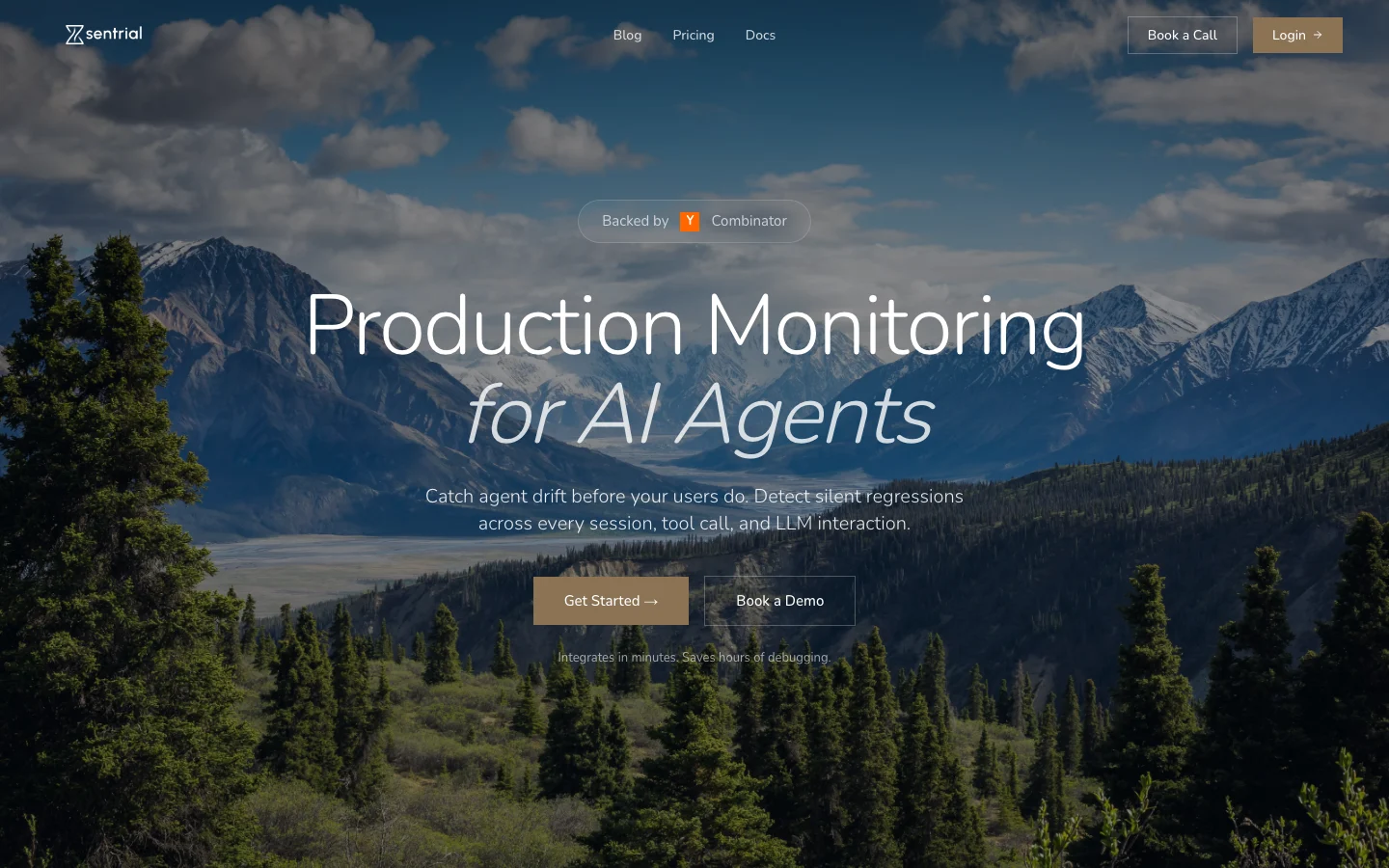
This is Sentrial's real first-party homepage, captured on 27 October 2026—not a generated product mock-up.
The review in 30 seconds
| The question | My answer |
|---|---|
| What is it? | production monitoring, evaluation and debugging software for AI agents |
| What is the interesting part? | Sentrial brings tracing, assertions, prompt experiments and alerts into one workflow. |
| What would I test first? | A production-agent team instruments one service and imports a labelled sample containing clean sessions, tool timeouts, invalid arguments, frustration and hallucinated claims. |
| What is the biggest concern? | Semantic detection is only useful when teams know its miss rate and false-alert rate. |
| How much does it cost? | Developer $10/month; Startup $450/month; Enterprise custom |
| Who should shortlist it? | engineering teams running production AI agents that need to detect behavioural regressions, diagnose tool failures and compare prompt or model changes |
Why Sentrial exists
Agent reliability includes behaviour, not only infrastructure. Teams need the trace, a way to flag semantic failures, an experiment framework for changes and an incident path that connects the alert back to the code or prompt involved.
In practical terms, it is trying to help teams:
- Trace agent sessions, tool calls, model interactions, latency and token cost
- Define assertions for hallucinations, loops, frustration and tool misuse
- Compare prompts, models and configurations on production outcomes
- Alert teams when behavioural or technical failures spike
- Connect recurring failures to likely code and prompt causes
The part I like most
Sentrial brings tracing, assertions, prompt experiments and alerts into one workflow. The components reinforce each other: a production failure can become an assertion, the assertion can guard an experiment and the alert can link back to the exact session.
That is the idea that earns Sentrial a place on a shortlist. The rest of the evaluation is about whether the implementation can support it without creating a new operational problem.
What Sentrial appears to do well
Session tracing
Sentrial presents a timeline of user inputs, tool calls and model responses with latency and token information. A pilot should test trace completeness, correlation across services, sampling, redaction and whether reviewers can reconstruct the exact state that produced an outcome.
Assertions and regression flags
Teams can define automated checks for behaviours such as repeated prompts, invalid tool arguments or goal abandonment. Evaluate each assertion on labelled positive and negative examples, and separate high-severity misses from noisy false alerts.
Production prompt experiments
The public product shows side-by-side prompt or configuration variants with success and latency measures. Experiments need stable assignment, clear outcomes, sufficient sample size and guardrails that prevent a cheaper or faster variant from silently reducing safety or task quality.
Slack alerts and incident workflow
Sentrial can notify teams when tool timeouts, error spikes or unusual behaviour appear. Test deduplication, acknowledgement, ownership and links back to the exact traces so alerts reduce diagnosis time instead of creating another queue.
Code-linked diagnosis
The product positions failure evidence alongside relevant files and functions. Treat suggested causes and fixes as hypotheses until an engineer reproduces the issue and tests the change; a plausible explanation is not proof of root cause.
The catch
Semantic detection is only useful when teams know its miss rate and false-alert rate. An impressive “user frustration” detector can still ignore subtle failures or create so much noise that engineers mute the channel.
That does not make the product a bad choice. It identifies the exact claim the pilot needs to prove. A polished demonstration is useful for learning the interface; it is not evidence that the difficult cases work.
Sentrial pricing: what the numbers actually mean
Sentrial lists Developer at $10 per month with 10,000 traces, basic evaluations and seven-day retention. Startup is $450 per month with one million traces, advanced evaluations, automated issue grouping and 30-day retention. Enterprise is custom and lists unlimited traces, custom retention, a dedicated support channel and VPC deployment options. Confirm trace definitions, overages, seats, environments, experiment limits and whether model or storage costs are included.
The published price is only the beginning of the cost. I would also model implementation, usage, storage, integrations, human review and the work required when something fails. When model or API consumption matters, the AI Token and API Cost Calculator can help turn expected volume into a range rather than a guess.
What makes me cautious about security and control
Agent traces may contain prompts, tool arguments, customer data, credentials and model outputs. Sentrial’s public site did not expose a complete security pack during this review. Before production use, verify encryption, authentication, roles, audit logs, redaction timing, model providers, retention, deletion, regional processing, VPC scope, incident terms and whether customer traces train shared systems.
I would request the current security pack and map every credential, data type, automated action and deletion path before production access. The important question is not whether the vendor has a security page; it is whether the purchased plan and proposed architecture satisfy the team's real boundary.
What looks strong—and what still needs proving
What looks strong:
- Covers behavioural failures that conventional application monitoring can miss
- Combines tracing, assertions, experiments and alerts in one workflow
- The $10 Developer plan lowers the cost of a bounded evaluation
- Public Startup limits make initial volume modelling possible
What still needs proving:
- Semantic detectors must be validated for misses and false alerts
- The price jumps from $10 Developer to $450 Startup
- Public security and compliance detail is limited
- Suggested root causes and fixes still require engineering reproduction
This is the useful dividing line between marketing and a buying decision. The strengths explain why the product is interesting. The unresolved points determine whether it is safe and economical for this particular team.
How I would test Sentrial
A production-agent team instruments one service and imports a labelled sample containing clean sessions, tool timeouts, invalid arguments, frustration and hallucinated claims. It configures assertions, routes high-severity alerts to a test Slack channel and runs one controlled prompt experiment. Reviewers measure trace coverage, detection precision and recall, alert delay, diagnosis time and cost per monitored session.
I would include normal work, edge cases and known failures, then record completion, serious errors, human corrections, latency and full cost. Preserve the same input set so another product can be tested on equal terms. The AI Tool Chooser can help turn those requirements into a consistent shortlist before the pilot starts.
Sentrial alternatives
| Consider | When it makes more sense |
|---|---|
| The Context Company | production pattern clustering and product insight are the priority |
| Langfuse | open-source tracing and prompt lifecycle tooling are required |
| Braintrust | offline datasets, evaluation and CI release gates lead the decision |
| Arize Phoenix | open-source observability and evaluation fit the existing stack |
| Datadog LLM Observability | the team wants agent telemetry inside its broader operations platform |
The feature labels may look similar, but the operating model can be completely different. Test the closest two options on the same work rather than comparing screenshots and plan names.
If the shortlist is already becoming another stack of overlapping subscriptions, our guide to why companies pay for too many AI tools explains the consolidation questions to ask. For a broader selection framework, which AI tool should I use for my business? separates useful fit from feature-count noise.
For adjacent examples, read our The Context Company review and Bluejay review.
Who should actually use Sentrial?
Sentrial makes the most sense for engineering teams running production AI agents that need to detect behavioural regressions, diagnose tool failures and compare prompt or model changes.
It is a weaker fit for teams without production traffic, organisations needing mature public compliance documentation before a trial, or simple chatbot projects adequately covered by existing logs. In that situation, a narrower product, an existing platform feature or a better manual process may solve the problem with less integration and governance work.
Software solves an operating problem; it does not automatically make a SaaS company discoverable. Teams that also need buyers and AI answer engines to find their product can review our AEO and AI visibility service as a separate acquisition decision.
The funding context
Sentrial is listed by Y Combinator in the Winter 2026 batch. YC’s standard investment is $500,000 for accepted companies. No company-confirmed cumulative funding total was found in the reviewed primary sources, so the funding label is “YC standard investment minimum only.”
Funding can help a company build the expensive parts of the product. It does not establish reliability, security or customer fit, so it is context—not part of the verdict.
Final verdict
Sentrial is worth evaluating for teams that need behavioural monitoring around production agents, not only latency and infrastructure telemetry. Its public feature set covers traces, assertions, prompt experiments, alerts and code-linked diagnosis, while a $10 Developer tier lowers trial cost. Buyers still need to validate semantic failure detection, false-alert rates, security controls and the economics of the jump to the $450 Startup plan.
My recommendation: Sentrial is worth a trial for production-agent teams that have outgrown ordinary logs. Bring labelled examples of loops, bad tool calls and hallucinations. The $10 Developer plan is an easy entry; make sure the value justifies the jump to the $450 Startup tier before expanding.
Frequently asked questions
What is Sentrial?
Sentrial is production monitoring, evaluation and debugging software designed for AI-agent sessions and behavioural failures.
How much does Sentrial cost?
Developer was $10 per month, Startup was $450 per month and Enterprise was custom when checked on 27 October 2026.
Can Sentrial run prompt experiments?
Yes. Its public product page presents production A/B tests for prompts, models and configurations alongside success and latency measures.
How much funding has Sentrial raised?
Sentrial is a Winter 2026 YC company and passes YC’s $500,000 standard investment threshold. We did not find a company-confirmed cumulative total.
Was this Sentrial review hands-on?
No. This is a research-based first-look review using official public evidence. We did not test an authenticated Sentrial workspace or connect production data.
Did Sentrial pay for inclusion?
No disclosed commercial relationship or payment influenced this review, and no numeric rating was assigned.

Tolu S.
Operations Lead, AI Search & GEO
Leads operations for AI search visibility and generative engine optimization (GEO) campaigns.