Table of Contents
- The review in 30 seconds
- Why HelixDB exists
- The part I like most
- What HelixDB appears to do well
- The catch
- HelixDB pricing: what the numbers actually mean
- What makes me cautious about security and control
- What looks strong—and what still needs proving
- How I would test HelixDB
- HelixDB alternatives
- Who should actually use HelixDB?
- The funding context
- Final verdict
- Frequently asked questions
Agent memory becomes awkward when relationships live in a graph database, semantic similarity lives in a vector store and exact text lives somewhere else. Every extra system creates a synchronization problem before the model sees a single result. HelixDB is trying to put those retrieval modes inside one transactional engine.
HelixDB is open-source graph, vector and full-text database infrastructure for AI retrieval and agent memory.
My short take: HelixDB is worth a prototype when one retrieval path genuinely needs graph relationships plus semantic or text search. Start with the Apache-licensed local version and your hardest query shape; move to Cloud only after correctness, p99 latency, migration and failure recovery are understood.
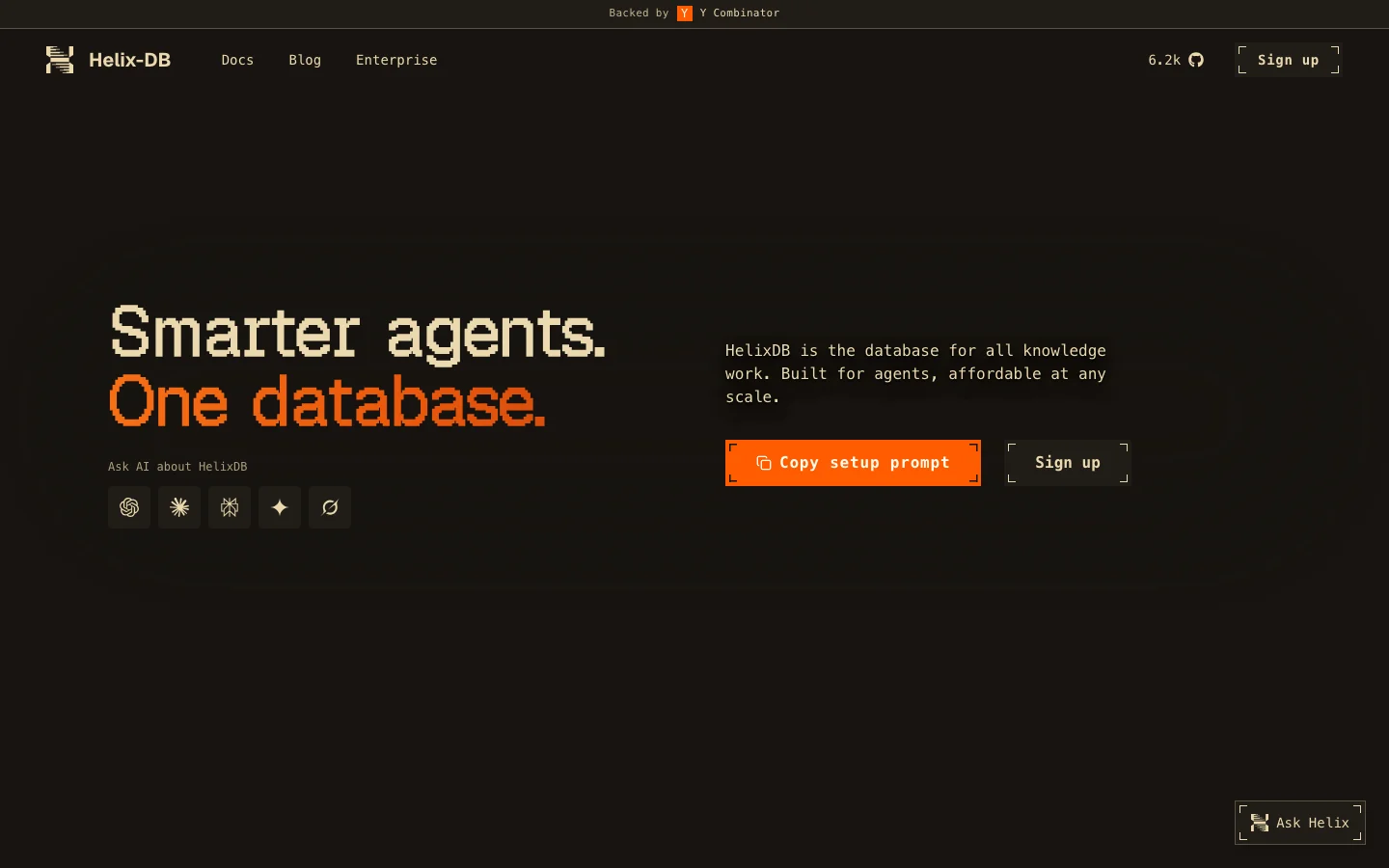
This is HelixDB's real first-party homepage, captured on 27 October 2026—not a generated product mock-up.
The review in 30 seconds
| The question | My answer |
|---|---|
| What is it? | open-source graph, vector and full-text database infrastructure for AI retrieval and agent memory |
| What is the interesting part? | The most interesting capability is graph-scoped retrieval in one transaction. |
| What would I test first? | A team models one production retrieval path with graph relationships, tenant filters, vectors and text. |
| What is the biggest concern? | Database benchmarks are unusually easy to make flattering. |
| How much does it cost? | Apache 2.0 self-hosting and embedding free; Cloud starts at $5/month for 200,000 reads and 100,000 writes; dedicated Growth clusters billed hourly |
| Who should shortlist it? | engineering teams building agent memory, GraphRAG, recommendations or permission-aware retrieval that need graph, vector and full-text operations in the same query path |
Why HelixDB exists
AI retrieval increasingly needs more than nearest-neighbour search. An agent may need only documents a user can access, connected to one account, matching a phrase and semantically related to the current request. HelixDB combines graph traversal, approximate vector search and BM25 text search so that filtering and ranking can share one snapshot.
In practical terms, it is trying to help teams:
- Store connected entities, embeddings and searchable text in one engine
- Run graph traversals with vector and BM25 ranking in one request
- Enforce tenant or permission scope before semantic retrieval
- Support local, embedded, self-hosted and managed-cloud deployment
- Expose typed SDK, HTTP and MCP interfaces to applications and agents
The part I like most
The most interesting capability is graph-scoped retrieval in one transaction. A traversal can define the exact permitted candidate set before vector or text ranking runs, avoiding an application-layer join between separate systems and reducing the risk that ranking searches data outside the intended tenant boundary.
That is the idea that earns HelixDB a place on a shortlist. The rest of the evaluation is about whether the implementation can support it without creating a new operational problem.
What HelixDB appears to do well
Graph, vector and full-text retrieval
HelixDB stores vectors on graph entities and supports BM25 text search, allowing one request to combine relationships, properties and ranking. Build correctness tests for ties, empty candidate sets, high-degree hubs and filters that exclude the globally nearest vector.
Transactions and consistency
The homepage states that each request is an ACID transaction with serializable snapshot isolation across graph, vector and text operations. Conflicting writes fail at commit. Helix Cloud readers may briefly lag the writer, so test writer-only read-after-write paths and retry behaviour for agent memory updates.
SDK and query model
Official SDKs cover Rust, TypeScript, Python and Go, with operation-tree queries sent through the SDK or JSON API. The earlier HelixQL is archived. Evaluate type safety, migrations, explainability, bulk ingestion, errors, cancellation and whether query construction remains maintainable as retrieval logic grows.
Deployment choices
The same query model can run embedded, as a local container or in Helix Cloud. That creates a useful adoption path, but parity needs proof around storage, backups, upgrades, high availability and limits. Self-hosting is free in licence cost but not in operational ownership.
Agent and MCP interfaces
HelixDB supplies agent skills, documentation endpoints and a hosted MCP server for Cloud. Public material says MCP writes and administrative changes require confirmation. Confirm identity mapping, service credentials, read boundaries, confirmation semantics and audit evidence before agents receive database access.
The catch
Database benchmarks are unusually easy to make flattering. HelixDB publishes reproducible material, but the headline comparisons are still vendor-run and omit parts of the operational workload. Buyers must measure cold starts, mixed writes, memory, recovery, skewed graphs, recall and tail latency on their own data.
That does not make the product a bad choice. It identifies the exact claim the pilot needs to prove. A polished demonstration is useful for learning the interface; it is not evidence that the difficult cases work.
HelixDB pricing: what the numbers actually mean
HelixDB is Apache 2.0 software, so embedding or self-hosting has no licence fee. Helix Cloud starts at $5 per month and lists 200,000 reads, 100,000 writes and unlimited storage with opt-in overage. The Growth path provides a dedicated cluster billed by the hour. The terms describe pay-as-you-go credits that may cover compute, memory, storage, egress, backups and other resources, so obtain the current rate card and model steady-state, burst, backup, egress and idle-cluster cost before production.
The published price is only the beginning of the cost. I would also model implementation, usage, storage, integrations, human review and the work required when something fails. When model or API consumption matters, the AI Token and API Cost Calculator can help turn expected volume into a range rather than a guess.
What makes me cautious about security and control
Helix Cloud uses read-only or read-write API keys for direct gateway requests, with immediate rotation or revocation, while MCP and CLI use WorkOS sign-in or scoped service credentials. The company states TLS in transit and server-side encryption at rest. SSO/SAML, RBAC, audit logs and AWS PrivateLink are described as roadmap items, which can be decisive for enterprise deployment. Verify region, backup encryption, administrator access, deletion timing, incident response and whether self-hosting is the safer interim boundary.
I would request the current security pack and map every credential, data type, automated action and deletion path before production access. The important question is not whether the vendor has a security page; it is whether the purchased plan and proposed architecture satisfy the team's real boundary.
What looks strong—and what still needs proving
What looks strong:
- Unifies graph traversal, vector similarity and full-text search
- Uses one transactional snapshot for several retrieval modes
- Apache 2.0 licensing and local deployment lower prototype friction
- A $5 managed-cloud entry and common SDKs make evaluation accessible
What still needs proving:
- Headline performance comparisons are vendor-run and workload-sensitive
- Several enterprise identity and private-network controls remain on the roadmap
- Cloud readers can briefly lag the writer unless a writer-only path is used
- An early database requires careful assessment of operations, recovery and ecosystem maturity
This is the useful dividing line between marketing and a buying decision. The strengths explain why the product is interesting. The unresolved points determine whether it is safe and economical for this particular team.
How I would test HelixDB
A team models one production retrieval path with graph relationships, tenant filters, vectors and text. It imports a realistic skewed dataset, records brute-force ground truth and compares HelixDB with the current stack under cold, warm and mixed read-write loads. Reviewers measure recall, p50/p95/p99 latency, resource use, recovery, write conflicts and the effort required to operate or migrate the system.
I would include normal work, edge cases and known failures, then record completion, serious errors, human corrections, latency and full cost. Preserve the same input set so another product can be tested on equal terms. The AI Tool Chooser can help turn those requirements into a consistent shortlist before the pilot starts.
HelixDB alternatives
| Consider | When it makes more sense |
|---|---|
| PostgreSQL with pgvector and graph modelling | the team prefers one mature operational system and modest graph depth |
| Neo4j | a mature property-graph ecosystem and graph tooling matter more than native hybrid simplicity |
| Weaviate | managed vector search and hybrid semantic retrieval lead the requirement |
| Qdrant | vector performance, filtering and a mature open-source vector engine are sufficient |
| A separate graph and vector stack | independent scaling and best-of-breed engines justify synchronization complexity |
The feature labels may look similar, but the operating model can be completely different. Test the closest two options on the same work rather than comparing screenshots and plan names.
If the shortlist is already becoming another stack of overlapping subscriptions, our guide to why companies pay for too many AI tools explains the consolidation questions to ask. For a broader selection framework, which AI tool should I use for my business? separates useful fit from feature-count noise.
For adjacent examples, read our Airweave review and The Context Company review.
Who should actually use HelixDB?
HelixDB makes the most sense for engineering teams building agent memory, GraphRAG, recommendations or permission-aware retrieval that need graph, vector and full-text operations in the same query path.
It is a weaker fit for ordinary CRUD applications, teams satisfied with PostgreSQL extensions or buyers requiring mature enterprise identity, audit and private-network features today. In that situation, a narrower product, an existing platform feature or a better manual process may solve the problem with less integration and governance work.
Software solves an operating problem; it does not automatically make a SaaS company discoverable. Teams that also need buyers and AI answer engines to find their product can review our AEO and AI visibility service as a separate acquisition decision.
The funding context
HelixDB is listed by Y Combinator in the Spring 2025 batch. YC’s standard deal invests $500,000 in accepted companies. We did not find a company-confirmed cumulative funding total in the reviewed primary sources, so this review records the YC investment minimum only.
Funding can help a company build the expensive parts of the product. It does not establish reliability, security or customer fit, so it is context—not part of the verdict.
Final verdict
HelixDB offers a technically coherent alternative to stitching together graph, vector and text stores. Apache 2.0 self-hosting, common SDKs, transactional queries and a $5 cloud entry make it unusually easy to investigate. It is still an early database decision: vendor benchmarks need independent reproduction, managed security controls remain uneven and the team must price operational maturity alongside raw query speed.
My recommendation: HelixDB is worth a prototype when one retrieval path genuinely needs graph relationships plus semantic or text search. Start with the Apache-licensed local version and your hardest query shape; move to Cloud only after correctness, p99 latency, migration and failure recovery are understood.
Frequently asked questions
What is HelixDB?
HelixDB is an open-source database that combines graph traversal, vector similarity and BM25 full-text search for AI retrieval and agent memory.
How much does HelixDB cost?
Self-hosting or embedding the Apache 2.0 software is free. Helix Cloud starts at $5 per month for 200,000 reads and 100,000 writes, with usage and dedicated-cluster charges beyond that.
Is HelixDB open source?
Yes. HelixDB states that its repository is Apache 2.0 licensed and can run embedded or self-hosted.
How much funding has HelixDB raised?
HelixDB is a Spring 2025 YC company and passes YC’s $500,000 standard investment threshold. We did not find a company-confirmed cumulative total.
Was this HelixDB review hands-on?
No. This is a research-based first-look review using official public evidence. We did not test an authenticated HelixDB workspace or connect production data.
Did HelixDB pay for inclusion?
No disclosed commercial relationship or payment influenced this review, and no numeric rating was assigned.

Tolu S.
Operations Lead, AI Search & GEO
Leads operations for AI search visibility and generative engine optimization (GEO) campaigns.