Table of Contents
- The review in 30 seconds
- Why Simulithic exists
- The part I like most
- What Simulithic appears to do well
- The catch
- Simulithic pricing: what the numbers actually mean
- What makes me cautious about security and control
- What looks strong—and what still needs proving
- How I would test Simulithic
- Simulithic alternatives
- Who should actually use Simulithic?
- The funding context
- Final verdict
- Frequently asked questions
AI can write a feature faster than a team can describe every way a customer might break it. Traditional end-to-end tests protect known paths, but selectors decay and the missing test is often the one that matters. Simulithic sends simulated users through the product instead of asking engineers to script every click.
Simulithic is AI end-to-end testing and production monitoring across browsers, phones and native applications.
My short take: Simulithic is worth testing for flow-heavy products whose manual QA and brittle browser suites cannot keep up. Run it beside—not instead of—critical deterministic tests, seed dedicated accounts and compare repeated verdicts across the same preview before making it a merge gate.
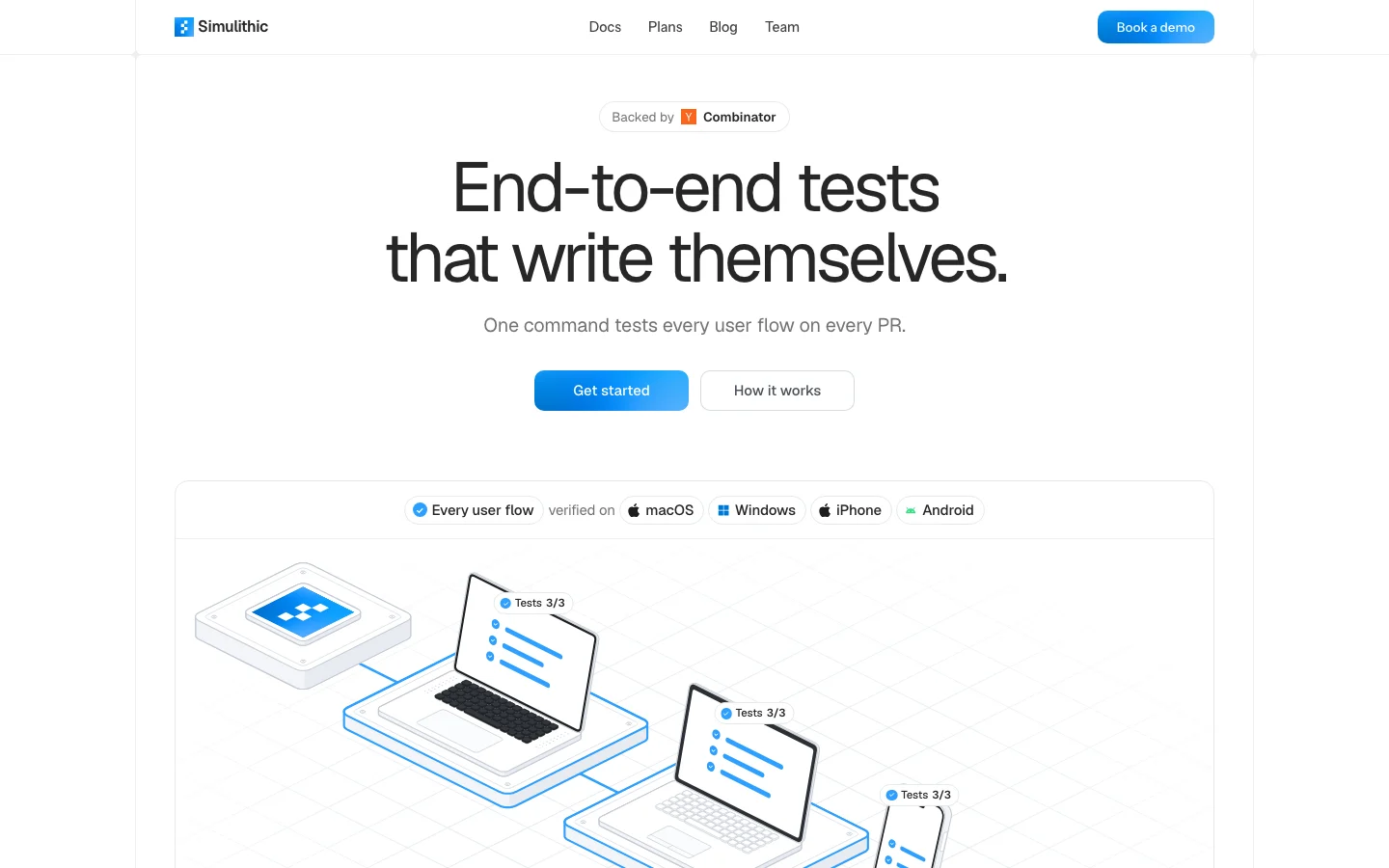
This is Simulithic's real first-party homepage, captured on 27 October 2026—not a generated product mock-up.
The review in 30 seconds
| The question | My answer |
|---|---|
| What is it? | AI end-to-end testing and production monitoring across browsers, phones and native applications |
| What is the interesting part? | Testing the same goal across the device mix real visitors use is the strongest idea. |
| What would I test first? | A team selects five revenue and account-management flows, provides dedicated test identities and keeps existing Playwright assertions. |
| What is the biggest concern? | Adaptive agents trade script maintenance for behavioural uncertainty. |
| How much does it cost? | Starter, Team and Enterprise allowances are public, but dollar prices require the Studio or sales; phone sessions count as three web sessions |
| Who should shortlist it? | web and mobile product teams with many user journeys, frequent interface changes and device-specific failures that are expensive to cover manually |
Why Simulithic exists
Verification is becoming the bottleneck as coding agents increase change volume. Simulithic maps flows, runs agents across browsers and devices, compares preview builds with production and monitors live journeys. It aims to adapt to interface changes while preserving user-goal testing.
In practical terms, it is trying to help teams:
- Discover product flows without hand-writing every test
- Run simulated users across browsers, phones, operating systems and network conditions
- Compare pull-request preview builds with production
- Monitor important flows continuously and alert in Slack
- Provide recordings, steps, reasoning and fix prompts for failures
The part I like most
Testing the same goal across the device mix real visitors use is the strongest idea. A flow can work in desktop Chrome and fail on a budget Android device or slow network; tying execution to observed audience segments makes cross-device coverage less arbitrary.
That is the idea that earns Simulithic a place on a shortlist. The rest of the evaluation is about whether the implementation can support it without creating a new operational problem.
What Simulithic appears to do well
Automatic flow mapping
The explorer presses safe controls and can combine repository context with observed visitor routes. Review the resulting map for missing roles, destructive exclusions and false duplicates. A discovered flow is an inventory candidate, not proof that its outcome is asserted correctly.
Simulated people and personas
Agents carry a task through the interface and can use personas based on actual visitors for UX runs. Repeat identical tests several times and measure outcome variance. Keep objective verification separate from subjective hesitation or abandonment analysis.
Cross-device execution
Runs cover cloud browsers, real Android devices, iOS simulators and Mac apps, with phone sessions weighted at three. Define the actual browser, OS, viewport and network matrix, then check whether the plan allowance sustains the cadence.
Pull-request checks
The GitHub App compares affected flows on the preview build with production and comments on the pull request. Protect the merge gate from flaky verdicts, preview authentication failures and unrelated production incidents; inspect replay evidence before overriding.
Production monitors and evidence
Scheduled agents can repeat flows and alert in Slack, with per-session recordings and issue summaries. Use dedicated accounts, idempotent data and staging for side effects. Verify how captures are tagged and excluded from the rest of the analytics stack.
The catch
Adaptive agents trade script maintenance for behavioural uncertainty. A simulated user can take a different path, misunderstand a goal or declare success too generously. Teams still need deterministic assertions around money, permissions and data integrity, plus evidence that repeated runs are stable.
That does not make the product a bad choice. It identifies the exact claim the pilot needs to prove. A polished demonstration is useful for learning the interface; it is not evidence that the difficult cases work.
Simulithic pricing: what the numbers actually mean
Simulithic publishes allowances but not plan dollar amounts. Starter monitors three flows every four hours with 2,000 monthly web sessions and 30 PR checks. Team monitors ten flows hourly with 8,000 sessions, unlimited checks on changed flows, web and phones, CLI/CI and Slack. Enterprise covers 30 flows, 25,000 sessions, broader devices, SSO and custom cadence. A phone session counts as three. The Studio quotes each run, so model flows × devices × people × cadence and request dollar pricing, overage, retention and cancellation terms.
The published price is only the beginning of the cost. I would also model implementation, usage, storage, integrations, human review and the work required when something fails. When model or API consumption matters, the AI Token and API Cost Calculator can help turn expected volume into a range rather than a guess.
What makes me cautious about security and control
Simulithic may process session behaviour, stored test credentials and production interfaces. It says masking occurs in the visitor browser, excludes passwords and sensitive fields by default, uses TLS and encrypted providers, and lists AWS and Anthropic for simulations. Verify masking against custom components, credential vaulting, tenant isolation, allowed origins, recordings, retention, deletion, model-provider terms, DPA, SSO, incident response and destructive-action prevention.
I would request the current security pack and map every credential, data type, automated action and deletion path before production access. The important question is not whether the vendor has a security page; it is whether the purchased plan and proposed architecture satisfy the team's real boundary.
What looks strong—and what still needs proving
What looks strong:
- Discovers and tests user goals without maintaining every selector script
- Covers browser, phone and native environments with replay evidence
- Connects PR verification and production monitoring
- Uses visitor segments to make device and persona coverage more realistic
What still needs proving:
- Public pages show allowances but not dollar pricing
- Agent behaviour may vary between identical runs
- Synthetic users can create data or side effects without isolation
- Privacy and masking need product-specific validation
This is the useful dividing line between marketing and a buying decision. The strengths explain why the product is interesting. The unresolved points determine whether it is safe and economical for this particular team.
How I would test Simulithic
A team selects five revenue and account-management flows, provides dedicated test identities and keeps existing Playwright assertions. Simulithic runs each flow five times on desktop and phone against production and a seeded faulty preview. Reviewers measure detection, false passes, false failures, variance, execution time, session use and replay clarity before enabling a non-blocking PR check.
I would include normal work, edge cases and known failures, then record completion, serious errors, human corrections, latency and full cost. Preserve the same input set so another product can be tested on equal terms. The AI Tool Chooser can help turn those requirements into a consistent shortlist before the pilot starts.
Simulithic alternatives
| Consider | When it makes more sense |
|---|---|
| Playwright | deterministic browser tests and full code ownership are the priority |
| BrowserStack | a mature cross-browser and real-device cloud is required |
| mabl | low-code testing with established enterprise controls fits better |
| Momentic | AI-assisted web test authoring and maintenance are the main need |
| Docket | vision-first cross-platform testing matches the application |
The feature labels may look similar, but the operating model can be completely different. Test the closest two options on the same work rather than comparing screenshots and plan names.
If the shortlist is already becoming another stack of overlapping subscriptions, our guide to why companies pay for too many AI tools explains the consolidation questions to ask. For a broader selection framework, which AI tool should I use for my business? separates useful fit from feature-count noise.
For adjacent examples, read our Docket review and Bluejay review.
Who should actually use Simulithic?
Simulithic makes the most sense for web and mobile product teams with many user journeys, frequent interface changes and device-specific failures that are expensive to cover manually.
It is a weaker fit for backend-only systems, safety-critical workflows needing fully deterministic assertions or teams unable to provide isolated test accounts and safe environments. In that situation, a narrower product, an existing platform feature or a better manual process may solve the problem with less integration and governance work.
Software solves an operating problem; it does not automatically make a SaaS company discoverable. Teams that also need buyers and AI answer engines to find their product can review our AEO and AI visibility service as a separate acquisition decision.
The funding context
Simulithic is listed by Y Combinator in the Fall 2026 batch. YC’s standard deal invests $500,000 in accepted companies. We did not find a company-confirmed cumulative funding total in the reviewed primary sources, so this review records the YC investment minimum only.
Funding can help a company build the expensive parts of the product. It does not establish reliability, security or customer fit, so it is context—not part of the verdict.
Final verdict
Simulithic offers a compelling verification layer for teams shipping quickly across browsers and phones: automatic flow discovery, PR comparisons, production monitors and session evidence share one system. The deciding risks are repeatability, false passes, synthetic side effects, privacy and commercial pricing, which is described by allowances but not public dollar amounts.
My recommendation: Simulithic is worth testing for flow-heavy products whose manual QA and brittle browser suites cannot keep up. Run it beside—not instead of—critical deterministic tests, seed dedicated accounts and compare repeated verdicts across the same preview before making it a merge gate.
Frequently asked questions
What is Simulithic?
Simulithic runs AI users through product flows across browsers and devices for pull-request checks, on-demand QA and production monitoring.
How much does Simulithic cost?
Simulithic publishes Starter, Team and Enterprise usage allowances but does not display dollar prices publicly. The Studio quotes individual runs and sales scopes plan pricing.
Does Simulithic replace Playwright?
Not entirely. Adaptive users can discover and verify unscripted paths, while deterministic tests remain important for critical rules, permissions and side effects.
How much funding has Simulithic raised?
Simulithic is a Fall 2026 YC company and passes YC’s $500,000 standard investment threshold. We did not find a company-confirmed cumulative total.
Was this Simulithic review hands-on?
No. This is a research-based first-look review using official public evidence. We did not test an authenticated Simulithic workspace or connect production data.
Did Simulithic pay for inclusion?
No disclosed commercial relationship or payment influenced this review, and no numeric rating was assigned.

Tolu S.
Operations Lead, AI Search & GEO
Leads operations for AI search visibility and generative engine optimization (GEO) campaigns.