Table of Contents
- The review in 30 seconds
- Why Docket exists
- The part I like most
- What Docket appears to do well
- The catch
- Docket pricing: what the numbers actually mean
- What makes me cautious about security and control
- What looks strong—and what still needs proving
- How I would test Docket
- Docket alternatives
- Who should actually use Docket?
- The funding context
- Final verdict
- Frequently asked questions
End-to-end tests usually fail for two very different reasons: the product broke, or the test did. Docket is betting that vision, coordinates and AI can reduce the second category without becoming blind to the first.
Docket is vision-first AI quality-assurance testing software for web, mobile and desktop applications.
My short take: Evaluate Docket when canvas elements, dynamic layouts or cross-platform workflows make existing tests expensive to maintain. Inject known failures during the pilot. If the system heals those into passes, stop there.
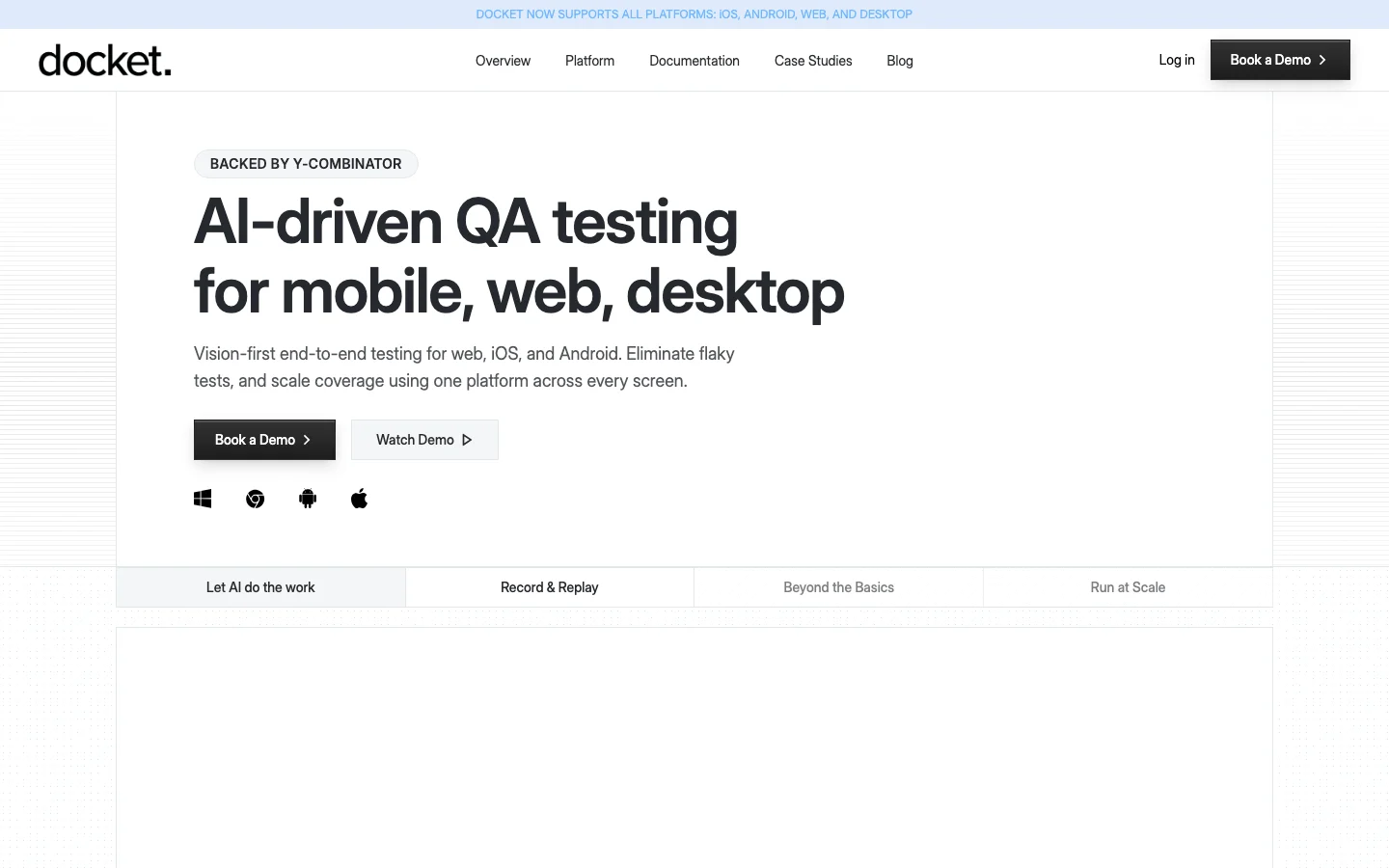
This is Docket's real first-party homepage, captured on 27 October 2026—not a generated product mock-up.
The review in 30 seconds
| The question | My answer |
|---|---|
| What is it? | vision-first AI quality-assurance testing software for web, mobile and desktop applications |
| What is the interesting part? | The hybrid model is the interesting part. |
| What would I test first? | A product team selects checkout, authentication and one canvas-heavy workflow. |
| What is the biggest concern? | Self-healing can hide a real regression. |
| How much does it cost? | Demo-led; no complete public rate card found |
| Who should shortlist it? | engineering and QA teams maintaining complex web, mobile or desktop workflows that change frequently or expose non-standard UI elements |
Why Docket exists
Selector-based automation works well until interfaces become dynamic, canvas-heavy, embedded or spread across desktop and mobile surfaces. Docket approaches the application more like a user does, mixing recorded interaction with AI-driven steps.
In practical terms, it is trying to help teams:
- Record end-to-end workflows through visual coordinates
- Create dynamic test steps with AI instructions
- Adapt tests when interface elements move
- Run suites on schedules and through CI/CD
- Capture evidence for failures across web, mobile and desktop environments
The part I like most
The hybrid model is the interesting part. Deterministic recorded steps can handle stable work, while AI steps are reserved for states that genuinely vary. That is more credible than pretending every test should become an autonomous agent.
That is the idea that earns Docket a place on a shortlist. The rest of the evaluation is about whether the implementation can support it without creating a new operational problem.
What Docket appears to do well
Coordinate-based record and replay
Docket says it records the x-y coordinates a user clicks instead of relying only on DOM selectors. That can reach canvases, iframes, popups and non-standard surfaces. Buyers should test screen sizes, responsive layouts, zoom, localization and accessibility modes because visual coordinates introduce their own sources of variation.
Self-healing behaviour
The platform describes adapting when elements move. A controlled test should introduce cosmetic movement, component rewrites, ambiguous duplicate buttons and genuine functional breakage. The system must adapt to harmless change without “healing” a real regression into a false pass.
AI steps for dynamic flows
AI steps can handle changing states and unpredictable interactions. Use them where deterministic scripts are genuinely costly, then measure repeatability, execution time, token or run cost, and whether reviewers can understand why the agent chose each action.
Cross-platform direction
Docket’s homepage positions one framework across web, iOS, Android and desktop. Verify the exact supported operating systems, browser and device versions, real-device versus emulator coverage, parallelism, geographic execution and any beta limitations in the proposed contract.
CI/CD, scheduling and evidence
Public navigation highlights CI integration, scheduled runs, notifications, mailboxes and authentication workflows. A useful pilot exports failure evidence into the team’s existing issue and release process, with screenshots, logs and reproducible steps rather than another isolated pass-rate dashboard.
The catch
Self-healing can hide a real regression. A system that adapts when a button moves is useful; a system that quietly chooses a different button and reports a pass is dangerous. Docket must prove it knows the difference.
That does not make the product a bad choice. It identifies the exact claim the pilot needs to prove. A polished demonstration is useful for learning the interface; it is not evidence that the difficult cases work.
Docket pricing: what the numbers actually mean
Docket invited visitors to book a demo and did not expose a complete public rate card during verification. Ask for prices by seat, application, test, execution minute, device, parallel worker and environment. Separate onboarding, test creation, managed support, CI runs, mobile or desktop coverage, data retention and overages. The homepage also used “Get Started for Free” language in some locations, but buyers should confirm the current free entitlement and limits rather than treating it as a published plan.
The published price is only the beginning of the cost. I would also model implementation, usage, storage, integrations, human review and the work required when something fails. When model or API consumption matters, the AI Token and API Cost Calculator can help turn expected volume into a range rather than a guess.
What makes me cautious about security and control
Testing tools may receive credentials, customer-like data, screenshots, logs and access to pre-production or production systems. Use synthetic accounts and isolated environments first. Verify secret handling, network access, recording retention, redaction, subprocessor use, role controls, audit logs and whether the agent can navigate outside the approved domain or application.
I would request the current security pack and map every credential, data type, automated action and deletion path before production access. The important question is not whether the vendor has a security page; it is whether the purchased plan and proposed architecture satisfy the team's real boundary.
What looks strong—and what still needs proving
What looks strong:
- Vision and coordinate interaction targets interfaces that DOM selectors struggle to address
- Combines recorded deterministic steps with AI-driven dynamic steps
- Public material covers web, mobile and desktop testing in one proposition
- CI/CD and scheduled-run support can place results inside release workflows
What still needs proving:
- No complete public rate card was available
- Coordinate and vision approaches must be tested across responsive and localized layouts
- Self-healing can conceal genuine regressions if acceptance rules are weak
- Vendor performance claims remain selected examples rather than expected outcomes
This is the useful dividing line between marketing and a buying decision. The strengths explain why the product is interesting. The unresolved points determine whether it is safe and economical for this particular team.
How I would test Docket
A product team selects checkout, authentication and one canvas-heavy workflow. It records deterministic steps, adds AI only where the state varies, and runs the suite across the required device matrix. Engineers then make harmless layout changes and inject known failures. Reviewers score correct passes, correct failures, false failures, missed regressions, maintenance time and evidence quality against the existing framework.
I would include normal work, edge cases and known failures, then record completion, serious errors, human corrections, latency and full cost. Preserve the same input set so another product can be tested on equal terms. The AI Tool Chooser can help turn those requirements into a consistent shortlist before the pilot starts.
Docket alternatives
| Consider | When it makes more sense |
|---|---|
| Momentic | AI-assisted natural-language end-to-end testing is the closest buying comparison |
| Mabl | a mature low-code cloud testing platform and enterprise workflow are preferred |
| testRigor | plain-English test authoring and broad packaged coverage are central |
| Playwright | the engineering team wants open-source, code-first deterministic control |
| QA Wolf | a managed test-automation service is preferable to operating the platform internally |
The feature labels may look similar, but the operating model can be completely different. Test the closest two options on the same work rather than comparing screenshots and plan names.
If the shortlist is already becoming another stack of overlapping subscriptions, our guide to why companies pay for too many AI tools explains the consolidation questions to ask. For a broader selection framework, which AI tool should I use for my business? separates useful fit from feature-count noise.
For adjacent examples, read our Tessl review and Orkes review.
Who should actually use Docket?
Docket makes the most sense for engineering and QA teams maintaining complex web, mobile or desktop workflows that change frequently or expose non-standard UI elements.
It is a weaker fit for teams satisfied with stable Playwright or Cypress suites, or buyers requiring transparent self-serve pricing before a sales process. In that situation, a narrower product, an existing platform feature or a better manual process may solve the problem with less integration and governance work.
Software solves an operating problem; it does not automatically make a SaaS company discoverable. Teams that also need buyers and AI answer engines to find their product can review our AEO and AI visibility service as a separate acquisition decision.
The funding context
Docket is listed as an active Spring 2025 Y Combinator company. YC’s standard deal is $500,000 for accepted companies, which passes this review queue’s minimum funding gate. Public third-party databases showed conflicting Docket totals, so this article does not repeat them. Until a primary source confirms more, the defensible label is “YC standard investment minimum only.”
Funding can help a company build the expensive parts of the product. It does not establish reliability, security or customer fit, so it is context—not part of the verdict.
Final verdict
Docket is worth evaluating when dynamic interfaces, canvas elements or frequent frontend changes make selector-based end-to-end tests expensive to maintain. Its coordinate-driven recording, AI steps and cross-platform direction are differentiated in public material. The unresolved questions are commercial: Docket does not publish a complete rate card, and buyers need reproducible evidence for self-healing accuracy, false failures and coverage across their actual device matrix.
My recommendation: Evaluate Docket when canvas elements, dynamic layouts or cross-platform workflows make existing tests expensive to maintain. Inject known failures during the pilot. If the system heals those into passes, stop there.
Frequently asked questions
What is Docket?
Docket is vision-first quality-assurance software for automating end-to-end tests across web, mobile and desktop applications.
Does Docket publish pricing?
No complete public rate card was found on 27 October 2026. Buyers should request an itemised quote and confirm any current free entitlement.
How is Docket different from Playwright?
Docket emphasizes coordinate and vision-based interaction plus AI steps, while Playwright is a code-first browser-automation framework commonly driven through selectors and explicit scripts.
How much funding has Docket raised?
Docket is a Spring 2025 YC company and therefore passes YC’s current $500,000 standard investment threshold. A company-confirmed cumulative total was not found.
Was this Docket review hands-on?
No. This is a research-based first-look review using official public evidence. We did not test an authenticated Docket workspace or connect production data.
Did Docket pay for inclusion?
No disclosed commercial relationship or payment influenced this review, and no numeric rating was assigned.

Tolu S.
Operations Lead, AI Search & GEO
Leads operations for AI search visibility and generative engine optimization (GEO) campaigns.