Table of Contents
- The review in 30 seconds
- Why RunAnywhere exists
- The part I like most
- What RunAnywhere appears to do well
- The catch
- RunAnywhere pricing: what the numbers actually mean
- What makes me cautious about security and control
- What looks strong—and what still needs proving
- How I would test RunAnywhere
- RunAnywhere alternatives
- Who should actually use RunAnywhere?
- The funding context
- Final verdict
- Frequently asked questions
Open models promise more control, but operating them can turn a model choice into a serving-infrastructure project. RunAnywhere is trying to remove that tax with Wally: one OpenAI-compatible endpoint for hosted models, plus a CLI and local SDK path when the request should stay on the device.
RunAnywhere is open-model inference software spanning the hosted Wally API, coding-agent CLI and open-source local SDKs.
My short take: RunAnywhere deserves a controlled benchmark if you want an OpenAI-compatible path to current open models or a common CLI across local and hosted inference. Keep production traffic bounded until latency, output quality, rate limits and preview reliability survive your real workload.
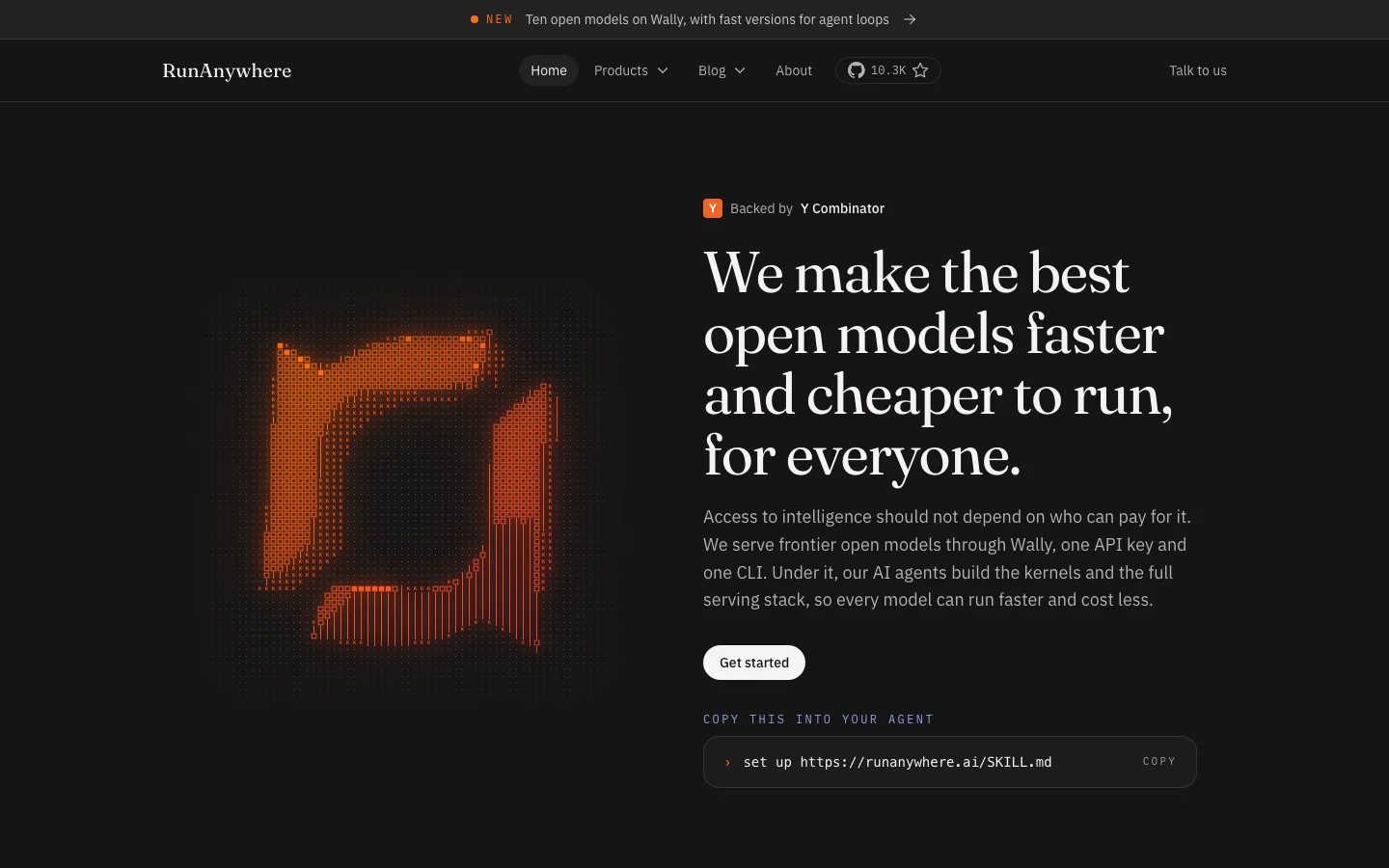
This is RunAnywhere's real first-party homepage, captured on 27 October 2026—not a generated product mock-up.
The review in 30 seconds
| The question | My answer |
|---|---|
| What is it? | open-model inference software spanning the hosted Wally API, coding-agent CLI and open-source local SDKs |
| What is the interesting part? | The cleanest decision is the explicit local-versus-cloud boundary. |
| What would I test first? | A team selects 100 representative prompts covering coding, tools, structured output and known failure cases. |
| What is the biggest concern? | Wally is still a preview service with no public uptime or support-response commitment. |
| How much does it cost? | Prepaid per-token credits; listed model rates range from $0.042 per million Eve input tokens to $15 per million Kimi K3 output tokens |
| Who should shortlist it? | developers and AI platform teams comparing hosted open models, connecting coding agents to them or preserving a future local-inference path |
Why RunAnywhere exists
Teams want to change models without rebuilding application code, and coding-agent users want a practical way to point existing tools at open weights. RunAnywhere combines hosted inference with open-source local work, while keeping the routing choice explicit instead of silently moving local requests into its cloud.
In practical terms, it is trying to help teams:
- Call frontier open models through one OpenAI-compatible endpoint
- Switch hosted models by changing a model identifier
- Connect existing coding agents through the Wally CLI
- Run supported local models through open-source SDKs
- Compare standard and speed-tuned model variants
The part I like most
The cleanest decision is the explicit local-versus-cloud boundary. A developer can choose a local model when privacy or offline use matters and add the cloud flag when a larger hosted model is required. Wally says it never shifts that boundary on its own.
That is the idea that earns RunAnywhere a place on a shortlist. The rest of the evaluation is about whether the implementation can support it without creating a new operational problem.
What RunAnywhere appears to do well
Hosted open-model API
Wally exposes ten listed models through one key and an OpenAI-compatible chat-completions endpoint. Test request and streaming compatibility, tool calls, structured output, context limits, error semantics and whether model identifiers stay pinned as upstream releases change.
Coding-agent CLI
The CLI configures tools such as OpenCode, Claude Code and Codex for a selected model. Confirm exactly which environment variables and local files change, whether credentials remain scoped to one process and how the adapter handles tool messages, images and long sessions.
Local and hosted execution
Local requests can remain on the device while cloud commands opt into Wally. That separation is useful, but workload parity is not guaranteed. Benchmark output, context length, thermal behaviour and memory locally, then document when the application is allowed to use cloud capacity.
Fast model variants
Several catalogue entries have speed-tuned identifiers for interactive loops. Measure end-to-end p50 and p95 time to first token, completion speed, quality and cost against the standard variant. “Fast” is a product label until the buyer reproduces it.
Model catalogue and Eve decisions
The catalogue includes DeepSeek, GLM, Kimi and MiniMax families plus Eve, which returns probabilities for decision questions. A probability is not calibration evidence; compare it with labelled outcomes and define abstention thresholds before software branches on it.
The catch
Wally is still a preview service with no public uptime or support-response commitment. A useful model catalogue and attractive token rate do not replace capacity guarantees, stable model versions, rate-limit clarity or a tested failover plan.
That does not make the product a bad choice. It identifies the exact claim the pilot needs to prove. A polished demonstration is useful for learning the interface; it is not evidence that the difficult cases work.
RunAnywhere pricing: what the numbers actually mean
Wally uses prepaid credits and gives new accounts a $5 promotional grant. Current per-million-token rates include DeepSeek V4.1 Flash at $0.30 input and $1.20 output, GLM-5.3 Flash at $0.272 and $0.65, MiniMax M3 at $0.33 and $1.32, and Kimi K3 at $3 and $15. Fast variants cost more, cached-input rates vary and Eve is $0.042 per million input tokens. Model mix, prompt length, cache behaviour and retries determine the real bill.
The published price is only the beginning of the cost. I would also model implementation, usage, storage, integrations, human review and the work required when something fails. When model or API consumption matters, the AI Token and API Cost Calculator can help turn expected volume into a range rather than a guess.
What makes me cautious about security and control
Production Wally says it does not store prompt or completion bodies, while retaining usage and billing metadata. The privacy notice names Google Cloud for model serving and says a SOC 2 Type II audit is in progress, not complete. Verify subprocessor regions, abuse monitoring, key scope, deletion, incident response, model-provider terms and whether zero retention applies to every selected model and support path.
I would request the current security pack and map every credential, data type, automated action and deletion path before production access. The important question is not whether the vendor has a security page; it is whether the purchased plan and proposed architecture satisfy the team's real boundary.
What looks strong—and what still needs proving
What looks strong:
- Transparent model-level token pricing
- One compatible endpoint and CLI reduce switching friction
- Explicit local and cloud paths support different data boundaries
- Zero-retention language is unusually direct for prompt and completion bodies
What still needs proving:
- Hosted Wally is a preview with no public uptime commitment
- SOC 2 Type II is in progress rather than complete
- Rate limits are not published and model access can require approval
- Open-model quality and fast-mode claims need workload-specific reproduction
This is the useful dividing line between marketing and a buying decision. The strengths explain why the product is interesting. The unresolved points determine whether it is safe and economical for this particular team.
How I would test RunAnywhere
A team selects 100 representative prompts covering coding, tools, structured output and known failure cases. It runs two Wally models, one fast variant and the current provider with fixed settings, then records accuracy, human preference, tool success, p95 latency, throttling and complete token cost. It repeats a smaller set locally and tests empty credits, 429 responses and provider failure.
I would include normal work, edge cases and known failures, then record completion, serious errors, human corrections, latency and full cost. Preserve the same input set so another product can be tested on equal terms. The AI Tool Chooser can help turn those requirements into a consistent shortlist before the pilot starts.
RunAnywhere alternatives
| Consider | When it makes more sense |
|---|---|
| Together AI | a broader managed open-model catalogue and enterprise serving options are required |
| Fireworks AI | production inference optimisation and dedicated deployments lead the decision |
| DeepInfra | a large low-cost model catalogue and simple API access matter |
| Ollama or llama.cpp | local control matters more than managed cloud convenience |
| Direct cloud endpoints | the team already standardises on one hyperscaler and wants its contracts and controls |
The feature labels may look similar, but the operating model can be completely different. Test the closest two options on the same work rather than comparing screenshots and plan names.
If the shortlist is already becoming another stack of overlapping subscriptions, our guide to why companies pay for too many AI tools explains the consolidation questions to ask. For a broader selection framework, which AI tool should I use for my business? separates useful fit from feature-count noise.
For adjacent examples, read our DeepInfra review and Parasail review.
Who should actually use RunAnywhere?
RunAnywhere makes the most sense for developers and AI platform teams comparing hosted open models, connecting coding agents to them or preserving a future local-inference path.
It is a weaker fit for regulated production teams that need a current SOC 2 report, contractual uptime, fixed capacity or a large managed-model catalogue today. In that situation, a narrower product, an existing platform feature or a better manual process may solve the problem with less integration and governance work.
Software solves an operating problem; it does not automatically make a SaaS company discoverable. Teams that also need buyers and AI answer engines to find their product can review our AEO and AI visibility service as a separate acquisition decision.
The funding context
RunAnywhere is listed by Y Combinator in the Winter 2026 batch. YC’s standard deal invests $500,000 in accepted companies. We did not find a company-confirmed cumulative funding total in the reviewed primary sources, so this review records the YC investment minimum only.
Funding can help a company build the expensive parts of the product. It does not establish reliability, security or customer fit, so it is context—not part of the verdict.
Final verdict
RunAnywhere gives Wally a coherent position: accessible hosted open models, explicit local/cloud execution, transparent token prices and zero-retention claims. It is easy to trial and technically flexible, but buyers should treat the hosted service as preview infrastructure and validate model quality, throughput, version stability, security and support before making it a production dependency.
My recommendation: RunAnywhere deserves a controlled benchmark if you want an OpenAI-compatible path to current open models or a common CLI across local and hosted inference. Keep production traffic bounded until latency, output quality, rate limits and preview reliability survive your real workload.
Frequently asked questions
What is RunAnywhere?
RunAnywhere develops Wally, a hosted open-model API and CLI, alongside open-source SDKs for local inference.
How much does Wally cost?
Wally uses prepaid credits and per-million-token pricing that varies by model. New accounts receive a $5 promotional credit.
Does Wally store prompts?
RunAnywhere says production Wally uses zero data retention for prompt and completion bodies, while keeping separate usage and billing metadata.
How much funding has RunAnywhere raised?
RunAnywhere is a Winter 2026 YC company and passes YC’s $500,000 standard investment threshold. We did not find a company-confirmed cumulative total.
Was this RunAnywhere review hands-on?
No. This is a research-based first-look review using official public evidence. We did not test an authenticated RunAnywhere workspace or connect production data.
Did RunAnywhere pay for inclusion?
No disclosed commercial relationship or payment influenced this review, and no numeric rating was assigned.

Tolu S.
Operations Lead, AI Search & GEO
Leads operations for AI search visibility and generative engine optimization (GEO) campaigns.