fact_checkResearch-based first look
Table of ContentsOpenClose
- dehaze at a glance
- What dehaze is designed to do
- The part I like most
- Core features and buyer value
- The catch
- dehaze pricing in 2026
- Who should use dehaze?
- How I would test dehaze
- dehaze alternatives
- Related reading for this decision
- My final verdict
- Frequently asked questions
dehaze at a glance
| Question | Answer |
|---|
| What is it? | AI health-risk and clinical decision-support platform |
| Best for | healthcare providers and payers evaluating proactive risk detection with clinical oversight |
| Less suitable for | patients seeking autonomous diagnosis or treatment without clinicians |
| Pricing | Sales-led unless stated otherwise below |
| Review access | Public-evidence first look; no authenticated workspace |
| Main buying test | Prove accurate, governed outcomes on representative work |
What dehaze is designed to do
The product is designed around five buyer jobs:
- Health-data unification and harmonisation
- Explainable patient risk profiling
- Doctor-in-the-loop data review
- Targeted AI follow-up workflows
- Provider and payer intervention support
The part I like most
Doctor review is the feature I would investigate before any promise of automated health-risk insight.
Core features and buyer value
The product material in the source record describes the following areas. I would evaluate them as a connected workflow, not assume that a named feature proves an operational result.
- Health-data unification and harmonisation
- Explainable patient risk profiling
- Doctor-in-the-loop data review
- Targeted AI follow-up workflows
- Provider and payer intervention support
Doctor review is the feature I would investigate before any promise of automated health-risk insight. A risk estimate is not a diagnosis, and errors can be concentrated in the patients least represented by the data.
The catch
A risk estimate is not a diagnosis, and errors can be concentrated in the patients least represented by the data.
dehaze pricing in 2026
Pricing evidence was recorded on 20 July 2026. The figures and plan descriptions below are historical research, not a newly verified quote. Confirm current terms with dehaze before budgeting.
dehaze does not publish a public rate card. Pricing should be scoped by covered lives, data sources, algorithms, deployment, clinical services and integrations.
Who should use dehaze?
dehaze is best suited to healthcare providers and payers evaluating proactive risk detection with clinical oversight.
It is less suitable for patients seeking autonomous diagnosis or treatment without clinicians.
How I would test dehaze
I would require a clinician-led evaluation protocol and appropriate data permissions before any product trial. A retrospective, de-identified dataset would be used to assess the intended risk question, subgroup performance, missing data and clinician overrides. I would keep outputs out of patient-care decisions until the responsible clinical and regulatory reviewers had established whether the system was suitable for that intended use.
dehaze alternatives
| Alternative | Consider it when |
|---|
| An established category incumbent | Procurement favours maturity and a broader ecosystem |
| A specialist point solution | One narrower capability matters more than platform breadth |
| An internal build | Control and proprietary workflow are strategic |
| A services-led provider | Expert execution matters more than software ownership |
| The current process | Volume and expected benefit do not justify migration |
Before adding dehaze to a shortlist, I would write down the job, the current alternative and the evidence needed to justify a change. Our guide to a requirements-first approach to choosing AI tools.
For dehaze, I would also count the existing tools, review time and operating work that remain after adoption. Our guide to a framework for reviewing overlapping software costs.
I would use the AI Tool Chooser to organise the shortlist around requirements before a vendor discussion. It does not replace the product-specific, technical or professional validation described for dehaze.
For related operations buying decisions, I would also read our Automata review and Beglaubigt.de review. These are adjacent evaluations, not a claim that every product replaces dehaze.
My final verdict
I would put dehaze on a conditional shortlist for healthcare providers and payers evaluating proactive risk detection with clinical oversight.
A risk estimate is not a diagnosis, and errors can be concentrated in the patients least represented by the data.
Frequently asked questions
What is dehaze?
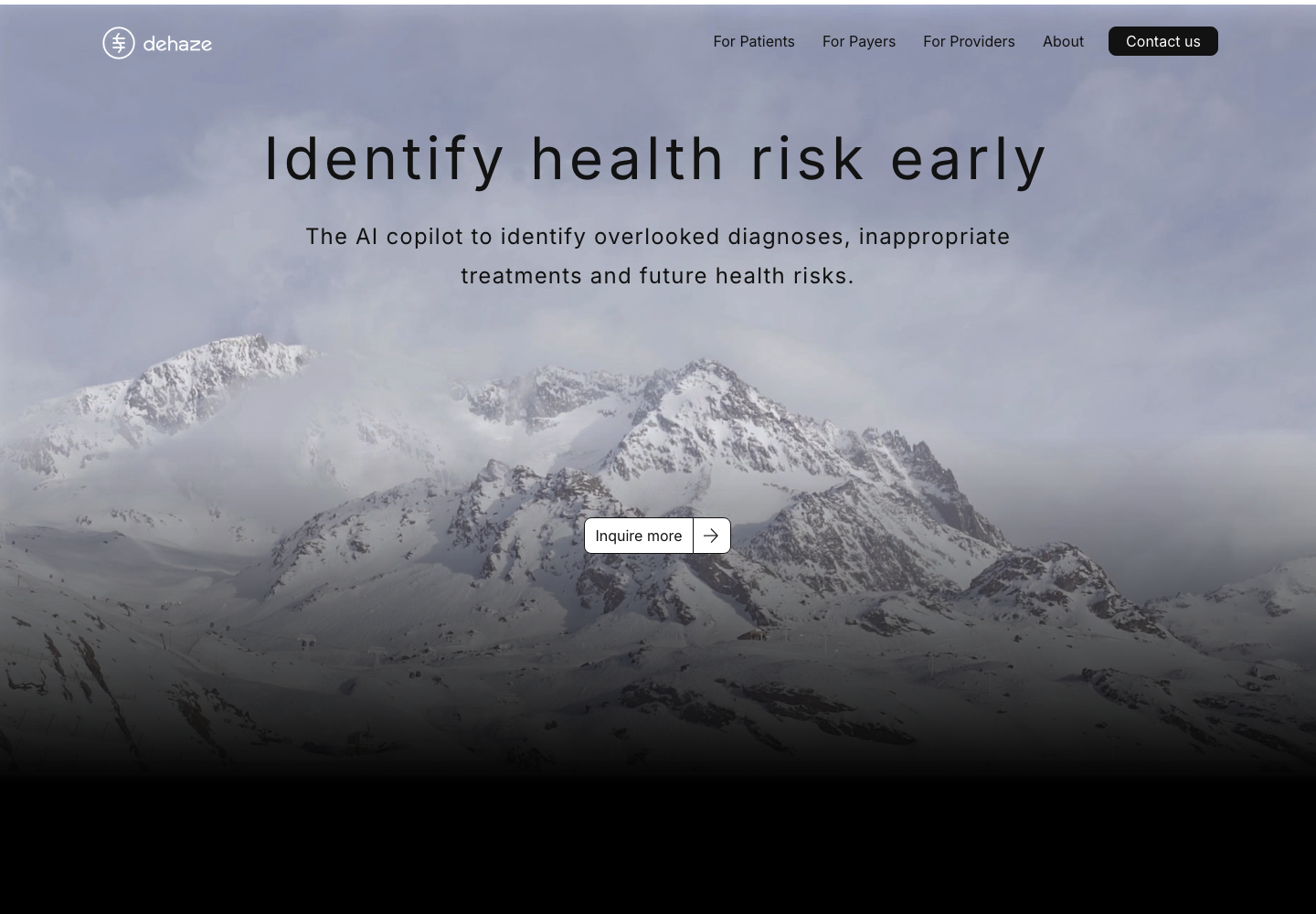
dehaze is AI health-risk and clinical decision-support platform. This review focuses on practical buyer fit rather than repeating vendor claims.
Does dehaze publish pricing?
dehaze does not publish a public rate card. Pricing should be scoped by covered lives, data sources, algorithms, deployment, clinical services and integrations.
Who is dehaze best for?
Healthcare providers and payers evaluating proactive risk detection with clinical oversight.
Was this dehaze review hands-on?
No. It is a research-based first look using official public evidence. No authenticated workspace or production integration was tested.
Did dehaze pay for inclusion?
No commercial relationship was disclosed for this review, and no rating was assigned.

Tolu S.
Operations Lead, AI Search & GEO
Leads operations for AI search visibility and generative engine optimization (GEO) campaigns.