Table of Contents
- The review in 30 seconds
- Why Quivly AI exists
- The part I like most
- What Quivly AI appears to do well
- The catch
- Quivly AI pricing: what the numbers actually mean
- What makes me cautious about security and control
- What looks strong—and what still needs proving
- How I would test Quivly AI
- Quivly AI alternatives
- Who should actually use Quivly AI?
- The funding context
- Final verdict
- Frequently asked questions
Closing a customer creates a new operational problem: calls, product usage, support tickets, billing signals and promises now live in different systems. Quivly AI wants to turn that fragmented account story into work before a missed task becomes churn.
Quivly AI is an AI-powered post-sales workspace for customer onboarding, adoption, expansion and renewal workflows.
My short take: Quivly deserves a pilot when CSMs are carrying too many accounts and assembling customer context manually. Start with one lifecycle stage and require evidence for every proposed action. Do not automate external messages until its account story agrees with the people who know the customer.
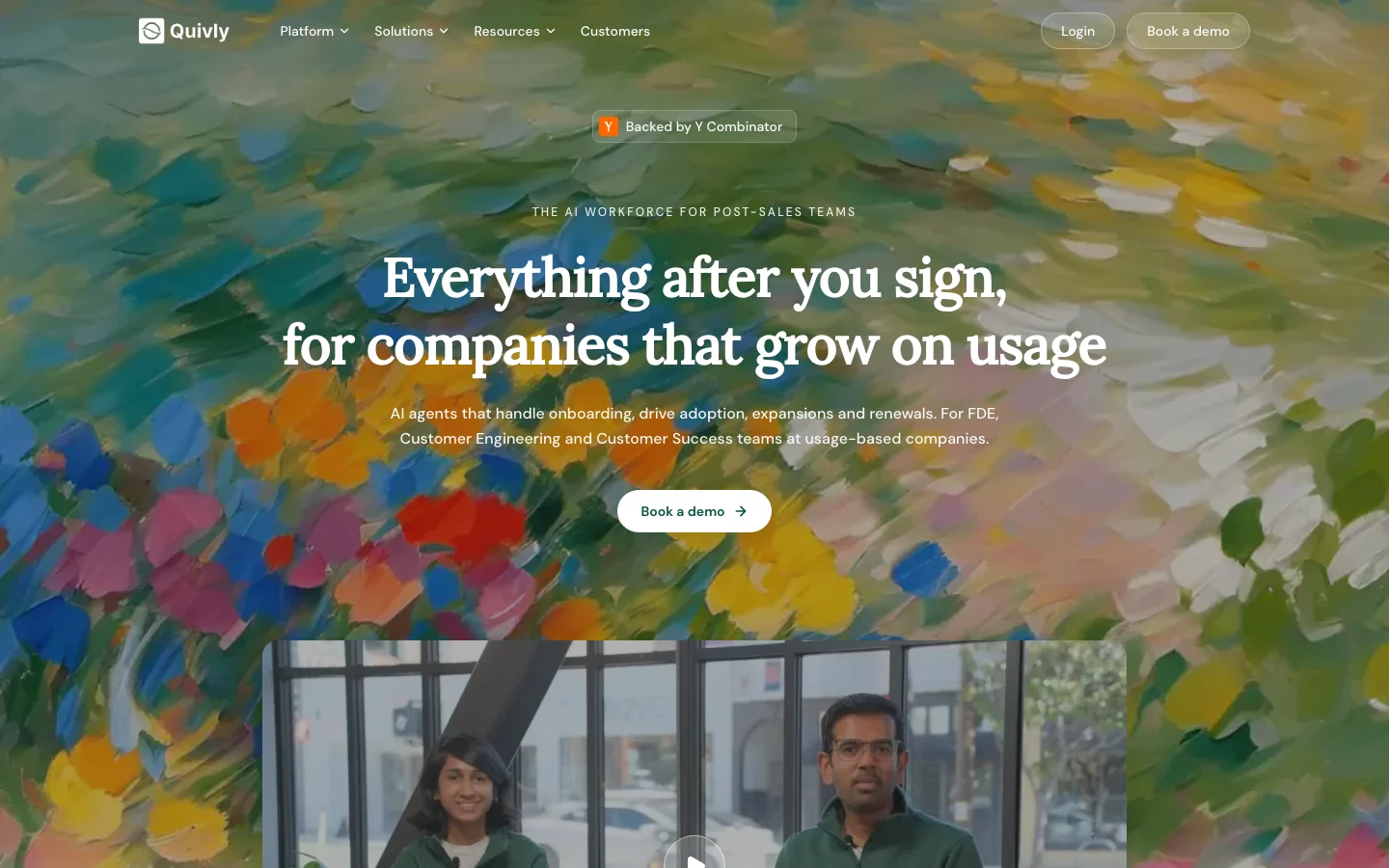
This is Quivly AI's real first-party homepage, captured on 27 October 2026—not a generated product mock-up.
The review in 30 seconds
| The question | My answer |
|---|---|
| What is it? | an AI-powered post-sales workspace for customer onboarding, adoption, expansion and renewal workflows |
| What is the interesting part? | Quivly connects the account signal to a visible piece of work. |
| What would I test first? | A customer-success team selects 20 accounts and one renewal motion. |
| What is the biggest concern? | The system can be confidently wrong at the worst moment. |
| How much does it cost? | No public rate card; pricing requires a demo or sales conversation |
| Who should shortlist it? | usage-based SaaS companies with growing customer books, fragmented post-sales data and teams that need structured onboarding, adoption and renewal workflows |
Why Quivly AI exists
Post-sales teams spend too much time assembling context and too little time acting on it. Quivly brings CRM, billing, support, calls, product usage and communication data into one account view, then uses agents to propose or execute onboarding, adoption, expansion and renewal work.
In practical terms, it is trying to help teams:
- Unify CRM, billing, support, call and product-usage data by account
- Build customer health scores and detect risk or expansion signals
- Turn kickoff calls and renewal work into owned projects
- Draft and execute post-sales actions with review gates
- Prepare grounded account research and renewal briefs
The part I like most
Quivly connects the account signal to a visible piece of work. A usage drop can become a recommended play, a kickoff call can become a project and a renewal can arrive with a grounded brief. That is more useful than another health score that turns red without explaining what happens next.
That is the idea that earns Quivly AI a place on a shortlist. The rest of the evaluation is about whether the implementation can support it without creating a new operational problem.
What Quivly AI appears to do well
Customer 360 and health scores
Quivly combines revenue, usage, calls, tickets, contacts and projects in one profile, with configurable health scoring. Test missing data, delayed events, conflicting account identities and whether each score can be explained from source records rather than accepted as a black box.
Projects and actions
Onboarding and renewal motions can become structured projects with owners, due dates and agent-assisted tasks. The buyer test is whether work synchronises cleanly with existing systems and whether humans can see, edit and stop an action before it reaches a customer.
Post-sales agents
A visual workflow builder can trigger agents from records, schedules, messages or score changes. Start with internal drafting and data hygiene. External emails, Slack posts and calendar changes need approval, rate limits, identity controls and a complete audit trail.
Ask Quivly, Brain and notebooks
The research layer answers questions across connected customer data and can prepare reusable account briefs. Reviewers should challenge it with contradictory sources, restricted notes and recently changed information, then inspect the citations behind every consequential claim.
Integrations and data surface
Quivly lists CRM, support, communication, warehouse, billing and project-management connections plus a larger integration catalogue. Count only the fields and actions required by the pilot, and verify sync frequency, write permissions, deletion, failure alerts and support for custom objects.
The catch
The system can be confidently wrong at the worst moment. A noisy usage event, incomplete CRM record or misread call can trigger outreach that damages a real customer relationship. Human review gates, source evidence and ownership matter more here than the number of available agents.
That does not make the product a bad choice. It identifies the exact claim the pilot needs to prove. A polished demonstration is useful for learning the interface; it is not evidence that the difficult cases work.
Quivly AI pricing: what the numbers actually mean
Quivly AI did not publish a public pricing page or rate card when checked on 27 October 2026. The website directs buyers to book a demo. Ask for the billing unit—seats, accounts, data volume, integrations, agent actions or a combination—and model implementation, historical-data import, premium connectors, model usage, support and contract minimums. Without that information, the product cannot be compared responsibly on total cost.
The published price is only the beginning of the cost. I would also model implementation, usage, storage, integrations, human review and the work required when something fails. When model or API consumption matters, the AI Token and API Cost Calculator can help turn expected volume into a range rather than a guess.
What makes me cautious about security and control
Quivly aggregates commercially sensitive customer records and may draft or execute communications. Its public trust centre states SOC 2 compliance and lists other frameworks with varying statuses; buyers should request the current reports and confirm which entity, product and period they cover. Verify SSO, roles, tenant isolation, encryption, data retention, model providers, training policy, subprocessor regions, deletion and approval logs.
I would request the current security pack and map every credential, data type, automated action and deletion path before production access. The important question is not whether the vendor has a security page; it is whether the purchased plan and proposed architecture satisfy the team's real boundary.
What looks strong—and what still needs proving
What looks strong:
- Connects customer signals to owned projects and recommended actions
- Covers onboarding through renewal instead of one point workflow
- Human review gates are part of the documented agent model
- A public trust centre supports initial security diligence
What still needs proving:
- No public pricing prevents independent cost comparison
- Outcome quality depends on clean identity and usage data across integrations
- Automated outreach can damage customer relationships when signals are wrong
- Vendor performance claims require reproduction on the buyer’s own accounts
This is the useful dividing line between marketing and a buying decision. The strengths explain why the product is interesting. The unresolved points determine whether it is safe and economical for this particular team.
How I would test Quivly AI
A customer-success team selects 20 accounts and one renewal motion. It connects the CRM, product usage and support systems, then compares Quivly’s account summaries, risks and recommended actions with a human-prepared baseline. For four weeks, all customer-facing actions require approval. The team measures missed signals, false alarms, research time saved, action acceptance and renewal-work completion.
I would include normal work, edge cases and known failures, then record completion, serious errors, human corrections, latency and full cost. Preserve the same input set so another product can be tested on equal terms. The AI Tool Chooser can help turn those requirements into a consistent shortlist before the pilot starts.
Quivly AI alternatives
| Consider | When it makes more sense |
|---|---|
| Gainsight | a mature enterprise customer-success platform and established governance lead the decision |
| Vitally | collaborative customer-success workspaces and account management are the priority |
| Planhat | customer analytics and structured success operations matter more than agent execution |
| ChurnZero | adoption monitoring and digital customer-success automation fit the current process |
| A warehouse and CRM workflow | the company already has reliable account models and can build its own plays |
The feature labels may look similar, but the operating model can be completely different. Test the closest two options on the same work rather than comparing screenshots and plan names.
If the shortlist is already becoming another stack of overlapping subscriptions, our guide to why companies pay for too many AI tools explains the consolidation questions to ask. For a broader selection framework, which AI tool should I use for my business? separates useful fit from feature-count noise.
For adjacent examples, read our The Context Company review and Bluejay review.
Who should actually use Quivly AI?
Quivly AI makes the most sense for usage-based SaaS companies with growing customer books, fragmented post-sales data and teams that need structured onboarding, adoption and renewal workflows.
It is a weaker fit for small teams with few high-touch accounts, companies without reliable product-usage data or buyers that need a public rate card before engaging sales. In that situation, a narrower product, an existing platform feature or a better manual process may solve the problem with less integration and governance work.
Software solves an operating problem; it does not automatically make a SaaS company discoverable. Teams that also need buyers and AI answer engines to find their product can review our AEO and AI visibility service as a separate acquisition decision.
The funding context
Quivly AI is listed by Y Combinator in the Fall 2026 batch. YC’s standard deal invests $500,000 in accepted companies. We did not find a company-confirmed cumulative funding total, so this review records the YC investment minimum only.
Funding can help a company build the expensive parts of the product. It does not establish reliability, security or customer fit, so it is context—not part of the verdict.
Final verdict
Quivly AI presents a more operational post-sales product than a generic customer-health dashboard: account data, projects, actions, research and agents share one workspace. The promise is attractive for usage-based SaaS teams, but the decision needs a careful proof of signal quality, human approval, integration completeness and measurable revenue outcomes. Pricing is sales-led, so cost transparency remains a material gap.
My recommendation: Quivly deserves a pilot when CSMs are carrying too many accounts and assembling customer context manually. Start with one lifecycle stage and require evidence for every proposed action. Do not automate external messages until its account story agrees with the people who know the customer.
Frequently asked questions
What is Quivly AI?
Quivly AI is a post-sales workspace that combines customer data, health scores, projects, research and agents for onboarding, adoption, expansion and renewal.
How much does Quivly AI cost?
Quivly AI did not publish a public rate card when checked on 27 October 2026. Pricing requires a demo or sales conversation.
Can Quivly AI take actions?
Its public documentation describes agents and an actions inbox with human review gates for proposed customer-success work.
How much funding has Quivly AI raised?
Quivly AI is a Fall 2026 YC company and passes YC’s $500,000 standard investment threshold. We did not find a company-confirmed cumulative total.
Was this Quivly AI review hands-on?
No. This is a research-based first-look review using official public evidence. We did not test an authenticated Quivly AI workspace or connect production data.
Did Quivly AI pay for inclusion?
No disclosed commercial relationship or payment influenced this review, and no numeric rating was assigned.

Tolu S.
Operations Lead, AI Search & GEO
Leads operations for AI search visibility and generative engine optimization (GEO) campaigns.