Table of Contents
- The review in 30 seconds
- Why Wato exists
- The part I like most
- What Wato appears to do well
- The catch
- Wato pricing: what the numbers actually mean
- What makes me cautious about security and control
- What looks strong—and what still needs proving
- How I would test Wato
- Wato alternatives
- Who should actually use Wato?
- The funding context
- Final verdict
- Frequently asked questions
Most companies do not have one AI agent. They have a growing collection of personal agents, copied prompts, local files and tool connections that nobody centrally owns. Wato is trying to turn that scattered activity into company infrastructure.
Wato is a governed shared workspace for AI-agent memory, MCP tools, workflows, cloud sessions and audit trails.
My short take: Shortlist Wato if several teams already use different agents and keep rebuilding the same memory and tool connections. Pilot it with one team, one sensitive connector and one reviewed-memory workflow. Do not roll it out company-wide until permission changes and bad-memory rollback are boringly predictable.
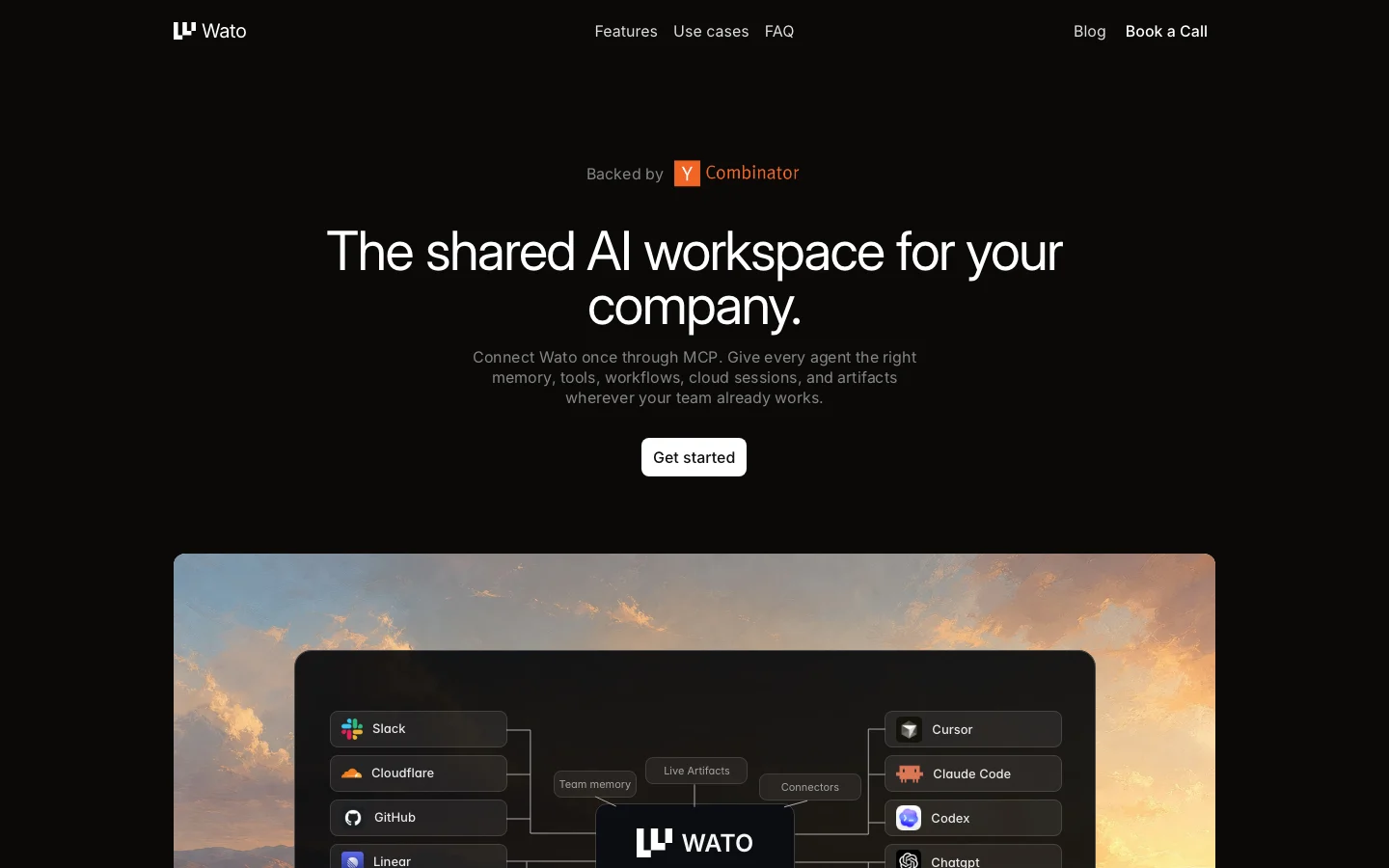
This is Wato's real first-party homepage, captured on 27 October 2026—not a generated product mock-up.
The review in 30 seconds
| The question | My answer |
|---|---|
| What is it? | a governed shared workspace for AI-agent memory, MCP tools, workflows, cloud sessions and audit trails |
| What is the interesting part? | The most convincing idea is the boundary between proposed memory and trusted memory. |
| What would I test first? | An engineering team connects a repository and issue tracker, imports one reviewed incident runbook and creates a shared debugging workflow. |
| What is the biggest concern? | A shared control point can also become a shared failure point. |
| How much does it cost? | No public rate card; access and pricing require a sales conversation |
| Who should shortlist it? | organisations with several AI-agent users that need shared context, approved MCP tools, reusable workflows and an auditable operating model |
Why Wato exists
AI work disappears easily. A useful investigation stays in one chat, a strong prompt lives on one laptop and each new agent reconnects to the same systems with a slightly different permission model. Wato creates a shared layer for reviewed memory, approved tools, reusable workflows and the traces that show what happened.
In practical terms, it is trying to help teams:
- Store reviewed company memory and reusable agent skills
- Control MCP tools by organisation, team, user, connector and tool
- Preserve useful agent sessions and outputs as shared artifacts
- Run collaborative cloud-agent sessions and recurring workflows
- Trace what agents accessed, called and produced
The part I like most
The most convincing idea is the boundary between proposed memory and trusted memory. An agent can suggest a change, but the change does not automatically become company truth. That review step matters because shared memory compounds both good context and bad context.
That is the idea that earns Wato a place on a shortlist. The rest of the evaluation is about whether the implementation can support it without creating a new operational problem.
What Wato appears to do well
Reviewed team memory
Wato separates proposed changes from approved memory and keeps knowledge versioned. That is the right shape for shared context, but a pilot should test conflicting edits, stale decisions, reviewer ownership, rollback and whether an agent can cite the exact approved source behind an answer.
One MCP with scoped tools
The product presents one MCP connection for memory and approved integrations, with organisation, team, user, connector and tool-level permissions. Test denied calls, revoked access, cross-team boundaries and whether source-system permissions remain intact after the connection is centralised.
Reusable skills and workflows
Teams can turn repeatable prompts and processes into shared defaults. The value is consistency, not merely reuse: each workflow should have an owner, version history, test cases and a clear path for retiring instructions that no longer match the business.
Collaborative cloud sessions
Wato describes cloud agents with desktop, filesystem, browser, environment and computer-use access that teammates can view and continue. This could make handoff practical, but session isolation, credential boundaries, takeover controls and cleanup need direct verification.
Tracing and living artifacts
Traces record what agents accessed and which tools they called, while artifacts keep outputs connected to approved data. Buyers should test export, retention, redaction, search and whether an audit trail can reconstruct a consequential decision without exposing unrelated sensitive content.
The catch
A shared control point can also become a shared failure point. If permissions drift, stale memory is approved or the MCP layer is unavailable, several agents can inherit the same problem at once. Centralisation only helps when review, rollback and access controls are exceptionally clear.
That does not make the product a bad choice. It identifies the exact claim the pilot needs to prove. A polished demonstration is useful for learning the interface; it is not evidence that the difficult cases work.
Wato pricing: what the numbers actually mean
Wato did not publish a public rate card when checked on 27 October 2026. The homepage routes buyers to request access or book a call, and the documentation describes choosing a plan during onboarding without exposing current plan prices. Treat the starting price as custom. Ask for plan limits covering users, teams, connectors, tool calls, memory, traces, cloud-agent compute, retention, support and on-premises deployment before calculating total cost.
The published price is only the beginning of the cost. I would also model implementation, usage, storage, integrations, human review and the work required when something fails. When model or API consumption matters, the AI Token and API Cost Calculator can help turn expected volume into a range rather than a guess.
What makes me cautious about security and control
Wato may sit between agents and sensitive company systems, so its permission model is the product rather than a side feature. Verify encryption, tenant isolation, connector credential storage, least-privilege scopes, reviewer roles, audit immutability, data retention, deletion, model providers, subprocessors, incident response and the exact architecture of any on-premises option.
I would request the current security pack and map every credential, data type, automated action and deletion path before production access. The important question is not whether the vendor has a security page; it is whether the purchased plan and proposed architecture satisfy the team's real boundary.
What looks strong—and what still needs proving
What looks strong:
- Addresses shared memory and tool governance in one layer
- Review workflows reduce the risk of agents silently rewriting trusted context
- Tool-level permissions and traces are central to the public proposition
- Works across MCP-compatible clients instead of requiring one agent interface
What still needs proving:
- No public pricing makes early cost comparison difficult
- Centralisation increases the blast radius of permission or memory mistakes
- Cloud-agent sessions create additional credential and isolation questions
- Public evidence does not replace testing with the buyer’s real identity model
This is the useful dividing line between marketing and a buying decision. The strengths explain why the product is interesting. The unresolved points determine whether it is safe and economical for this particular team.
How I would test Wato
An engineering team connects a repository and issue tracker, imports one reviewed incident runbook and creates a shared debugging workflow. One agent proposes a memory update after an incident, a human approves or rejects it, and a second agent attempts to reuse it. The pilot records permission leaks, stale-context errors, review time, rollback behaviour and trace completeness.
I would include normal work, edge cases and known failures, then record completion, serious errors, human corrections, latency and full cost. Preserve the same input set so another product can be tested on equal terms. The AI Tool Chooser can help turn those requirements into a consistent shortlist before the pilot starts.
Wato alternatives
| Consider | When it makes more sense |
|---|---|
| Hyperspell | company-wide context retrieval and a context graph matter more than workflow governance |
| Airweave | developers mainly need reusable source connectors and retrieval infrastructure |
| Dust | the buyer wants a broader employee-facing agent platform |
| A Git-based internal library | versioned prompts and memory are enough and the team can maintain access itself |
| Direct MCP connections | the tool set is small and central governance would add more complexity than value |
The feature labels may look similar, but the operating model can be completely different. Test the closest two options on the same work rather than comparing screenshots and plan names.
If the shortlist is already becoming another stack of overlapping subscriptions, our guide to why companies pay for too many AI tools explains the consolidation questions to ask. For a broader selection framework, which AI tool should I use for my business? separates useful fit from feature-count noise.
For adjacent examples, read our Hyperspell review and Airweave review.
Who should actually use Wato?
Wato makes the most sense for organisations with several AI-agent users that need shared context, approved MCP tools, reusable workflows and an auditable operating model.
It is a weaker fit for small teams using one agent, companies unwilling to centralise agent access, or buyers that require transparent self-serve pricing before a pilot. In that situation, a narrower product, an existing platform feature or a better manual process may solve the problem with less integration and governance work.
Software solves an operating problem; it does not automatically make a SaaS company discoverable. Teams that also need buyers and AI answer engines to find their product can review our AEO and AI visibility service as a separate acquisition decision.
The funding context
Wato is listed by Y Combinator in the Spring 2026 batch. YC’s standard deal invests $500,000 in each accepted company. We did not find a company-confirmed cumulative funding total, so this review records the accelerator investment minimum only and does not treat it as evidence of product quality.
Funding can help a company build the expensive parts of the product. It does not establish reliability, security or customer fit, so it is context—not part of the verdict.
Final verdict
Wato has a coherent answer to a real enterprise problem: useful AI work should belong to the company rather than vanish inside personal chats. Reviewed memory, tool-level permissions and shared traces make the proposition stronger than a simple prompt library. The unresolved questions are equally important: public pricing is unavailable, and a buyer must validate permission fidelity, memory lifecycle, audit coverage and control-plane resilience before broad adoption.
My recommendation: Shortlist Wato if several teams already use different agents and keep rebuilding the same memory and tool connections. Pilot it with one team, one sensitive connector and one reviewed-memory workflow. Do not roll it out company-wide until permission changes and bad-memory rollback are boringly predictable.
Frequently asked questions
What is Wato?
Wato is a governed shared workspace for AI-agent memory, MCP tool access, reusable workflows, cloud sessions and traceability.
How much does Wato cost?
Wato did not publish a public rate card when checked on 27 October 2026. Buyers need to request access or discuss pricing with the company.
Does Wato work with MCP clients?
Yes. Wato presents one MCP connection for clients including Codex, Claude, Cursor and other MCP-compatible agents.
How much funding has Wato raised?
Wato is a Spring 2026 YC company and passes YC’s $500,000 standard investment threshold. We did not find a company-confirmed cumulative total.
Was this Wato review hands-on?
No. This is a research-based first-look review using official public evidence. We did not test an authenticated Wato workspace or connect production data.
Did Wato pay for inclusion?
No disclosed commercial relationship or payment influenced this review, and no numeric rating was assigned.

Tolu S.
Operations Lead, AI Search & GEO
Leads operations for AI search visibility and generative engine optimization (GEO) campaigns.