Table of Contents
- The review in 30 seconds
- Why Definite exists
- The part I like most
- What Definite appears to do well
- The catch
- Definite pricing: what the numbers actually mean
- What makes me cautious about security and control
- What looks strong—and what still needs proving
- How I would test Definite
- Definite alternatives
- Who should actually use Definite?
- The funding context
- Final verdict
- Frequently asked questions
Finance automation has an uncomfortable failure mode: the agent produces a plausible number, but nobody can reconstruct which records, rules and judgements created it. Definite draws a hard line—agents can do the labour, while deterministic rules decide and humans retain approval.
Definite is AI workflow and ontology software for finance operations, controls and evidence.
My short take: Definite is worth a serious pilot for finance teams whose reconciliations depend on several systems and manual evidence assembly. Begin with one bounded, read-only workflow, reproduce a closed period and have finance and audit independently verify every mapping, verdict and receipt.
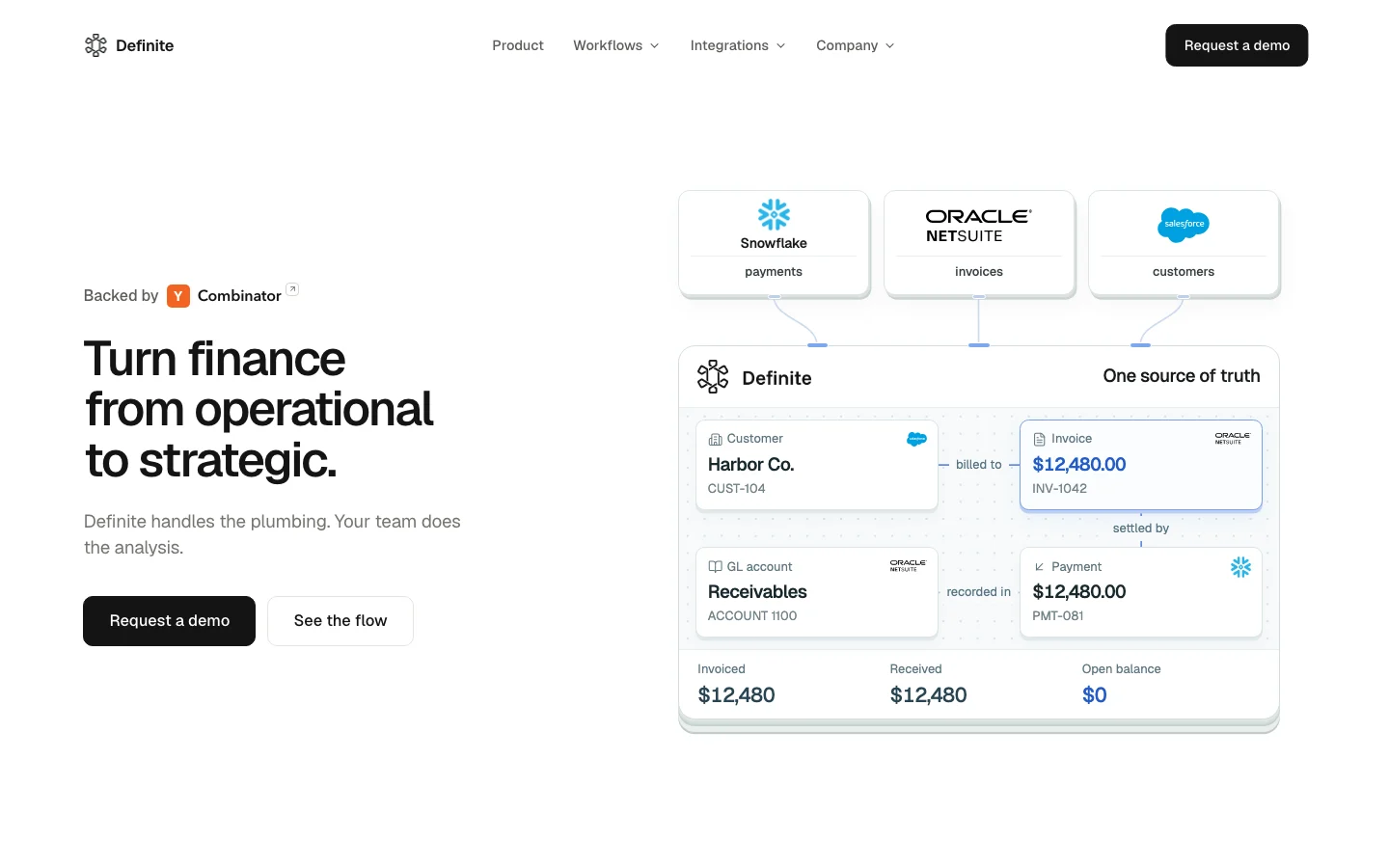
This is Definite's real first-party homepage, captured on 27 October 2026—not a generated product mock-up.
The review in 30 seconds
| The question | My answer |
|---|---|
| What is it? | AI workflow and ontology software for finance operations, controls and evidence |
| What is the interesting part? | The separation between agent labour and deterministic verdicts is the best part. |
| What would I test first? | A controllership team chooses one monthly cash reconciliation and replays a closed period through read-only snapshots. |
| What is the biggest concern? | Deterministic does not mean correct. |
| How much does it cost? | Custom order-form pricing based on workflow, deployment and agreement; no public self-serve plans |
| Who should shortlist it? | finance, controllership and audit teams running complex reconciliations, controls or reporting across several systems with strict evidence requirements |
Why Definite exists
Close, reconciliation, planning and compliance work span ledgers, billing, banks, warehouses and spreadsheets. Definite maps those systems into one finance model, runs bounded workflows and preserves lineage so exceptions and reports remain connected to source evidence.
In practical terms, it is trying to help teams:
- Connect finance systems through read-only credentials and immutable snapshots
- Map records into a shared finance ontology
- Run deterministic checks with PASS, FAIL or CANNOT_VERIFY outcomes
- Use agents to investigate exceptions and draft explanations
- Produce signed receipts, workpapers and evidence packs with source lineage
The part I like most
The separation between agent labour and deterministic verdicts is the best part. A model may propose a mapping or explanation, but it cannot emit PASS or override CANNOT_VERIFY. That is a much more credible control boundary than asking the same model to do the work and grade itself.
That is the idea that earns Definite a place on a shortlist. The rest of the evaluation is about whether the implementation can support it without creating a new operational problem.
What Definite appears to do well
Connected finance model
Definite maps ERP, billing, bank, warehouse and document records into shared entities and definitions. Sample high-risk mappings, preserve competing values and test effective dates, currencies, legal entities and policy changes. An ontology is valuable only when finance recognises it as the business.
Bounded agent workflow
Agents can map, investigate and draft, while source connections remain read-only. Inspect every task’s declared fields, model identity, tool access and provenance. Confirm that retries, fallbacks and human edits cannot quietly broaden the agent’s authority.
Deterministic verdict engine
Versioned rules emit PASS, FAIL or CANNOT_VERIFY, and missing or disputed evidence fails closed. Recalculate a sample independently, test thresholds and rounding, then verify that rule changes create new versions rather than rewriting historical outcomes.
Human review and separation of duties
Named admins or owners approve mappings, definitions and final exports; raw API keys cannot do so. Test role removal, preparer-versus-approver separation, override reasons and whether a correction creates a new run with a preserved trail.
Signed receipts and audit ledger
Receipts bind rule versions, verdicts and hashed input references into a signed chain, backed by a Merkle ledger and published verification keys. Have an independent team verify a bundle offline and test key rotation, missing receipts and tamper detection.
The catch
Deterministic does not mean correct. Rules, mappings and source definitions can still encode the wrong accounting treatment, and an ontology implementation can be substantial. The product needs controlled change management, independent rule review and reconciliation against the existing close before its receipts mean anything.
That does not make the product a bad choice. It identifies the exact claim the pilot needs to prove. A polished demonstration is useful for learning the interface; it is not evidence that the difficult cases work.
Definite pricing: what the numbers actually mean
Definite does not publish standard plans. Its terms say fees, billing period and renewal terms are set in an order form or written agreement and are normally paid in advance. Ask the quote to separate implementation, connectors, entities, workflows, run frequency, data volume, users, deployment, evidence retention, support, model usage and custom rule work. The total cost includes finance and audit time spent defining and approving the operating model.
The published price is only the beginning of the cost. I would also model implementation, usage, storage, integrations, human review and the work required when something fails. When model or API consumption matters, the AI Token and API Cost Calculator can help turn expected volume into a range rather than a guess.
What makes me cautious about security and control
Definite supports hosted, customer-cloud or VPC, on-premises and air-gapped deployments. Public documentation describes read-only credentials, per-tenant isolation, secret management, TLS, SAML/SCIM options and stateless agent execution, with no client-data training. Verify the actual contracted architecture, penetration and assurance reports, key custody, region, backup and deletion, model endpoints, support access, disaster recovery and proof-verification procedures.
I would request the current security pack and map every credential, data type, automated action and deletion path before production access. The important question is not whether the vendor has a security page; it is whether the purchased plan and proposed architecture satisfy the team's real boundary.
What looks strong—and what still needs proving
What looks strong:
- Separates model-assisted labour from deterministic decisions
- Read-only source boundary reduces transaction and posting risk
- Fail-closed CANNOT_VERIFY outcomes keep missing evidence visible
- Signed receipts and deployment options support serious audit requirements
What still needs proving:
- No public pricing or standard implementation scope
- Ontology, mapping and rule validation require substantial stakeholder work
- Deterministic rules can still be wrong or poorly governed
- The platform deliberately does not post entries, move funds or submit filings
This is the useful dividing line between marketing and a buying decision. The strengths explain why the product is interesting. The unresolved points determine whether it is safe and economical for this particular team.
How I would test Definite
A controllership team chooses one monthly cash reconciliation and replays a closed period through read-only snapshots. It validates mappings and rules, injects a missing feed and conflicting balance, then compares verdicts with signed-off workpapers. Internal audit independently verifies receipts and lineage before the team considers a live parallel run.
I would include normal work, edge cases and known failures, then record completion, serious errors, human corrections, latency and full cost. Preserve the same input set so another product can be tested on equal terms. The AI Tool Chooser can help turn those requirements into a consistent shortlist before the pilot starts.
Definite alternatives
| Consider | When it makes more sense |
|---|---|
| BlackLine | mature enterprise close and reconciliation workflows lead the decision |
| FloQast | collaborative close management around an existing ERP is the priority |
| Numeric | modern close automation and variance workflows fit the team better |
| An ERP-native controls module | keeping workflows inside the system of record matters most |
| A governed warehouse and workflow stack | the organisation can build and maintain its own semantic, rules and evidence layers |
The feature labels may look similar, but the operating model can be completely different. Test the closest two options on the same work rather than comparing screenshots and plan names.
If the shortlist is already becoming another stack of overlapping subscriptions, our guide to why companies pay for too many AI tools explains the consolidation questions to ask. For a broader selection framework, which AI tool should I use for my business? separates useful fit from feature-count noise.
For adjacent examples, read our Ramp review and Fimple review.
Who should actually use Definite?
Definite makes the most sense for finance, controllership and audit teams running complex reconciliations, controls or reporting across several systems with strict evidence requirements.
It is a weaker fit for small teams seeking a plug-and-play bookkeeping assistant, organisations unwilling to define rules and ownership or buyers wanting agents to post entries automatically. In that situation, a narrower product, an existing platform feature or a better manual process may solve the problem with less integration and governance work.
Software solves an operating problem; it does not automatically make a SaaS company discoverable. Teams that also need buyers and AI answer engines to find their product can review our AEO and AI visibility service as a separate acquisition decision.
The funding context
Definite is listed by Y Combinator in the Fall 2026 batch. YC’s standard deal invests $500,000 in accepted companies. We did not find a company-confirmed cumulative funding total in the reviewed primary sources, so this review records the YC investment minimum only.
Funding can help a company build the expensive parts of the product. It does not establish reliability, security or customer fit, so it is context—not part of the verdict.
Final verdict
Definite has one of the more thoughtful control models in finance AI: read-only sources, bounded agents, fail-closed verdicts, named human approvals and independently verifiable receipts. Its flexibility and deployment choices suit serious workflows, but custom pricing, implementation depth and the need to validate every rule make this an enterprise project—not a self-serve assistant.
My recommendation: Definite is worth a serious pilot for finance teams whose reconciliations depend on several systems and manual evidence assembly. Begin with one bounded, read-only workflow, reproduce a closed period and have finance and audit independently verify every mapping, verdict and receipt.
Frequently asked questions
What is Definite?
Definite is an AI workflow and ontology layer for finance teams that connects systems read-only and produces deterministic checks with signed evidence.
How much does Definite cost?
Definite uses custom order-form pricing based on the workflow, deployment and commercial agreement. It does not publish self-serve plan prices.
Can Definite post journal entries or move money?
No. Definite says its source connections are read-only and it does not post entries, amend source records, initiate payments or submit filings.
How much funding has Definite raised?
Definite is a Fall 2026 YC company and passes YC’s $500,000 standard investment threshold. We did not find a company-confirmed cumulative total.
Was this Definite review hands-on?
No. This is a research-based first-look review using official public evidence. We did not test an authenticated Definite workspace or connect production data.
Did Definite pay for inclusion?
No disclosed commercial relationship or payment influenced this review, and no numeric rating was assigned.

Tolu S.
Operations Lead, AI Search & GEO
Leads operations for AI search visibility and generative engine optimization (GEO) campaigns.