Table of Contents
- The review in 30 seconds
- Why Casco exists
- The part I like most
- What Casco appears to do well
- The catch
- Casco pricing: what the numbers actually mean
- What makes me cautious about security and control
- What looks strong—and what still needs proving
- How I would test Casco
- Casco alternatives
- Who should actually use Casco?
- The funding context
- Final verdict
- Frequently asked questions
Security scanners are good at producing lists. The harder job is proving which findings are genuinely exploitable, showing the attack path and checking that a fix actually closes it. Casco is selling that harder outcome as a continuous service rather than an annual PDF.
Casco is autonomous security testing and supervised penetration-testing software for web applications, APIs, cloud systems and AI agents.
My short take: Shortlist Casco if annual pentests and scanner queues leave too much time between discovery and verified remediation. Begin with a tightly scoped non-production target, agree explicit stop conditions and require reproducible evidence for every serious finding before expanding coverage.
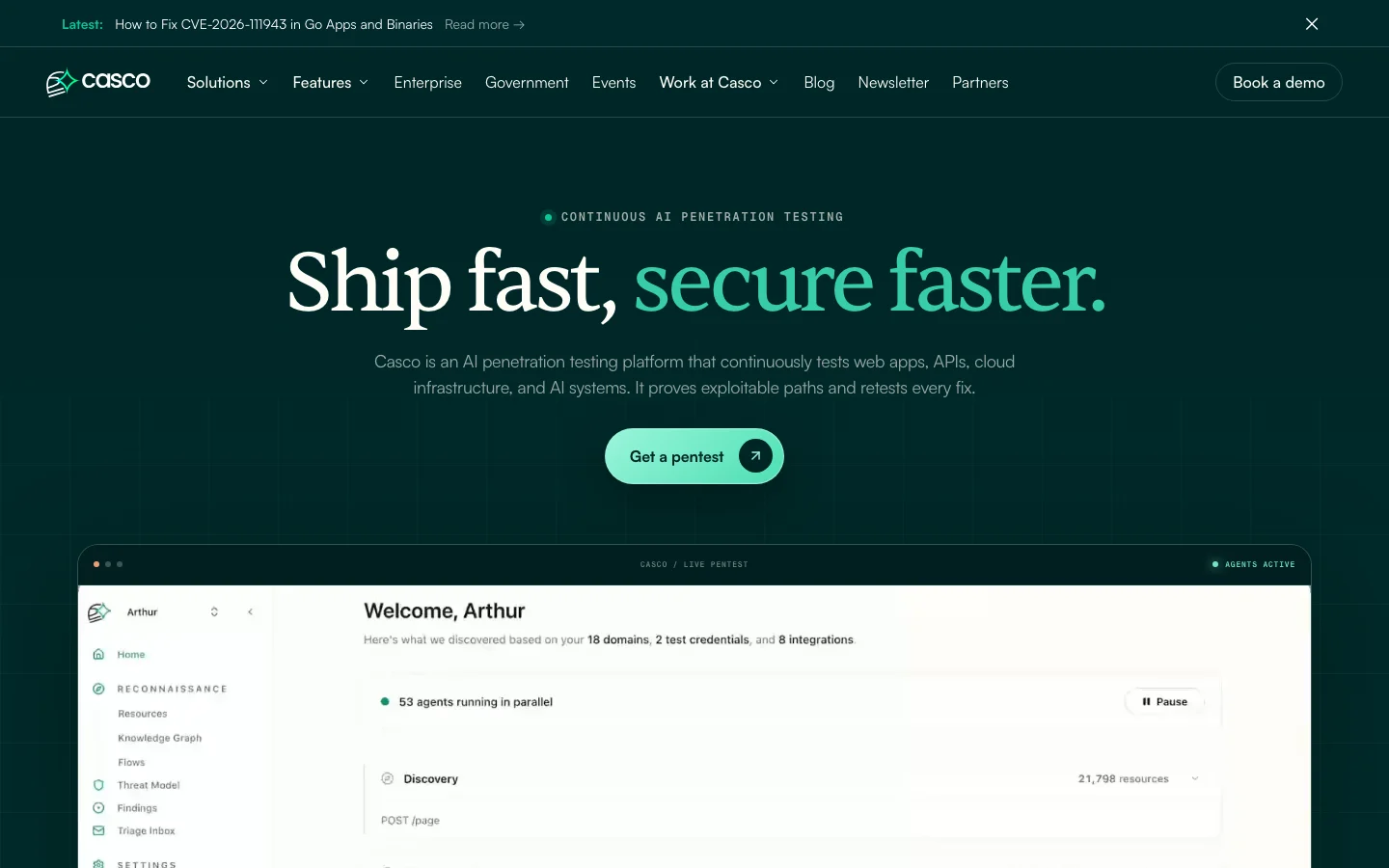
This is Casco's real first-party homepage, captured on 27 October 2026—not a generated product mock-up.
The review in 30 seconds
| The question | My answer |
|---|---|
| What is it? | autonomous security testing and supervised penetration-testing software for web applications, APIs, cloud systems and AI agents |
| What is the interesting part? | The most persuasive idea is the closed loop between a proven attack and remediation. |
| What would I test first? | A security team gives Casco two isolated test accounts with different roles in a staging copy of one revenue-critical workflow. |
| What is the biggest concern? | Autonomous offensive testing has a real blast radius. |
| How much does it cost? | Custom, based on product tier, usage and supervised-test scope; standard subscription period is one year |
| Who should shortlist it? | security and engineering teams with frequently changing web, API, cloud or agent surfaces that need more continuous exploit validation than an annual penetration test provides |
Why Casco exists
A conventional vulnerability scanner often flags patterns without demonstrating practical impact, while a point-in-time penetration test begins ageing as soon as the application changes. Casco combines an autonomous testing agent with a supervised service in which security engineers can scope and verify the work.
In practical terms, it is trying to help teams:
- Test web applications, APIs, cloud environments and AI systems for exploitable weaknesses
- Validate findings with attack evidence instead of severity labels alone
- Retest remediation and preserve the relationship between a finding and its fix
- Run supervised engagements with human security engineers
- Produce reports and compliance attestation evidence
The part I like most
The most persuasive idea is the closed loop between a proven attack and remediation. A team should be able to see the exploit path, fix the weakness and replay the relevant test instead of waiting for next year’s engagement or trusting that a ticket marked complete means the exposure disappeared.
That is the idea that earns Casco a place on a shortlist. The rest of the evaluation is about whether the implementation can support it without creating a new operational problem.
What Casco appears to do well
Autonomous attack execution
Casco describes an agent that tests web, API, cloud, mobile, network and AI surfaces. The first evaluation should define permitted hosts, accounts, data mutations, rate limits and stop conditions, then verify that the agent cannot cross them. A broad capability list is useful only when its execution boundary is dependable.
Exploit validation and attack paths
The product emphasises proving exploitability rather than reporting scanner patterns. Reviewers should demand request-level evidence, prerequisites, affected identity and business impact, then reproduce a sample manually. Duplicate findings and chained weaknesses should resolve into one understandable attack story.
Remediation and retesting
Continuous retesting can shorten the gap between a code change and security assurance. Test whether Casco distinguishes a fixed root cause from a blocked symptom, handles environment changes and alerts on regression without reopening irrelevant historical noise.
Casco Supervised
The supervised service adds human engineers who help scope testing, verify findings and communicate through Slack, Teams or email. Casco says reports normally arrive within five business days and includes 90-day retesting. Confirm deliverables, rush fees, attestation language and the engineer’s responsibility in the order form.
Coverage frameworks
Casco cites OWASP Top 10, API Top 10, LLM Top 10, Cloud Top 10 and the OWASP Agentic Threat Model. Framework coverage is a starting map, not a guarantee of business-logic depth. Include tenant isolation, role abuse and product-specific workflows in the scope.
The catch
Autonomous offensive testing has a real blast radius. A useful agent needs enough access to reach meaningful paths, but an over-broad test can affect data, availability or connected systems. “Exploitable” also needs evidence that a security engineer can reproduce—not merely a confident model narrative.
That does not make the product a bad choice. It identifies the exact claim the pilot needs to prove. A polished demonstration is useful for learning the interface; it is not evidence that the difficult cases work.
Casco pricing: what the numbers actually mean
Casco does not publish a self-serve price. Its terms say fees vary by product tier and usage, use a one-year subscription period and may be updated for the next subscription after notice. Casco Supervised says penetration-test pricing depends on scope. Ask for the number of targets and environments, testing frequency, authenticated roles, retest window, engineer time, rush fees, report and attestation deliverables, usage overages and renewal terms in one quote.
The published price is only the beginning of the cost. I would also model implementation, usage, storage, integrations, human review and the work required when something fails. When model or API consumption matters, the AI Token and API Cost Calculator can help turn expected volume into a range rather than a guess.
What makes me cautious about security and control
Casco’s trust centre lists SOC 2 Type II reports for 2025 and 2026 and says FedRAMP 20x Class C is in progress. Those are useful diligence signals, not permission to test carelessly. Confirm data handling, tester access, credential storage, source IPs, safe-harbour language, tenant isolation, evidence retention, deletion and incident escalation. The customer must also obtain internal and third-party authorisation for every target.
I would request the current security pack and map every credential, data type, automated action and deletion path before production access. The important question is not whether the vendor has a security page; it is whether the purchased plan and proposed architecture satisfy the team's real boundary.
What looks strong—and what still needs proving
What looks strong:
- Focuses on demonstrated exploit paths and remediation verification
- Supports autonomous testing and a human-supervised engagement model
- Publishes current SOC 2 evidence through a trust centre
- Covers application, API, cloud and emerging AI-agent attack surfaces
What still needs proving:
- No public entry price or standard scope makes budgeting dependent on sales
- Testing capability creates production and data-integrity risk if boundaries fail
- Framework coverage does not prove depth in a buyer’s business logic
- The value depends on reproducible evidence and prompt remediation ownership
This is the useful dividing line between marketing and a buying decision. The strengths explain why the product is interesting. The unresolved points determine whether it is safe and economical for this particular team.
How I would test Casco
A security team gives Casco two isolated test accounts with different roles in a staging copy of one revenue-critical workflow. It agrees explicit forbidden actions and monitors logs while Casco tests authentication, authorisation and business logic. Engineers manually reproduce every high-severity finding, repair one issue and verify that the exact attack fails during retesting without breaking legitimate use.
I would include normal work, edge cases and known failures, then record completion, serious errors, human corrections, latency and full cost. Preserve the same input set so another product can be tested on equal terms. The AI Tool Chooser can help turn those requirements into a consistent shortlist before the pilot starts.
Casco alternatives
| Consider | When it makes more sense |
|---|---|
| Pentera | a mature automated security-validation platform and broad enterprise attack surface are required |
| Horizon3.ai NodeZero | autonomous internal and external infrastructure pentesting leads the decision |
| Burp Suite Enterprise | web application scanning and a familiar application-security workflow are sufficient |
| A specialist penetration-testing firm | human creativity, a bespoke scope and board-ready attestation matter more than continuous automation |
| An internal red team | the organisation has enough scale and expertise to own continuous adversarial validation |
The feature labels may look similar, but the operating model can be completely different. Test the closest two options on the same work rather than comparing screenshots and plan names.
If the shortlist is already becoming another stack of overlapping subscriptions, our guide to why companies pay for too many AI tools explains the consolidation questions to ask. For a broader selection framework, which AI tool should I use for my business? separates useful fit from feature-count noise.
For adjacent examples, read our Salus review and Sentrial review.
Who should actually use Casco?
Casco makes the most sense for security and engineering teams with frequently changing web, API, cloud or agent surfaces that need more continuous exploit validation than an annual penetration test provides.
It is a weaker fit for small teams without an owner for remediation, organisations unable to provide a safe test boundary or buyers seeking a low-cost commodity vulnerability scanner. In that situation, a narrower product, an existing platform feature or a better manual process may solve the problem with less integration and governance work.
Software solves an operating problem; it does not automatically make a SaaS company discoverable. Teams that also need buyers and AI answer engines to find their product can review our AEO and AI visibility service as a separate acquisition decision.
The funding context
Casco is listed by Y Combinator in the Spring 2025 batch. YC’s standard deal invests $500,000 in accepted companies. We did not find a company-confirmed cumulative funding total in the reviewed primary sources, so this review uses the YC investment minimum only and does not treat funding as product validation.
Funding can help a company build the expensive parts of the product. It does not establish reliability, security or customer fit, so it is context—not part of the verdict.
Final verdict
Casco has a sharper proposition than another vulnerability dashboard: continuously attempt realistic attacks, prove the path and retest the repair. Its supervised option, defined reporting window and current SOC 2 evidence make it a credible evaluation candidate. The buying decision still depends on safe scope controls, reproducibility, false-positive rate, production impact and custom commercial terms.
My recommendation: Shortlist Casco if annual pentests and scanner queues leave too much time between discovery and verified remediation. Begin with a tightly scoped non-production target, agree explicit stop conditions and require reproducible evidence for every serious finding before expanding coverage.
Frequently asked questions
What is Casco?
Casco provides autonomous and supervised penetration testing for web applications, APIs, cloud environments and AI systems.
How much does Casco cost?
Casco uses custom pricing based on tier, usage and testing scope. Its public terms describe an annual subscription, while supervised pentest pricing depends on scope.
Is Casco SOC 2 compliant?
Casco’s trust centre lists SOC 2 Type II reports for 2025 and 2026. Buyers should obtain the report and confirm that its scope covers the purchased service.
How much funding has Casco raised?
Casco is a Spring 2025 YC company and therefore passes YC’s $500,000 standard investment threshold. We did not find a company-confirmed cumulative total.
Was this Casco review hands-on?
No. This is a research-based first-look review using official public evidence. We did not test an authenticated Casco workspace or connect production data.
Did Casco pay for inclusion?
No disclosed commercial relationship or payment influenced this review, and no numeric rating was assigned.

Tolu S.
Operations Lead, AI Search & GEO
Leads operations for AI search visibility and generative engine optimization (GEO) campaigns.