Table of Contents
- Zevero at a glance
- What Zevero is designed to do
- How we evaluated Zevero
- Core features and buyer value
- Example Zevero workflow
- Zevero pricing in 2026
- Security, privacy and governance questions
- Advantages
- Limitations and unresolved questions
- Who should use Zevero?
- A practical pilot plan
- Procurement checklist
- Zevero alternatives
- Is Zevero worth it?
- Final verdict
- Frequently asked questions
Zevero is carbon accounting, product footprint and decarbonisation platform. Zevero provides an approachable combination of carbon-accounting software and expert guidance, with unusually visible entry pricing. It suits growing companies formalising Scope 1–3 measurement, provided they test data lineage, emission-factor choices and assurance readiness rather than treating a dashboard total as settled truth.
This review answers the practical buying questions: what the product actually does, where it may create value, what remains unverified, how pricing works, and what a responsible pilot should measure. We separate observed public evidence from vendor claims and do not assign a numerical rating without repeatable authenticated testing.
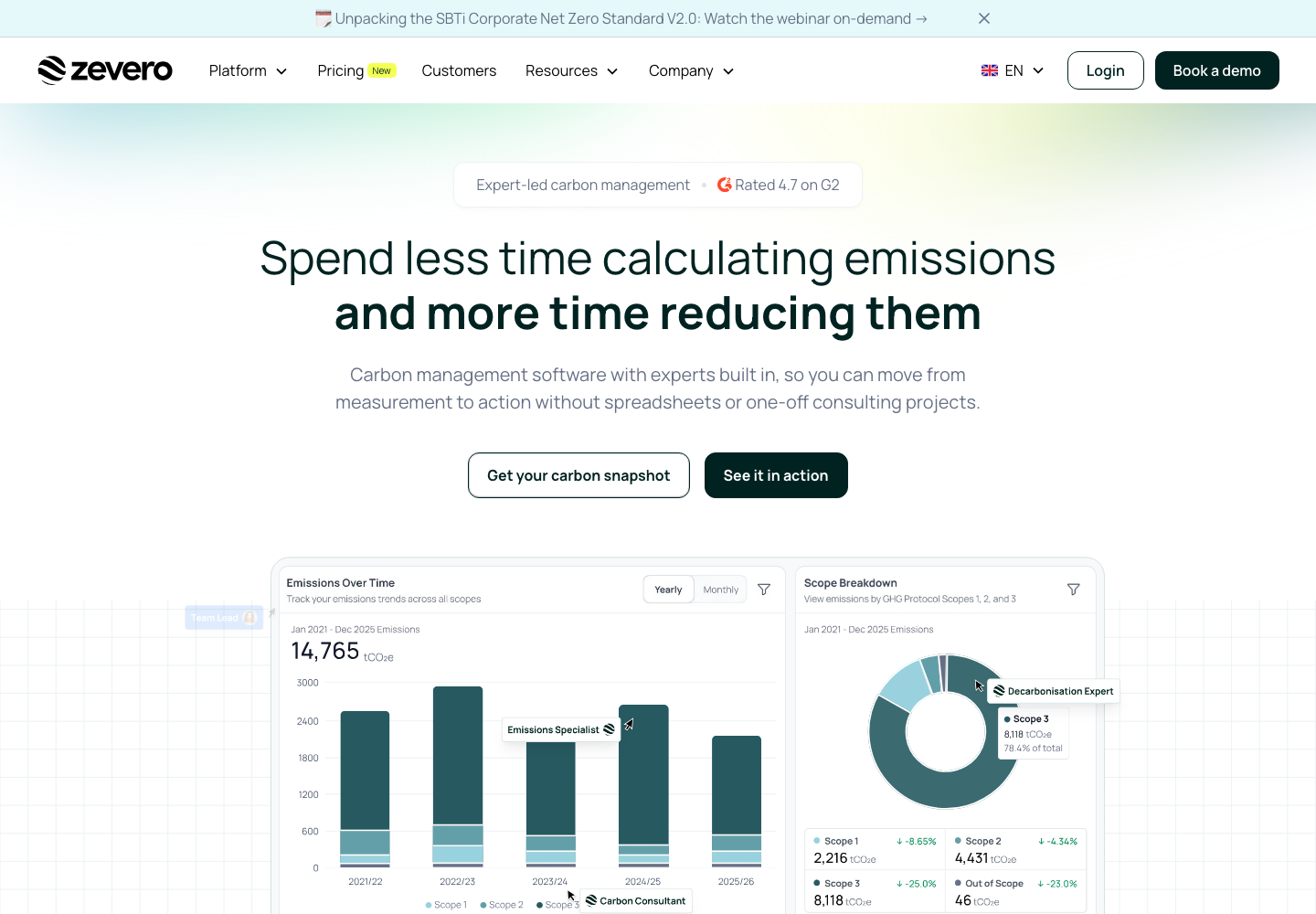
Authentic homepage evidence from Zevero. The interface and claims may change after capture.
Zevero at a glance
| Question | Answer |
|---|---|
| What is it? | carbon accounting, product footprint and decarbonisation platform |
| Best for | growing businesses measuring corporate and product emissions and planning decarbonisation |
| Less suitable for | organisations seeking a substitute for independent assurance or those without owners for supplier data |
| Pricing | Sales-led unless stated otherwise below |
| Review access | Public-evidence first look; no authenticated workspace |
| Main buying test | Prove accurate, governed outcomes on representative work |
What Zevero is designed to do
The product is designed around five buyer jobs:
- Calculate Scope 1, 2 and 3 emissions
- Identify emissions hotspots
- Build product carbon footprints
- Prepare ESG and disclosure outputs
- Model reduction pathways and targets
The important distinction is between a capability demonstrated on a website and a dependable operational result. A buyer should translate every claimed feature into a task, a source of truth, an acceptable error rate and a named owner. That makes a pilot comparable with the current process and prevents an attractive demo from becoming the success criterion.
How we evaluated Zevero
This is not a hands-on review. We reviewed the official positioning, publicly described capabilities and available commercial information, then designed a testing framework based on the risks of the category. We did not create a workspace, connect live company data or reproduce performance claims.
Our evaluation asks six questions:
- Does the product solve a frequent, costly job rather than add another dashboard?
- Can users inspect the evidence behind outputs and actions?
- What permissions and sensitive data does it require?
- How does it behave with missing, conflicting or adversarial inputs?
- Can actions be approved, reversed, exported and audited?
- Is the full cost justified by measured time, risk or revenue outcomes?
For teams evaluating AI software, our AI Tool Chooser can turn requirements into a more disciplined shortlist. If usage pricing is material, the AI Token Cost Calculator helps model scenarios before vendor negotiations.
Core features and buyer value
Corporate footprint
Scope calculations need source-level lineage, boundaries and factor versions. Review methodology with finance and sustainability owners.
Product carbon footprints
Per-product analysis supports design and customer claims. Allocation and supplier assumptions require documentation.
AI-assisted validation and reporting
Automation can find gaps and draft outputs. Human experts must approve material claims.
Reduction modelling
Scenario tools can compare interventions. Separate modelled potential from funded and achieved reductions.
Expert support
Guided implementation and reviews can improve quality. Clarify included hours and assurance boundaries.
Example Zevero workflow
Calculate one reporting year and one representative product. Reconcile source data to finance, inspect emission factors and assumptions, have an independent reviewer challenge boundaries, then model two reduction actions with accountable owners.
The workflow should be repeated with normal, edge-case and deliberately difficult inputs. Record completion, human edits, exceptions, failures and downstream consequences. Average quality can conceal a small number of expensive errors, so results should also be segmented by task and risk.
Zevero pricing in 2026
Zevero Lite starts at £1,500 yearly for Scope 1 and 2. Essential begins at £3,500 yearly for Scope 1–3, and Leading at £7,500 yearly. Product carbon footprints begin at £500 per product and AI ESG reporting at £1,000.
Pricing was checked on 20 July 2026 and can change. Ask the vendor to separate platform, implementation, usage, connectors, storage, support and overage costs. Build low, expected and high-volume scenarios, include internal administration, and insist that renewal assumptions are visible. A discount on an unclear unit of consumption is not cost predictability.
Security, privacy and governance questions
Before connecting production data, request the current security pack, subprocessors, architecture, data-flow diagram, retention schedule, deletion process and incident terms. Confirm encryption, SSO, role-based access, audit logs, regional processing, model-provider terms and whether customer data trains shared systems.
Create separate permissions for reading, drafting and acting. Use service identities rather than personal credentials, and give every automated action an owner, limit and revocation path. Test prompt injection and poisoned source content where AI interprets untrusted text. Export and deletion should be demonstrated, not answered only in a questionnaire.
If the product influences public visibility, customer communication or generated answers, establish an external baseline with our LLM Visibility Checker and document what changed. Software can reveal or automate work, but it does not replace the authority signals created through relevant coverage and credible sources; that is where 1stpage Agency’s link-building services serve a different execution need.
Advantages
- Public entry pricing
- Combines corporate and product footprints
- Guided expert implementation
- Supports measurement and reduction planning
Limitations and unresolved questions
- Supplier Scope 3 data can remain estimated
- Software does not replace independent assurance
- Higher-quality data requires internal work
- Public claims need careful methodology disclosure
These are diligence items rather than automatic disqualifiers. The purpose of a pilot is to convert them into evidence, contractual commitments or a clear decision not to proceed.
Who should use Zevero?
Zevero is best suited to growing businesses measuring corporate and product emissions and planning decarbonisation. The team should have a measurable baseline, an operational owner and enough representative work to test repeatably.
It is less suitable for organisations seeking a substitute for independent assurance or those without owners for supplier data. In that case, a narrower tool, existing platform capability or improved manual process may create more value with less integration and governance overhead.
A practical pilot plan
Start with one bounded workflow and 30 to 100 representative cases. Include routine examples, edge cases, incomplete inputs and known failures. Keep a human-labelled reference set hidden from the system, then measure accuracy, completion, time saved, edit rate and serious-error frequency.
During week one, connect only a sandbox or read-only source. During week two, let users review suggested outputs. During week three, enable reversible low-risk actions if thresholds are met. Preserve the existing process as a control group. Interview both enthusiastic and reluctant users; adoption data without reasons is difficult to interpret.
Define stop conditions before testing. Examples include exposure of restricted data, actions outside scope, unsupported claims, unrecoverable changes or a serious error above the agreed threshold. At the end, calculate value after review time, exceptions, implementation, licences and retained tools—not before those costs.
Document the baseline before the vendor configures the pilot. Record current cycle time, labour, error and exception rates, existing software cost, user satisfaction and the business consequence of failure. Keep the original input set and scoring rubric so competing products can be tested fairly. When the pilot ends, distinguish one-off onboarding gains from improvements likely to persist at full scale. A credible decision memo should show the measured evidence, unresolved risks, sensitivity to higher usage and the conditions that would trigger renewal, expansion or exit.
Procurement checklist
- Obtain an itemised three-year cost model and renewal cap.
- Confirm contract definitions for users, assets, tasks, usage and overages.
- Map every integration, permission and data category.
- Require export formats, deletion timing and transition assistance.
- Review uptime, support severity, recovery and incident commitments.
- Agree pilot acceptance thresholds and who signs them off.
- Ask for references with similar scale, industry and workflow complexity.
- Document which vendor claims remain unverified.
Zevero alternatives
| Alternative | Consider it when |
|---|---|
| Watershed | Enterprise climate programme and data breadth fit |
| Sweep | Collaborative carbon management is preferred |
| Plan A | European carbon accounting and decarbonisation fit |
| Normative | Accounting-led enterprise carbon platform suits |
| Specialist consultant | Bespoke methodology and assurance readiness dominate |
An alternative should be tested on the same input set and scored against the same outcomes. Feature counts are a weak comparison because two products may label a capability similarly while requiring very different implementation, review and governance effort.
For another view of how we separate product claims from buyer evidence, see our Nimt.ai review and Peec AI review. Those products serve different jobs, but the citation, pricing and pilot disciplines remain relevant.
Is Zevero worth it?
Zevero provides an approachable combination of carbon-accounting software and expert guidance, with unusually visible entry pricing. It suits growing companies formalising Scope 1–3 measurement, provided they test data lineage, emission-factor choices and assurance readiness rather than treating a dashboard total as settled truth.
The strongest purchase case is a measured improvement in a costly recurring workflow. The weakest is a broad ambition to “use AI” without baseline data, owners or acceptable-error definitions. Enter commercial discussions with the pilot dataset and security questions prepared; that changes the conversation from feature theatre to operational evidence.
Final verdict
Zevero deserves consideration for the specific best-fit users identified above, but this research-based review cannot establish production reliability or return on investment. Shortlist it if the workflow is frequent and valuable, then require a controlled pilot, inspectable evidence, reversible actions and transparent total cost. Do not scale solely on vendor-reported outcomes or a curated demonstration.
Frequently asked questions
How much does Zevero cost?
Lite starts at £1,500 yearly, Essential at £3,500 and Leading at £7,500.
Does Zevero measure Scope 3?
Essential and higher plans include Scope 1, 2 and 3 footprinting.
Can Zevero create product footprints?
Yes. Product carbon footprint work is offered separately from £500 per product.
Was this Zevero review hands-on?
No. It is a research-based first look using official public evidence. No authenticated workspace or production integration was tested.
Did Zevero pay for inclusion?
No commercial relationship was disclosed for this review, and no rating was assigned.

Tolu S.
Associate Director
Evidence-led product reviews and founder profiles for search, marketing, authority, and AI visibility teams.