Table of Contents
- The review in 30 seconds
- Why Specific exists
- The part I like most
- What Specific appears to do well
- The catch
- Specific pricing: what the numbers actually mean
- What makes me cautious about security and control
- What looks strong—and what still needs proving
- How I would test Specific
- Specific alternatives
- Who should actually use Specific?
- The funding context
- Final verdict
- Frequently asked questions
Coding agents can now create an application faster than most teams can provision a safe place to run it. That mismatch is where demos turn into infrastructure tickets. Specific wants the agent to handle both sides of the job without handing it the keys to an entire cloud account.
Specific is an agent-first cloud platform for defining, developing, deploying and observing application infrastructure.
My short take: Specific is worth a serious trial for small engineering teams already building with coding agents. Let an agent create one service, database and preview environment, then force a rollback and a migration. If the team cannot explain how to leave the platform, the trial is not finished.
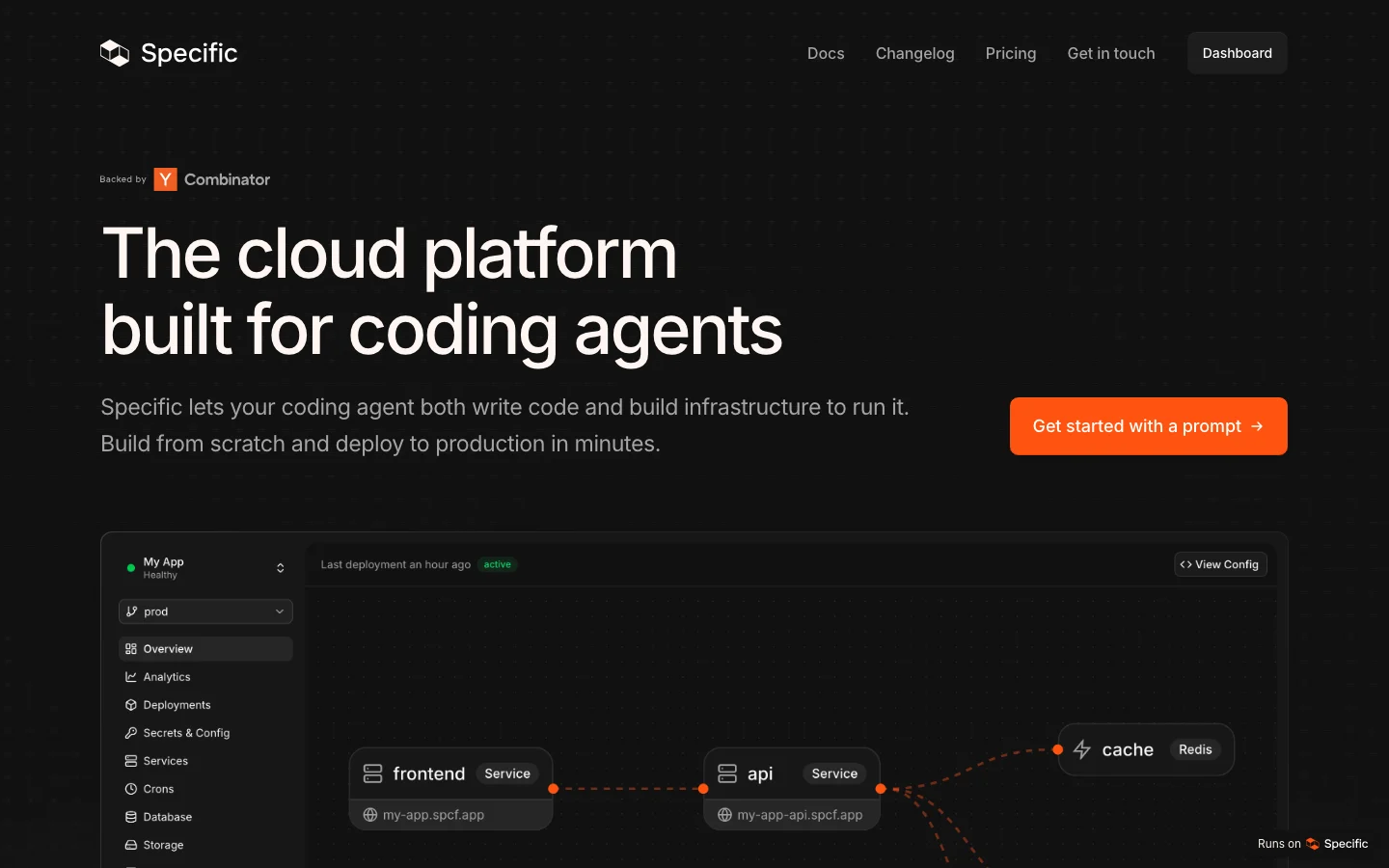
This is Specific's real first-party homepage, captured on 27 October 2026—not a generated product mock-up.
The review in 30 seconds
| The question | My answer |
|---|---|
| What is it? | an agent-first cloud platform for defining, developing, deploying and observing application infrastructure |
| What is the interesting part? | Infrastructure changes live in a reviewable specific.hcl file, while destructive production controls stay with humans in the dashboard. |
| What would I test first? | A team asks its normal coding agent to build a small API with Postgres, a background worker and file storage. |
| What is the biggest concern? | The abstraction is still a platform commitment. |
| How much does it cost? | Free $0; Pro $25/month with credits; Scale $299/month with credits; Enterprise custom; infrastructure usage billed separately |
| Who should shortlist it? | startups and product teams using coding agents that want one configuration for local development, previews, deployment and managed application services |
Why Specific exists
A coding agent that can edit application code but cannot create a database, inspect logs or reproduce the stack locally still depends on a human for every infrastructure boundary. Specific gives the agent a constrained configuration and CLI for services, data, storage, workflows, secrets and deployment.
In practical terms, it is trying to help teams:
- Define services and dependencies in one agent-readable configuration
- Run the full application stack locally without production credentials
- Create preview environments and deploy through CLI or GitHub
- Provide managed Postgres, storage, Redis, workflows and observability
- Keep sensitive production operations under human control
The part I like most
Infrastructure changes live in a reviewable specific.hcl file, while destructive production controls stay with humans in the dashboard. That is a more credible safety model than giving an agent broad cloud credentials and hoping the prompt contains enough caution.
That is the idea that earns Specific a place on a shortlist. The rest of the evaluation is about whether the implementation can support it without creating a new operational problem.
What Specific appears to do well
Agent-readable infrastructure
Specific teaches supported coding agents to edit a constrained HCL configuration, validate it and use matching CLI documentation. The pilot should test invalid resources, unsupported dependencies and whether code review makes the proposed infrastructure change understandable to a human.
Local development and previews
The same configuration can start local services and create temporary preview environments. That can close the gap between agent-written code and production, but buyers should test data masking, preview cleanup, migration safety and the risk of testing against production-derived data.
Deployment and managed building blocks
Specific covers web services, workers, cron jobs, Postgres, object storage, Redis-compatible caching, real-time sync and durable workflows. Each convenience creates an operating dependency, so test backups, restore, scaling, provider incidents and service-specific limits.
Observability for coding agents
Agents can query logs and metrics to diagnose deployed applications. Useful access needs boundaries: confirm which environments and fields an agent can see, how sensitive log data is redacted and whether a plausible automated fix still requires review before deployment.
Human production controls
Specific states that scaling, production secrets and deletion remain dashboard actions for humans. Validate the actual role model, approval path, audit history and API surface; a boundary described in documentation should also resist direct or indirect agent access.
The catch
The abstraction is still a platform commitment. Standard protocols reduce application lock-in, but deployment behaviour, managed services, regions, limits and operational tooling remain Specific’s responsibility. A simple first deploy does not prove a difficult migration or incident will be equally simple.
That does not make the product a bad choice. It identifies the exact claim the pilot needs to prove. A polished demonstration is useful for learning the interface; it is not evidence that the difficult cases work.
Specific pricing: what the numbers actually mean
Specific’s Free plan was $0 with five projects, limited compute and storage, unlimited users and one-day operational-data retention. Pro was $25 per month including $25 in usage credits, with unlimited projects, previews, autoscaling, custom domains and seven-day retention. Scale was $299 per month including the same amount in credits, with higher limits, SSO-based internal apps, exports and 30-day retention. Enterprise was custom and could add bring-your-own-cloud or on-premises deployment. Compute, database, workflow, storage and egress usage have separate published rates, so the monthly plan is not the full bill.
The published price is only the beginning of the cost. I would also model implementation, usage, storage, integrations, human review and the work required when something fails. When model or API consumption matters, the AI Token and API Cost Calculator can help turn expected volume into a range rather than a guess.
What makes me cautious about security and control
Specific says application services run on its Kubernetes platform in AWS eu-central-1, while managed Postgres and object storage use named infrastructure partners. Map every data store, secret and log to its processor and region. Verify encryption, isolation, backups, recovery objectives, access logs, deletion, SSO scope, incident terms and the security consequences of preview environments using production-like data.
I would request the current security pack and map every credential, data type, automated action and deletion path before production access. The important question is not whether the vendor has a security page; it is whether the purchased plan and proposed architecture satisfy the team's real boundary.
What looks strong—and what still needs proving
What looks strong:
- Public plan and usage pricing support realistic cost modelling
- One configuration spans local development and production deployment
- Standard protocols reduce application-code dependence on a proprietary SDK
- Human-only destructive controls create a sensible agent boundary
What still needs proving:
- A single primary application region may not fit every latency or residency need
- Managed building blocks create operational dependence despite standard interfaces
- Usage pricing spans several meters and needs workload modelling
- A young platform must prove recovery and support during real incidents
This is the useful dividing line between marketing and a buying decision. The strengths explain why the product is interesting. The unresolved points determine whether it is safe and economical for this particular team.
How I would test Specific
A team asks its normal coding agent to build a small API with Postgres, a background worker and file storage. It runs locally, opens a preview from a pull request and deploys to a non-critical environment. Reviewers then break a migration, rotate a secret, trigger an alert, restore data and document the path for moving each component elsewhere.
I would include normal work, edge cases and known failures, then record completion, serious errors, human corrections, latency and full cost. Preserve the same input set so another product can be tested on equal terms. The AI Tool Chooser can help turn those requirements into a consistent shortlist before the pilot starts.
Specific alternatives
| Consider | When it makes more sense |
|---|---|
| Render | the team wants a mature general-purpose application platform |
| Railway | fast developer-led deployment matters more than an agent-specific control model |
| Fly.io | regional placement and lower-level runtime control lead the decision |
| Supabase | database, auth and backend services are the centre of the application |
| Direct cloud plus Terraform | the team can own infrastructure code and needs maximum provider control |
The feature labels may look similar, but the operating model can be completely different. Test the closest two options on the same work rather than comparing screenshots and plan names.
If the shortlist is already becoming another stack of overlapping subscriptions, our guide to why companies pay for too many AI tools explains the consolidation questions to ask. For a broader selection framework, which AI tool should I use for my business? separates useful fit from feature-count noise.
For adjacent examples, read our Sourcebot review and Cua review.
Who should actually use Specific?
Specific makes the most sense for startups and product teams using coding agents that want one configuration for local development, previews, deployment and managed application services.
It is a weaker fit for teams requiring many cloud regions, highly bespoke infrastructure, direct ownership of every primitive or an established platform workflow they do not want to replace. In that situation, a narrower product, an existing platform feature or a better manual process may solve the problem with less integration and governance work.
Software solves an operating problem; it does not automatically make a SaaS company discoverable. Teams that also need buyers and AI answer engines to find their product can review our AEO and AI visibility service as a separate acquisition decision.
The funding context
Specific is listed by Y Combinator in the Fall 2025 batch. YC’s standard deal invests $500,000 in accepted companies. No company-confirmed cumulative funding total was found in the reviewed primary sources, so the funding status is the accelerator investment minimum only.
Funding can help a company build the expensive parts of the product. It does not establish reliability, security or customer fit, so it is context—not part of the verdict.
Final verdict
Specific is one of the clearer attempts to make infrastructure legible to coding agents without granting unrestricted cloud control. Its local workflow, reviewable configuration, human-only destructive operations and unusually transparent pricing make evaluation practical. The buying decision depends on operational depth: teams must test recovery, observability, provider boundaries, regional fit and portability before trusting the platform with production systems.
My recommendation: Specific is worth a serious trial for small engineering teams already building with coding agents. Let an agent create one service, database and preview environment, then force a rollback and a migration. If the team cannot explain how to leave the platform, the trial is not finished.
Frequently asked questions
What is Specific?
Specific is a cloud application platform designed so coding agents can define infrastructure, run the stack locally, deploy it and inspect production telemetry through a constrained configuration and CLI.
How much does Specific cost?
Specific had a free plan, a $25-per-month Pro plan and a $299-per-month Scale plan when checked on 27 October 2026. Infrastructure usage is billed separately.
Is Specific itself a coding agent?
No. It works with coding agents such as Codex, Claude Code and Cursor and gives them infrastructure documentation and commands.
How much funding has Specific raised?
Specific is a Fall 2025 YC company and passes YC’s $500,000 standard investment threshold. We did not find a company-confirmed cumulative total.
Was this Specific review hands-on?
No. This is a research-based first-look review using official public evidence. We did not test an authenticated Specific workspace or connect production data.
Did Specific pay for inclusion?
No disclosed commercial relationship or payment influenced this review, and no numeric rating was assigned.

Tolu S.
Operations Lead, AI Search & GEO
Leads operations for AI search visibility and generative engine optimization (GEO) campaigns.