Table of Contents
- The review in 30 seconds
- Why Latent exists
- The part I like most
- What Latent appears to do well
- The catch
- Latent pricing: what the numbers actually mean
- What makes me cautious about security and control
- What looks strong—and what still needs proving
- How I would test Latent
- Latent alternatives
- Who should actually use Latent?
- The funding context
- Final verdict
- Frequently asked questions
Most AI monitoring tells you a bad answer happened after the user received it. A second model can judge the output before delivery, but it adds cost and delay. Latent is trying to move the decision into the serving path by reading risk signals while—or immediately after—the first model answers.
Latent is runtime validation and intervention software for unsupported or incorrect language-model answers.
My short take: Latent is a strong pilot candidate for high-cost answer failures, especially where responses should be grounded in supplied sources. Run it in observe-only mode first, label a representative sample and measure serious-miss recall, flag precision and added latency before enabling automatic holds.
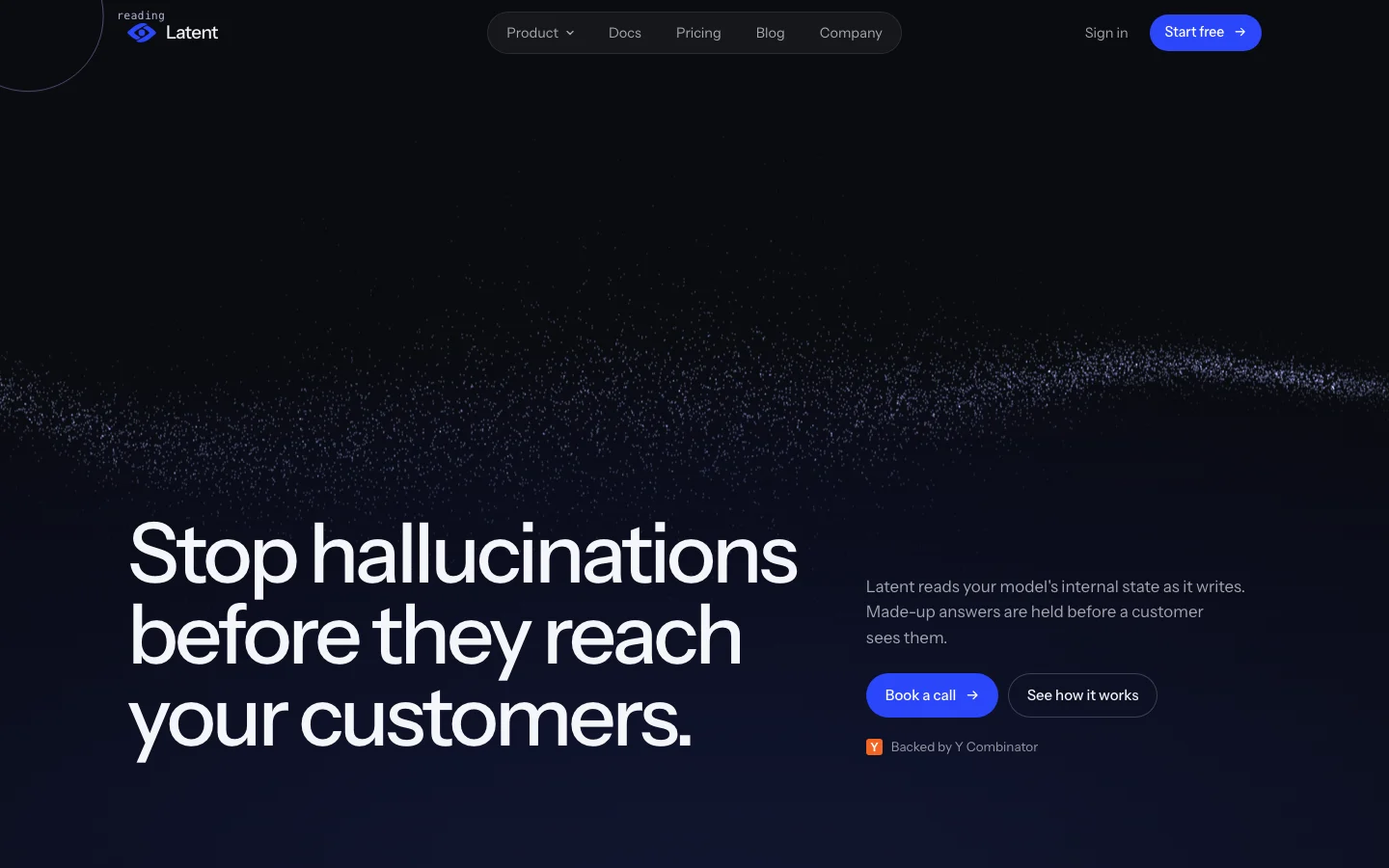
This is Latent's real first-party homepage, captured on 27 October 2026—not a generated product mock-up.
The review in 30 seconds
| The question | My answer |
|---|---|
| What is it? | runtime validation and intervention software for unsupported or incorrect language-model answers |
| What is the interesting part? | The product connects detection to an operational response. |
| What would I test first? | A support team mirrors 10,000 grounded answers into Latent without blocking users, then has two reviewers label a stratified sample. |
| What is the biggest concern? | A hallucination detector is another modelled judgement with false negatives and false positives. |
| How much does it cost? | Free 5,000 answers; Pro $299 for 100,000; Team $1,499 for one million; VPC add-on $1,500; Enterprise custom |
| Who should shortlist it? | AI teams in support, finance, legal, healthcare or agent workflows where an unsupported answer has material cost and a fallback path exists |
Why Latent exists
Production evals measure known scenarios, while live traffic keeps producing new combinations. Latent scores each response, routes risky answers to a fallback or review queue and learns from confirmed labels. For self-hosted models it can read internal activations; API models use a smaller reader model.
In practical terms, it is trying to help teams:
- Score model answers for unsupported or incorrect content
- Identify the sentence and tokens driving a risk flag
- Hold, replace, reroute or queue risky responses
- Calibrate thresholds from labelled production answers
- Export scores, alerts and confirmed examples into observability and training workflows
The part I like most
The product connects detection to an operational response. Teams can hold, replace or reroute a flagged answer instead of merely logging a score. That makes validation useful at the moment of risk, provided the detector is accurate and the fallback behaves predictably.
That is the idea that earns Latent a place on a shortlist. The rest of the evaluation is about whether the implementation can support it without creating a new operational problem.
What Latent appears to do well
Runtime answer scoring
Latent wraps supported model calls or exposes a compatible gateway and scores each finished answer. Test grounded, ungrounded, partially correct and adversarial outputs across response lengths. Measure p50 and p95 latency independently rather than assuming the reader is free.
In-band reads for self-hosted models
For supported self-hosted deployments, Latent can inspect internal state through a vLLM plugin while tokens are generated. Confirm exact model architectures, quantisation, batching and serving versions, plus GPU overhead and behaviour after a model upgrade.
Policies and automatic holds
Paid plans can hold, replace or reroute flagged responses and alert through Slack, PagerDuty, email or webhooks. Define timeout, detector-unavailable and fallback-unavailable behaviour. Observe-only rollout should precede any user-facing block.
Calibration and review queue
Reviewer confirmations become labelled examples and can move the threshold toward the buyer’s traffic. Build separate labels for unsupported, contradicted, incomplete and policy-invalid answers; an aggregate wrong label can hide different risks.
Deployment and observability
Latent supports its hosted service, a customer-cloud add-on and Enterprise deployments on customer hardware. It publishes Prometheus and OpenTelemetry integration claims. Verify which text, scores, hashes, activations and metadata cross each boundary.
The catch
A hallucination detector is another modelled judgement with false negatives and false positives. Vendor claims such as 95% flag precision or no added latency are not transferable to a buyer’s traffic. Calibration, domain drift and failure handling determine whether the safety layer helps or blocks good answers.
That does not make the product a bad choice. It identifies the exact claim the pilot needs to prove. A polished demonstration is useful for learning the interface; it is not evidence that the difficult cases work.
Latent pricing: what the numbers actually mean
Latent Free scores 5,000 answers per month. Pro is $299 for 100,000, then $1 per 1,000; Team is $1,499 for one million, then $0.60 per 1,000 up to five million. Pro calibration is $25 per run or $99 monthly for weekly calibration, while Team includes it. Running in the customer cloud adds $1,500 per month to Team. Judge analyses have daily allowances and $0.10 overage. Count streaming sentences, calibrations, judge explanations and retained text—not only chats.
The published price is only the beginning of the cost. I would also model implementation, usage, storage, integrations, human review and the work required when something fails. When model or API consumption matters, the AI Token and API Cost Calculator can help turn expected volume into a range rather than a guess.
What makes me cautious about security and control
Hosted plans send prompts and answers to Latent under project retention settings; activations are not sent. Customer-cloud Team can send scores, hashes and metadata back, while Enterprise can keep serving data inside the environment. Calibration or explanations may send samples to Anthropic unless the buyer uses its own judge or human labels. Verify redaction, retention, regions, subprocessors, authentication, telemetry, DPA, SLA and zero-retention terms.
I would request the current security pack and map every credential, data type, automated action and deletion path before production access. The important question is not whether the vendor has a security page; it is whether the purchased plan and proposed architecture satisfy the team's real boundary.
What looks strong—and what still needs proving
What looks strong:
- Connects detection to holds, fallback and review actions
- Publishes detailed allowances, overages and deployment pricing
- Supports hosted, customer-cloud and customer-hardware boundaries
- Explanations and labelled feedback make detector behaviour inspectable
What still needs proving:
- Accuracy claims require reproduction on the buyer’s traffic
- False positives can block valid answers and false negatives can leak risky ones
- Hosted scoring processes prompt and answer text
- Self-hosted internal-state support depends on model and serving compatibility
This is the useful dividing line between marketing and a buying decision. The strengths explain why the product is interesting. The unresolved points determine whether it is safe and economical for this particular team.
How I would test Latent
A support team mirrors 10,000 grounded answers into Latent without blocking users, then has two reviewers label a stratified sample. It measures serious-error recall, flag precision, inter-reviewer agreement, p95 latency and cost. Only one low-risk route receives automatic rerouting, with a deterministic fallback and immediate rollback.
I would include normal work, edge cases and known failures, then record completion, serious errors, human corrections, latency and full cost. Preserve the same input set so another product can be tested on equal terms. The AI Tool Chooser can help turn those requirements into a consistent shortlist before the pilot starts.
Latent alternatives
| Consider | When it makes more sense |
|---|---|
| Patronus AI | broader evaluator suites and enterprise testing lead the decision |
| Lakera Guard | prompt injection and policy security matter more than factual grounding |
| Galileo | observability and evaluation across the LLM lifecycle are required |
| A second-model judge | the workload is low-volume and simplicity matters |
| A deterministic citation checker | structured sources and rule-based validation are sufficient |
The feature labels may look similar, but the operating model can be completely different. Test the closest two options on the same work rather than comparing screenshots and plan names.
If the shortlist is already becoming another stack of overlapping subscriptions, our guide to why companies pay for too many AI tools explains the consolidation questions to ask. For a broader selection framework, which AI tool should I use for my business? separates useful fit from feature-count noise.
For adjacent examples, read our Bluejay review and Sentrial review.
Who should actually use Latent?
Latent makes the most sense for AI teams in support, finance, legal, healthcare or agent workflows where an unsupported answer has material cost and a fallback path exists.
It is a weaker fit for low-risk prototypes, applications without grounding sources or teams unable to label enough real traffic to validate calibration. In that situation, a narrower product, an existing platform feature or a better manual process may solve the problem with less integration and governance work.
Software solves an operating problem; it does not automatically make a SaaS company discoverable. Teams that also need buyers and AI answer engines to find their product can review our AEO and AI visibility service as a separate acquisition decision.
The funding context
Latent is listed by Y Combinator under the trylatent profile in the Fall 2026 batch. YC’s standard deal invests $500,000 in accepted companies. This is distinct from the Winter 2023 healthcare company with the same name. We found no company-confirmed cumulative funding total, so this review uses the YC investment minimum only.
Funding can help a company build the expensive parts of the product. It does not establish reliability, security or customer fit, so it is context—not part of the verdict.
Final verdict
Latent attacks a real gap between offline evals and live delivery. Per-answer scoring, calibrated policies, automatic intervention and VPC deployment create a serious evaluation path, while public pricing is unusually detailed. It must still earn trust on each workload: hidden-state access is model-specific, hosted scoring processes answer text and detector errors can expose bad outputs or suppress valid ones.
My recommendation: Latent is a strong pilot candidate for high-cost answer failures, especially where responses should be grounded in supplied sources. Run it in observe-only mode first, label a representative sample and measure serious-miss recall, flag precision and added latency before enabling automatic holds.
Frequently asked questions
What is Latent?
Latent scores language-model answers at runtime, flags likely unsupported or incorrect content and can hold, replace, reroute or queue risky responses.
How much does Latent cost?
Latent has a free 5,000-answer plan. Pro is $299 per month, Team is $1,499 and customer-cloud deployment adds $1,500 to Team; Enterprise is custom.
Does Latent add latency?
Latent markets some self-hosted reads as having no added serving latency, but API-reader and policy paths should be benchmarked on the buyer’s stack.
How much funding has Latent raised?
This Latent is a Fall 2026 YC company and passes YC’s $500,000 standard investment threshold. We did not find a company-confirmed cumulative total.
Was this Latent review hands-on?
No. This is a research-based first-look review using official public evidence. We did not test an authenticated Latent workspace or connect production data.
Did Latent pay for inclusion?
No disclosed commercial relationship or payment influenced this review, and no numeric rating was assigned.

Tolu S.
Operations Lead, AI Search & GEO
Leads operations for AI search visibility and generative engine optimization (GEO) campaigns.