Table of Contents
- The review in 30 seconds
- Why cubic exists
- The part I like most
- What cubic appears to do well
- The catch
- cubic pricing: what the numbers actually mean
- What makes me cautious about security and control
- What looks strong—and what still needs proving
- How I would test cubic
- cubic alternatives
- Who should actually use cubic?
- The funding context
- Final verdict
- Frequently asked questions
Coding agents can create a pull request in minutes. A senior engineer still has to work out whether it quietly breaks another service, violates a house rule or merely looks plausible. cubic wants to absorb that first review pass—and eventually approve the changes it considers safe.
cubic is AI code-review software for GitHub pull requests and continuous codebase scanning.
My short take: cubic deserves a trial for GitHub teams whose review queue is growing faster than reviewer capacity. Run it silently on previously reviewed pull requests first, compare its comments with known defects and keep human approval for high-risk changes until its miss rate is understood.
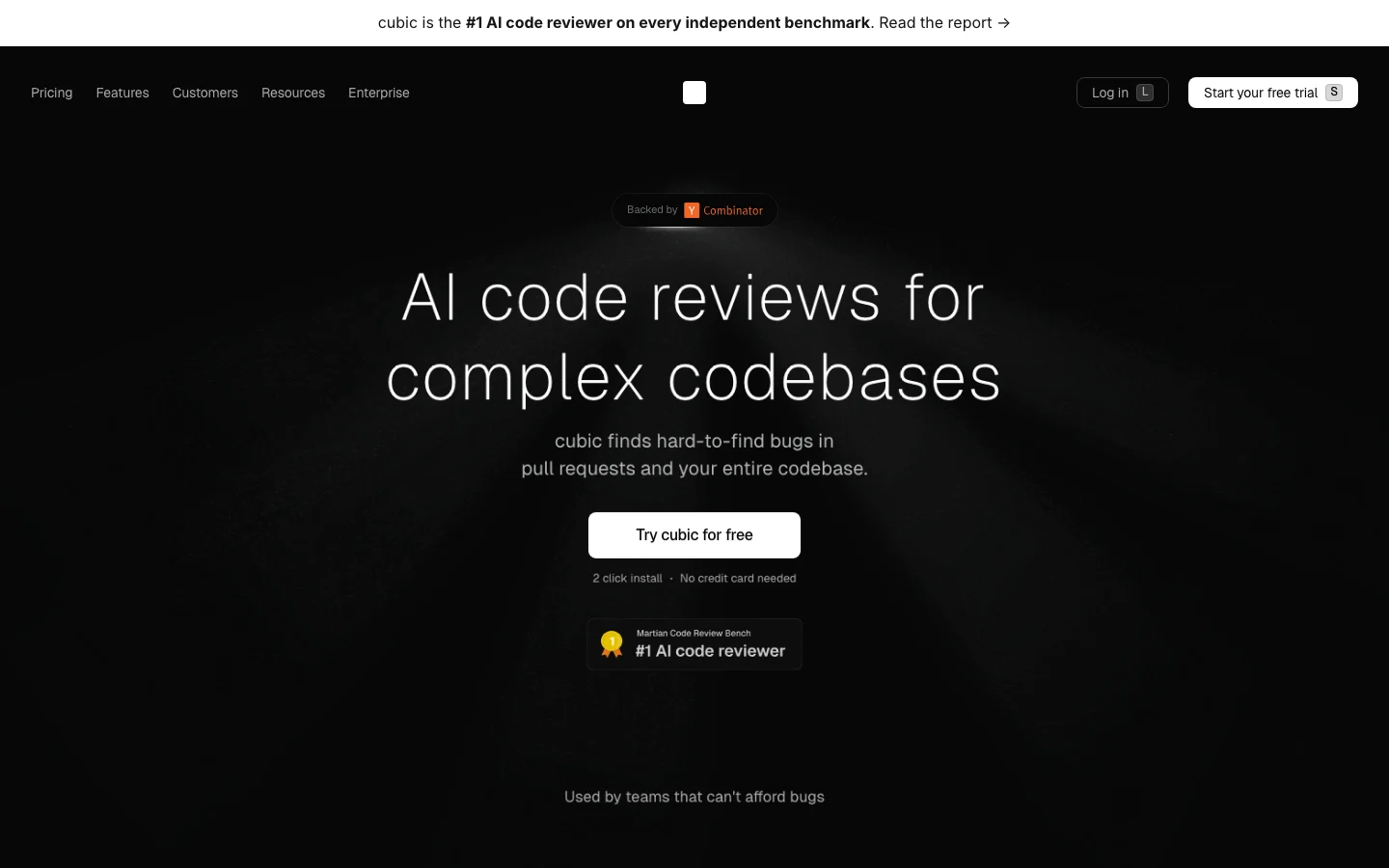
This is cubic's real first-party homepage, captured on 27 October 2026—not a generated product mock-up.
The review in 30 seconds
| The question | My answer |
|---|---|
| What is it? | AI code-review software for GitHub pull requests and continuous codebase scanning |
| What is the interesting part? | The strongest idea is turning useful comments from senior engineers into reusable review rules. |
| What would I test first? | An engineering team selects 50 merged pull requests: 20 clean, 20 with useful human comments and 10 that later caused defects. |
| What is the biggest concern? | Auto-approval and a merge-confidence score can make uncertainty look precise. |
| How much does it cost? | Starter free; Team $30 annual or $40 monthly per developer; Pro $79 annual or $99 monthly; Max $160 annual; Enterprise custom |
| Who should shortlist it? | GitHub-based engineering teams with frequent pull requests, senior-reviewer bottlenecks and enough historical review data to define what good looks like |
Why cubic exists
The volume of generated code is rising faster than experienced reviewers. Diff-only tools miss dependencies elsewhere in a repository, and generic comments create more work than they save. cubic tries to bring whole-codebase context, learned team conventions and automated fixes into the pull-request loop.
In practical terms, it is trying to help teams:
- Review pull requests with context beyond the changed lines
- Apply team-specific rules written in plain English
- Learn recurring standards from senior reviewers’ comments
- Score merge confidence and optionally approve low-risk changes
- Scan entire codebases and hand findings to coding agents for fixes
The part I like most
The strongest idea is turning useful comments from senior engineers into reusable review rules. If the system can learn what a team repeatedly catches and apply that standard to every pull request, expertise becomes a shared control instead of a queue around two people.
That is the idea that earns cubic a place on a shortlist. The rest of the evaluation is about whether the implementation can support it without creating a new operational problem.
What cubic appears to do well
Repository-aware pull-request review
cubic says each pull request is evaluated against the broader codebase rather than the diff alone. Build a test set containing cross-file contracts, migrations, permission changes and subtle regressions, then check whether the cited context is current and actually supports the comment.
Custom and learned review agents
Teams can describe rules in plain English and use historical reviewer feedback to teach recurring expectations. Review the generated rule before enforcement, version changes and include negative examples so a stylistic preference does not become a noisy universal warning.
Merge confidence and auto-approval
cubic assigns a one-to-five confidence score and can approve low-risk pull requests. Treat this as a policy decision, not a convenience toggle. Start with documentation or generated-file changes, monitor overrides and exclude authentication, money movement, migrations and other high-blast-radius paths.
CLI and coding-agent fixes
The CLI can run a review before a pull request opens, while Pro and Max can pass findings to coding agents for fixes. Confirm that proposed changes are isolated on a branch, preserve protected-branch rules and receive an independent review rather than allowing the same model loop to grade its own repair.
Continuous codebase scans
Higher plans include background scans that search beyond active pull requests. These can uncover inherited weaknesses, but thousands of agents can also generate a backlog. Sample finding precision, cap ticket creation and assign ownership before increasing scan frequency.
The catch
Auto-approval and a merge-confidence score can make uncertainty look precise. A reviewer that finds impressive edge cases but misses one consequential bug is not ready to become an authority. Teams need to measure false negatives, low-value comments and developer overrides—not just the number of findings.
That does not make the product a bad choice. It identifies the exact claim the pilot needs to prove. A polished demonstration is useful for learning the interface; it is not evidence that the difficult cases work.
cubic pricing: what the numbers actually mean
cubic’s Starter plan includes 20 private-repository pull-request reviews per organisation each month and is free for public repositories subject to fair use. Team lists 40,000 reviewed lines per developer at $30 monthly when billed yearly or $40 monthly. Pro lists 80,000 lines at $79 yearly or $99 monthly and adds coding-agent fixes and scans for three repositories. Max lists 160,000 lines at $160 per developer per month billed yearly. Extra capacity is $20 per 10,000 reviewed lines when enabled, while Enterprise adds custom identity, audit and contract terms. Confirm which contributors require seats and model line volume from real pull requests.
The published price is only the beginning of the cost. I would also model implementation, usage, storage, integrations, human review and the work required when something fails. When model or API consumption matters, the AI Token and API Cost Calculator can help turn expected volume into a range rather than a guess.
What makes me cautious about security and control
cubic says code is reviewed in real time, not retained or used for training, and that it is SOC 2 compliant. Its own technical material specifies SOC 2 Type 1. Verify the current report, subprocessors, model-provider retention, regional processing, GitHub App permissions, secret filtering, sandbox destruction, incident history, deletion evidence, SSO and audit-log availability. Teams that require code to remain on their network should note that public plans do not list self-hosting.
I would request the current security pack and map every credential, data type, automated action and deletion path before production access. The important question is not whether the vendor has a security page; it is whether the purchased plan and proposed architecture satisfy the team's real boundary.
What looks strong—and what still needs proving
What looks strong:
- Combines whole-repository context with pull-request review
- Can convert team conventions and reviewer feedback into reusable rules
- Offers a practical free allowance and published paid pricing
- Links findings to CLI checks, coding agents and broader codebase scans
What still needs proving:
- Current public product coverage is GitHub-only
- Auto-approval can magnify false confidence if the miss rate is unknown
- Reviewed-line allowances and developer seats require workload modelling
- Managed processing may not fit organisations that require on-premises code review
This is the useful dividing line between marketing and a buying decision. The strengths explain why the product is interesting. The unresolved points determine whether it is safe and economical for this particular team.
How I would test cubic
An engineering team selects 50 merged pull requests: 20 clean, 20 with useful human comments and 10 that later caused defects. It runs cubic without posting publicly, labels every finding and calculates serious-defect recall, false-positive rate and reviewer time saved. Only low-risk repositories receive auto-approval during a second phase; protected paths remain human-gated.
I would include normal work, edge cases and known failures, then record completion, serious errors, human corrections, latency and full cost. Preserve the same input set so another product can be tested on equal terms. The AI Tool Chooser can help turn those requirements into a consistent shortlist before the pilot starts.
cubic alternatives
| Consider | When it makes more sense |
|---|---|
| CodeRabbit | support for GitLab, Bitbucket or Azure DevOps and integrated static tools matter |
| Greptile | repository graph context across GitHub, GitLab and Bitbucket is preferred |
| Kodus | open-source or self-hosted review and broad Git-host coverage are required |
| GitHub Copilot code review | the team wants a native feature within an existing GitHub and Copilot contract |
| Human review with static analysis | change volume is manageable and deterministic checks cover the main risks |
The feature labels may look similar, but the operating model can be completely different. Test the closest two options on the same work rather than comparing screenshots and plan names.
If the shortlist is already becoming another stack of overlapping subscriptions, our guide to why companies pay for too many AI tools explains the consolidation questions to ask. For a broader selection framework, which AI tool should I use for my business? separates useful fit from feature-count noise.
For adjacent examples, read our Sourcebot review and Tessl review.
Who should actually use cubic?
cubic makes the most sense for GitHub-based engineering teams with frequent pull requests, senior-reviewer bottlenecks and enough historical review data to define what good looks like.
It is a weaker fit for GitLab, Bitbucket or Azure DevOps teams, small repositories with light review volume or organisations that cannot send code to a managed service. In that situation, a narrower product, an existing platform feature or a better manual process may solve the problem with less integration and governance work.
Software solves an operating problem; it does not automatically make a SaaS company discoverable. Teams that also need buyers and AI answer engines to find their product can review our AEO and AI visibility service as a separate acquisition decision.
The funding context
cubic is listed by Y Combinator in the Spring 2025 batch. YC’s standard deal invests $500,000 in accepted companies. We did not find a company-confirmed cumulative funding total in the primary evidence reviewed, so this article records the YC investment minimum only.
Funding can help a company build the expensive parts of the product. It does not establish reliability, security or customer fit, so it is context—not part of the verdict.
Final verdict
cubic presents a coherent answer to AI-driven code volume: repository context, learned rules, inline review, CLI checks and background scans in one GitHub-centred workflow. Transparent plans and a useful free tier lower the cost of evaluation. The decisive question is not whether it finds bugs in a demo, but whether its signal remains dependable enough to reduce human review without hiding serious misses.
My recommendation: cubic deserves a trial for GitHub teams whose review queue is growing faster than reviewer capacity. Run it silently on previously reviewed pull requests first, compare its comments with known defects and keep human approval for high-risk changes until its miss rate is understood.
Frequently asked questions
What is cubic?
cubic is an AI code-review platform for GitHub pull requests, repository-specific rules and continuous codebase scans.
How much does cubic cost?
Starter includes 20 pull-request reviews per month. Team starts at $30 per developer per month billed yearly, Pro at $79 and Max at $160; monthly billing and Enterprise terms differ.
Does cubic support GitLab or Bitbucket?
No. cubic’s current public product material says its pull-request review supports GitHub only.
How much funding has cubic raised?
cubic is a Spring 2025 YC company and passes YC’s $500,000 standard investment threshold. We did not find a company-confirmed cumulative funding total.
Was this cubic review hands-on?
No. This is a research-based first-look review using official public evidence. We did not test an authenticated cubic workspace or connect production data.
Did cubic pay for inclusion?
No disclosed commercial relationship or payment influenced this review, and no numeric rating was assigned.

Tolu S.
Operations Lead, AI Search & GEO
Leads operations for AI search visibility and generative engine optimization (GEO) campaigns.