Table of Contents
- The review in 30 seconds
- Why Golf exists
- The part I like most
- What Golf appears to do well
- The catch
- Golf pricing: what the numbers actually mean
- What makes me cautious about security and control
- What looks strong—and what still needs proving
- How I would test Golf
- Golf alternatives
- Who should actually use Golf?
- The funding context
- Final verdict
- Frequently asked questions
An engineer can connect an AI coding tool to GitHub, Postgres or an internal API before security knows an MCP server exists. The agent may be authorised by a valid credential, while the organisation still has no inventory, policy checkpoint or usable audit trail. Golf is built for that visibility gap.
Golf is enterprise security and governance software for AI agents and Model Context Protocol connections.
My short take: Golf merits a pilot for enterprises where MCP adoption is already outrunning security review. Start in discovery-only mode across one engineering group, reconcile its inventory with endpoint, identity and network records, then enforce a single narrow policy before expanding.
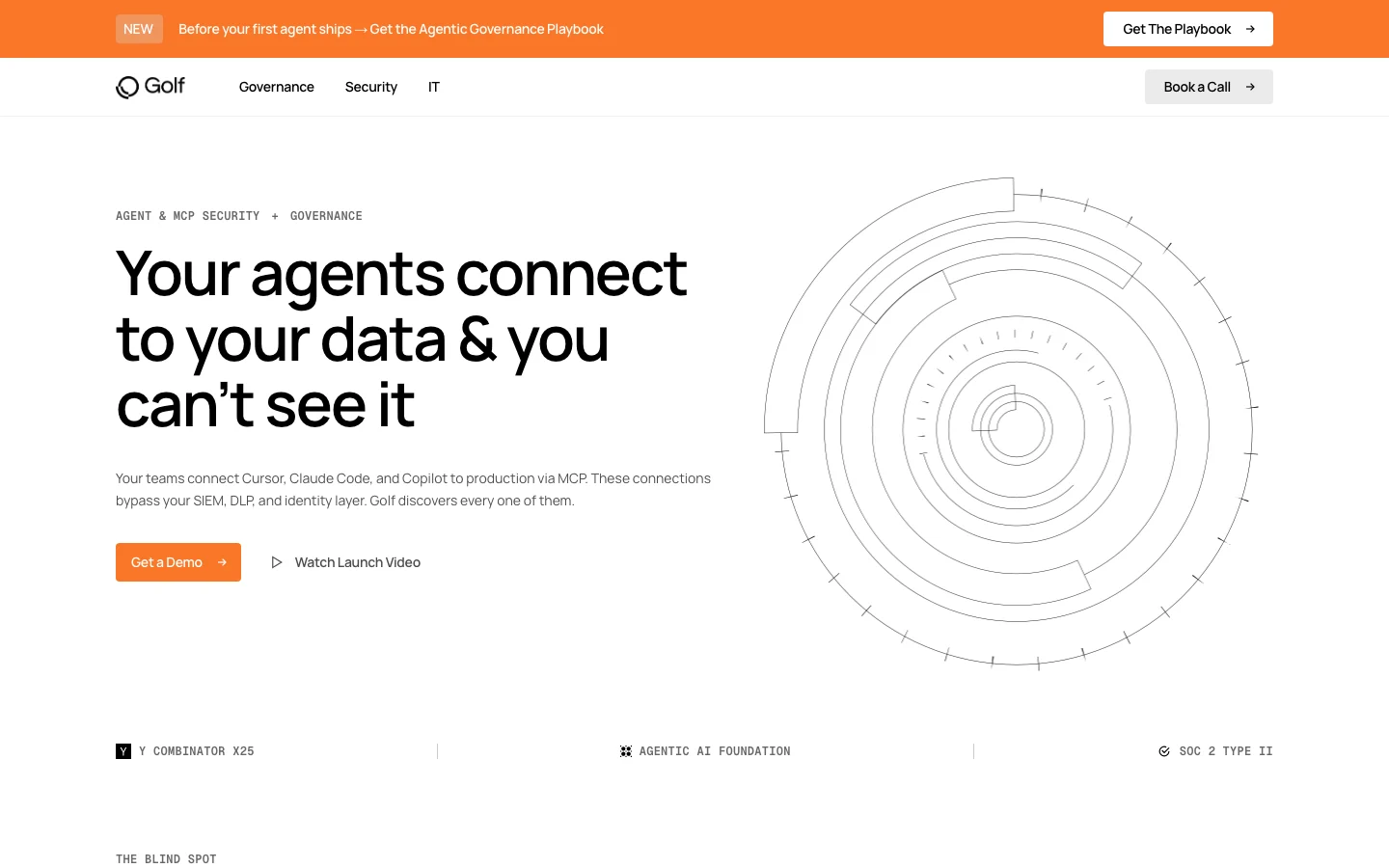
This is Golf's real first-party homepage, captured on 27 October 2026—not a generated product mock-up.
The review in 30 seconds
| The question | My answer |
|---|---|
| What is it? | enterprise security and governance software for AI agents and Model Context Protocol connections |
| What is the interesting part? | The compelling choice is to govern the point where agents reach company systems instead of trying to own every model interface. |
| What would I test first? | A platform-security team deploys Golf in discovery mode for one engineering group and leaves normal AI workflows unchanged. |
| What is the biggest concern? | A control plane is only as good as its coverage. |
| How much does it cost? | No public self-serve price; Golf uses an enterprise sales and demonstration process |
| Who should shortlist it? | enterprise security, platform and governance teams that already have agents connecting to sensitive systems through MCP across several AI clients |
Why Golf exists
Traditional SIEM, DLP and identity tools were not designed to interpret MCP tools and agent actions. Blocking every new agent slows adoption; approving them through spreadsheets leaves the control stale. Golf places discovery, policy and evidence around the MCP connection layer rather than requiring one approved language model.
In practical terms, it is trying to help teams:
- Discover MCP servers, agents, connected tools and data flows
- Classify shadow AI connections and assign organisational ownership
- Enforce policies by server, agent, team and data type
- Redact sensitive data and require approval for high-risk actions
- Create provenance-rich audit records and compliance evidence
The part I like most
The compelling choice is to govern the point where agents reach company systems instead of trying to own every model interface. If that coverage works, teams can keep using Cursor, Claude Code, Copilot or ChatGPT while security applies consistent rules to the tools and data those agents call.
That is the idea that earns Golf a place on a shortlist. The rest of the evaluation is about whether the implementation can support it without creating a new operational problem.
What Golf appears to do well
MCP discovery and inventory
Golf says it can auto-discover MCP servers, connected agents and data flows. Validate that claim against managed laptops, CI workers, cloud hosts, remote servers and local developer processes. Reconcile results with identity and network evidence, then measure what remains unknown.
Policy enforcement
Policies can apply by tool, team, data source and risk, including PII redaction and approvals. Test nested tool calls, renamed servers, retries, streaming responses and malformed payloads. Document whether an outage fails open, fails closed or degrades to a restricted read-only mode.
Protocol-aware security
Golf positions itself as MCP-aware rather than a generic LLM guardrail and cites prompt-injection detection and tool controls. Use benign and adversarial tool descriptions, poisoned responses, credential requests and exfiltration attempts to measure blocks and false positives.
Audit and governance evidence
The product describes a 90-day immutable trail and mappings to SOC 2, ISO 27001, NIST AI RMF, the EU AI Act and FINRA. A mapping accelerates evidence collection; it does not certify compliance. Auditors should confirm event completeness, timestamps, actor identity, exports and retention.
Deployment and integrations
Golf presents cloud, hybrid and on-premises options and says customer data can remain in the environment. Confirm which components, metadata and support diagnostics leave the boundary, plus identity-provider and SIEM compatibility, upgrade ownership and high-availability design.
The catch
A control plane is only as good as its coverage. One unmanaged MCP server, direct API credential or alternate proxy can bypass the policy story. Golf must prove discovery completeness, identity attribution and predictable fail behaviour before a buyer can call the resulting inventory authoritative.
That does not make the product a bad choice. It identifies the exact claim the pilot needs to prove. A polished demonstration is useful for learning the interface; it is not evidence that the difficult cases work.
Golf pricing: what the numbers actually mean
Golf does not publish plan or usage pricing on its current product pages. The commercial motion is a 30-minute enterprise call, so buyers should request a written model covering protected users, agents, MCP servers, tool calls, event volume, deployment type, data retention, integrations, support, implementation, overages and renewal increases. Compare the quote with the internal cost of inventory, gateway engineering and ongoing policy operations—not only another security licence.
The published price is only the beginning of the cost. I would also model implementation, usage, storage, integrations, human review and the work required when something fails. When model or API consumption matters, the AI Token and API Cost Calculator can help turn expected volume into a range rather than a guess.
What makes me cautious about security and control
Golf says it is SOC 2 Type II and supports on-premises or hybrid deployment where data does not leave the customer environment. Obtain the current report and architecture diagram, then verify certificate and key handling, control-plane access, log integrity, tenant isolation, redaction timing, update channels, subprocessors and support access. Because Golf may see sensitive tool traffic and enforce critical actions, its own compromise and outage scenarios belong in the threat model.
I would request the current security pack and map every credential, data type, automated action and deletion path before production access. The important question is not whether the vendor has a security page; it is whether the purchased plan and proposed architecture satisfy the team's real boundary.
What looks strong—and what still needs proving
What looks strong:
- Governs the MCP connection boundary without forcing one model vendor
- Combines discovery, enforcement and audit evidence in one product story
- Lists on-premises and hybrid deployment for sensitive environments
- Frames policies around actual tools, teams and data rather than abstract AI principles
What still needs proving:
- No public pricing or standard plan limits
- The proposition weakens if discovery misses alternate connection paths
- A control-plane outage or policy mistake can interrupt developer work
- Compliance mappings still require buyer and auditor validation
This is the useful dividing line between marketing and a buying decision. The strengths explain why the product is interesting. The unresolved points determine whether it is safe and economical for this particular team.
How I would test Golf
A platform-security team deploys Golf in discovery mode for one engineering group and leaves normal AI workflows unchanged. It compares the observed MCP inventory with endpoint, SIEM, identity and developer surveys, labels missed or duplicate connections and tests attribution. It then enforces one policy—blocking a synthetic credential from a test database—while measuring bypasses, latency, false positives and outage behaviour.
I would include normal work, edge cases and known failures, then record completion, serious errors, human corrections, latency and full cost. Preserve the same input set so another product can be tested on equal terms. The AI Tool Chooser can help turn those requirements into a consistent shortlist before the pilot starts.
Golf alternatives
| Consider | When it makes more sense |
|---|---|
| MCP gateways built into an existing platform | the organisation has one controlled agent stack and limited server variety |
| Cloudflare AI Gateway | model traffic observability and network controls matter more than MCP inventory |
| Lakera Guard | prompt injection and model input/output filtering are the primary concern |
| Permit.io or Open Policy Agent | the team can build its own protocol integration around a general policy engine |
| An internal MCP registry and proxy | platform engineering has the capacity to own discovery, enforcement and audit availability |
The feature labels may look similar, but the operating model can be completely different. Test the closest two options on the same work rather than comparing screenshots and plan names.
If the shortlist is already becoming another stack of overlapping subscriptions, our guide to why companies pay for too many AI tools explains the consolidation questions to ask. For a broader selection framework, which AI tool should I use for my business? separates useful fit from feature-count noise.
For adjacent examples, read our Salus review and Cua review.
Who should actually use Golf?
Golf makes the most sense for enterprise security, platform and governance teams that already have agents connecting to sensitive systems through MCP across several AI clients.
It is a weaker fit for small teams with a handful of known read-only integrations or organisations whose agent connections do not use MCP. In that situation, a narrower product, an existing platform feature or a better manual process may solve the problem with less integration and governance work.
Software solves an operating problem; it does not automatically make a SaaS company discoverable. Teams that also need buyers and AI answer engines to find their product can review our AEO and AI visibility service as a separate acquisition decision.
The funding context
Golf is listed by Y Combinator in the Spring 2025 batch. YC’s standard deal invests $500,000 in accepted companies. No company-confirmed cumulative funding total was found in the primary sources reviewed, so the funding label is the YC investment minimum only.
Funding can help a company build the expensive parts of the product. It does not establish reliability, security or customer fit, so it is context—not part of the verdict.
Final verdict
Golf targets a genuine gap between fast agent adoption and enterprise control. Its MCP-layer approach, deployment choices, policy model and audit framing are more concrete than a generic AI-governance dashboard. The purchase case depends on evidence that discovery catches the real environment, enforcement cannot be bypassed and the custom commercial terms justify another critical control plane.
My recommendation: Golf merits a pilot for enterprises where MCP adoption is already outrunning security review. Start in discovery-only mode across one engineering group, reconcile its inventory with endpoint, identity and network records, then enforce a single narrow policy before expanding.
Frequently asked questions
What is Golf?
Golf is security and governance software that discovers, controls and audits AI-agent connections made through MCP.
How much does Golf cost?
Golf does not publish self-serve pricing. Buyers need a custom enterprise quote based on deployment, coverage, integrations and usage.
Can Golf run on premises?
Golf’s public pages list on-premises, hybrid and cloud deployment and state that customer data can remain in the environment. Confirm the exact architecture during diligence.
How much funding has Golf raised?
Golf is a Spring 2025 YC company and passes YC’s $500,000 standard investment threshold. We did not find a company-confirmed cumulative total.
Was this Golf review hands-on?
No. This is a research-based first-look review using official public evidence. We did not test an authenticated Golf workspace or connect production data.
Did Golf pay for inclusion?
No disclosed commercial relationship or payment influenced this review, and no numeric rating was assigned.

Tolu S.
Operations Lead, AI Search & GEO
Leads operations for AI search visibility and generative engine optimization (GEO) campaigns.