Table of Contents
- The review in 30 seconds
- Why Databuddy exists
- The part I like most
- What Databuddy appears to do well
- The catch
- Databuddy pricing: what the numbers actually mean
- What makes me cautious about security and control
- What looks strong—and what still needs proving
- How I would test Databuddy
- Databuddy alternatives
- Who should actually use Databuddy?
- The funding context
- Final verdict
- Frequently asked questions
Early product teams often buy analytics, error tracking, uptime monitoring, feature flags and an AI query layer separately—then still need someone to explain why conversion moved. Databuddy compresses those jobs into one script and one dashboard.
Databuddy is cookieless product analytics, monitoring and AI analysis software for startups.
My short take: Databuddy is an attractive trial for startups that want useful product analytics before hiring a data team. Instrument one conversion journey, reconcile the counts with application records and test Databunny on questions whose answers you already know before trusting scheduled investigations.
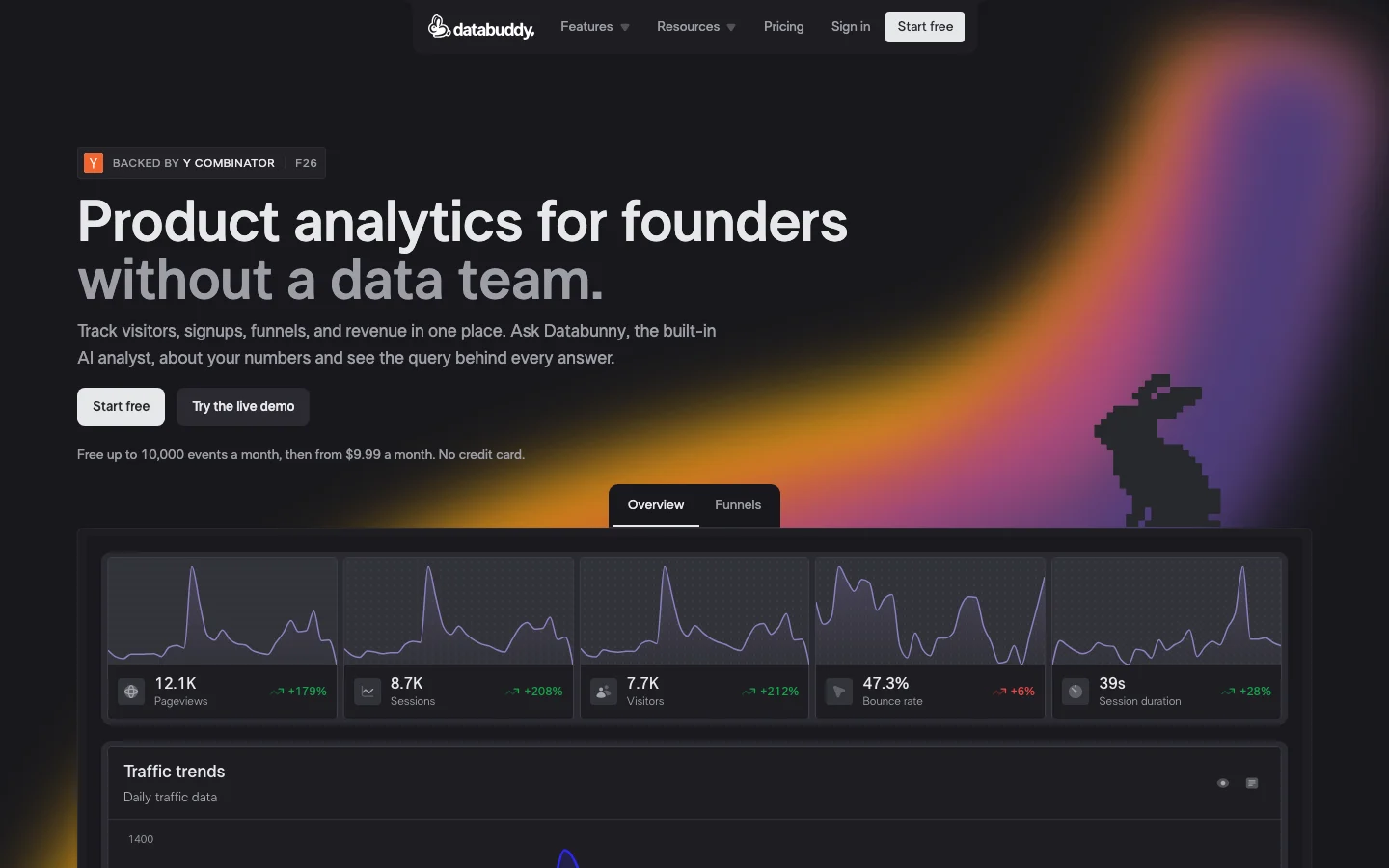
This is Databuddy's real first-party homepage, captured on 27 October 2026—not a generated product mock-up.
The review in 30 seconds
| The question | My answer |
|---|---|
| What is it? | cookieless product analytics, monitoring and AI analysis software for startups |
| What is the interesting part? | Showing the query behind an AI answer is the right instinct. |
| What would I test first? | A startup instruments signup, activation and purchase with a written event contract and server-side totals. |
| What is the biggest concern? | An all-in-one tracker can become a broad operational dependency. |
| How much does it cost? | Free 10,000 events; Hobby $9.99; Pro $49.99; Business $299; Scale $799; Enterprise custom |
| Who should shortlist it? | founders and lean product teams that need traffic, funnels, performance, errors and basic AI analysis in one developer-friendly platform |
Why Databuddy exists
Founders need enough behavioural evidence to make decisions without building a data team or maintaining a warehouse stack. Databuddy collects product events, performance and errors, then lets Databunny answer questions and show the query behind its answer. Higher plans add recurring investigations.
In practical terms, it is trying to help teams:
- Track visitors, sessions, events, funnels and goals
- Monitor Web Vitals, application errors and uptime
- Manage feature flags and short links
- Ask an AI analyst questions with visible query evidence
- Run recurring investigations and notify teams about changes
The part I like most
Showing the query behind an AI answer is the right instinct. A founder can inspect how the number was produced instead of treating an articulate explanation as evidence. That does not guarantee correctness, but it gives the team something concrete to challenge.
That is the idea that earns Databuddy a place on a shortlist. The rest of the evaluation is about whether the implementation can support it without creating a new operational problem.
What Databuddy appears to do well
Unified product telemetry
One tracker feeds traffic, conversion, error and performance views. Define an event dictionary, owners and versioning before rollout. Compare pageviews, signups and purchases with server records and inspect how ad blockers, SPA routing and duplicate events affect counts.
Databunny AI analyst
Databunny answers natural-language questions and shows its underlying query. Test metric ambiguity, time zones, cohort definitions, joins and no-answer behaviour. A visible query makes review possible, but someone still needs to understand whether it represents the business question.
Scheduled investigations
Business and Scale include recurring investigations that end with evidence and a proposed next step. Run them against known launches and incidents, label useful versus spurious alerts and prevent automatic ticket or workflow creation until precision is acceptable.
Errors, Web Vitals and uptime
Combining product and technical signals can connect a conversion drop with a browser-specific failure. Verify source maps, sampling, alert delay, retention and whether affected-user counts line up with analytics identity.
Feature flags and MCP
Feature flags sit in the same platform, and MCP lets agents inspect data or create analytics objects with confirmation. Protect write-capable tools, separate production and development, record agent actions and keep rollout safety independent of an AI explanation.
The catch
An all-in-one tracker can become a broad operational dependency. A simple install does not ensure event definitions, identity, funnels or revenue are modelled correctly. If the data contract is vague, Databunny can explain the wrong metric beautifully.
That does not make the product a bad choice. It identifies the exact claim the pilot needs to prove. A polished demonstration is useful for learning the interface; it is not evidence that the difficult cases work.
Databuddy pricing: what the numbers actually mean
Databuddy’s Free plan includes 10,000 events and 10 monthly AI credits. Hobby is $9.99 for 30,000 events; Pro is $49.99 for one million events and 350 monthly AI credits; Business is $299 for two million events, 1,500 credits and 100 investigations; Scale is $799 for six million events, 3,000 credits and 250 investigations plus SSO and audit logs. Additional investigations cost $1, while paid event overages use tiered per-thousand rates. Model identified profiles, event growth and investigation volume together.
The published price is only the beginning of the cost. I would also model implementation, usage, storage, integrations, human review and the work required when something fails. When model or API consumption matters, the AI Token and API Cost Calculator can help turn expected volume into a range rather than a guess.
What makes me cautious about security and control
Databuddy documents cookieless collection, no raw IP retention, origin validation, TLS, rate limits and optional AES-256-GCM protection for identity fields. Identification changes the privacy boundary: names, emails and custom properties become personal data controlled by the customer. Verify hosting regions, retention, subprocessors, deletion, role controls, SSO plan requirements, audit logs and whether localStorage use needs consent in each jurisdiction.
I would request the current security pack and map every credential, data type, automated action and deletion path before production access. The important question is not whether the vendor has a security page; it is whether the purchased plan and proposed architecture satisfy the team's real boundary.
What looks strong—and what still needs proving
What looks strong:
- Broad analytics and monitoring coverage from one tracker
- Transparent plans from free through Scale
- AI answers expose the query used to produce them
- Cookieless and anonymous defaults reduce unnecessary collection
What still needs proving:
- Metric quality still depends on disciplined instrumentation
- SSO and audit logs begin on the $799 Scale plan
- Event and investigation overages introduce two cost axes
- An all-in-one platform creates switching and availability concentration
This is the useful dividing line between marketing and a buying decision. The strengths explain why the product is interesting. The unresolved points determine whether it is safe and economical for this particular team.
How I would test Databuddy
A startup instruments signup, activation and purchase with a written event contract and server-side totals. It runs Databuddy for two weeks, reconciles counts daily, builds one funnel and asks Databunny ten questions with known answers. It then schedules one investigation and scores evidence quality, false alerts and whether the recommendation changed a decision.
I would include normal work, edge cases and known failures, then record completion, serious errors, human corrections, latency and full cost. Preserve the same input set so another product can be tested on equal terms. The AI Tool Chooser can help turn those requirements into a consistent shortlist before the pilot starts.
Databuddy alternatives
| Consider | When it makes more sense |
|---|---|
| PostHog | open-source deployment, experimentation and a broader product stack matter |
| Plausible | simple privacy-focused web analytics without AI analysis is enough |
| Amplitude | mature behavioural analytics and enterprise governance lead the decision |
| Mixpanel | deep event analysis and established product workflows are required |
| A warehouse and BI stack | the organisation needs a governed semantic layer across many systems |
The feature labels may look similar, but the operating model can be completely different. Test the closest two options on the same work rather than comparing screenshots and plan names.
If the shortlist is already becoming another stack of overlapping subscriptions, our guide to why companies pay for too many AI tools explains the consolidation questions to ask. For a broader selection framework, which AI tool should I use for my business? separates useful fit from feature-count noise.
For adjacent examples, read our Funnel review and Pigment review.
Who should actually use Databuddy?
Databuddy makes the most sense for founders and lean product teams that need traffic, funnels, performance, errors and basic AI analysis in one developer-friendly platform.
It is a weaker fit for enterprises with an established warehouse and semantic layer, teams needing advanced experimentation or organisations requiring self-hosting and deep governance on lower plans. In that situation, a narrower product, an existing platform feature or a better manual process may solve the problem with less integration and governance work.
Software solves an operating problem; it does not automatically make a SaaS company discoverable. Teams that also need buyers and AI answer engines to find their product can review our AEO and AI visibility service as a separate acquisition decision.
The funding context
Databuddy is listed by Y Combinator in the Fall 2026 batch. YC’s standard deal invests $500,000 in accepted companies. No company-confirmed cumulative funding total was found in the reviewed primary sources, so this review uses the YC investment minimum only.
Funding can help a company build the expensive parts of the product. It does not establish reliability, security or customer fit, so it is context—not part of the verdict.
Final verdict
Databuddy packs an unusually broad startup analytics stack into transparent, accessible plans. Cookieless defaults, query visibility and a $9.99 entry tier are genuine strengths. Buyers still need disciplined event design, privacy review, AI-answer validation and a cost model for event growth and investigations.
My recommendation: Databuddy is an attractive trial for startups that want useful product analytics before hiring a data team. Instrument one conversion journey, reconcile the counts with application records and test Databunny on questions whose answers you already know before trusting scheduled investigations.
Frequently asked questions
What is Databuddy?
Databuddy is product analytics software that combines traffic, funnels, errors, performance, feature flags and an AI analyst called Databunny.
How much does Databuddy cost?
Databuddy has a free 10,000-event plan. Paid plans start at $9.99 per month and rise through Pro, Business, Scale and custom Enterprise.
Is Databuddy cookieless?
Databuddy says its analytics use local storage rather than tracking cookies and avoid cross-site tracking. Identification and customer configuration can still change privacy obligations.
How much funding has Databuddy raised?
Databuddy is a Fall 2026 YC company and passes YC’s $500,000 standard investment threshold. We did not find a company-confirmed cumulative total.
Was this Databuddy review hands-on?
No. This is a research-based first-look review using official public evidence. We did not test an authenticated Databuddy workspace or connect production data.
Did Databuddy pay for inclusion?
No disclosed commercial relationship or payment influenced this review, and no numeric rating was assigned.

Tolu S.
Operations Lead, AI Search & GEO
Leads operations for AI search visibility and generative engine optimization (GEO) campaigns.