fact_checkResearch-based first look
Table of ContentsOpenClose
- Funnel at a glance
- What Funnel is designed to do
- The part I like most
- Core features and buyer value
- The catch
- Funnel pricing in 2026
- Who should use Funnel?
- How I would test Funnel
- Funnel alternatives
- Related reading for this decision
- My final verdict
- Frequently asked questions
Funnel at a glance
| Question | Answer |
|---|
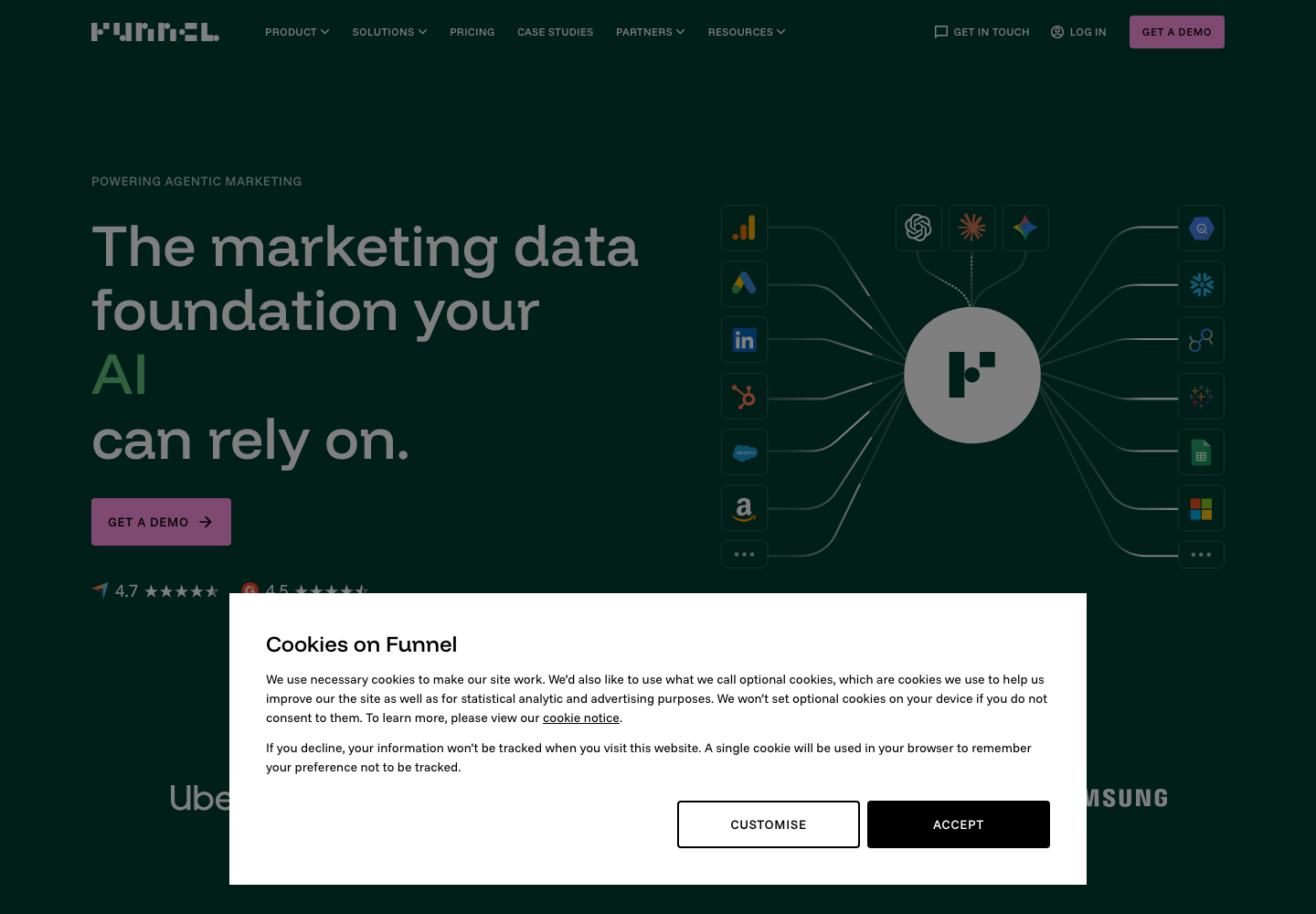
| What is it? | marketing data hub for collection, modelling and activation |
| Best for | brands and agencies consolidating data from many advertising, analytics and commerce platforms |
| Less suitable for | small teams with a few stable sources or data-engineering teams preferring code-first pipelines |
| Pricing | Sales-led unless stated otherwise below |
| Review access | Public-evidence first look; no authenticated workspace |
| Main buying test | Prove accurate, governed outcomes on representative work |
What Funnel is designed to do
The product is designed around five buyer jobs:
- Connect marketing data sources without maintaining APIs
- Store and transform metrics and dimensions
- Build dashboards and spreadsheet reports
- Export governed data to warehouses and BI tools
- Support measurement and agency client reporting
The part I like most
Managed marketing-data connections appeal to me when they remove recurring reconciliation work.
- Large managed marketing connector catalogue
- Reduces API maintenance burden
- Supports brands and agencies explicitly
- Clear published entry prices
Core features and buyer value
Managed connector catalogue
Starter exposes a smaller connector set while Business expands beyond 500. Verify exact sources, fields, refresh and history.
Marketing data modelling
Marketer-friendly rules can standardise campaign names and metrics. Test edge cases and change control.
Reporting and dashboards
Native and destination reporting supports different teams. Reconcile every total against source platforms.
Warehouse and destination export
Business plans broaden exports. Model duplicate storage, egress and refresh requirements.
Measurement
Higher tiers include measurement capabilities. Confirm methods, data prerequisites and whether results are decision-ready.
The catch
Connector count is a weak buying signal if revenue definitions, historical reloads or schema changes cannot be trusted.
- Entry cost is high for small teams
- Final cost depends on configuration
- Transformation convenience can hide logic complexity
- Source-platform attribution differences remain
Funnel pricing in 2026
Pricing evidence was recorded on 20 July 2026. The figures and plan descriptions below are historical research, not a newly verified quote. Confirm current terms with Funnel before budgeting.
Funnel Starter begins at $300 per month billed annually and Business at $600 per month billed annually. Final pricing varies by connectors, data volume, destinations and capabilities; enterprise and agency configurations require a quote.
Who should use Funnel?
Funnel is best suited to brands and agencies consolidating data from many advertising, analytics and commerce platforms.
It is less suitable for small teams with a few stable sources or data-engineering teams preferring code-first pipelines.
How I would test Funnel
For Funnel, my proposed test would use this scenario rather than begin with a production rollout:
Connect the five largest spend sources, reproduce one executive and one channel report, then compare totals, freshness and maintenance time for 30 days. Test a changed API field and historical reload before migration.
Funnel alternatives
| Alternative | Consider it when |
|---|
| Supermetrics | Spreadsheet and BI extraction is the primary need |
| Adverity | Enterprise marketing data operations fit |
| Improvado | Managed marketing analytics pipelines are preferred |
| Fivetran | General warehouse ingestion dominates |
| Airbyte | Open-source connector control is strategic |
Before adding Funnel to a shortlist, I would write down the job, the current alternative and the evidence needed to justify a change. Our guide to a requirements-first approach to choosing AI tools.
For Funnel, I would also count the existing tools, review time and operating work that remain after adoption. Our guide to a framework for reviewing overlapping software costs.
I would use the AI Tool Chooser to organise the shortlist around requirements before a vendor discussion. It does not replace the product-specific, technical or professional validation described for Funnel.
For related creative buying decisions, I would also read our autone review and Bannersnack review. These are adjacent evaluations, not a claim that every product replaces Funnel.
My final verdict
I would put Funnel on a conditional shortlist for brands and agencies consolidating data from many advertising, analytics and commerce platforms.
Connector count is a weak buying signal if revenue definitions, historical reloads or schema changes cannot be trusted.
Frequently asked questions
How much does Funnel cost?
Starter begins at $300 monthly billed annually and Business at $600, with configuration affecting final price.
Does Funnel provide connectors?
Yes. Its plans include managed connectors, with the broader catalogue on Business.
It includes dashboards but also prepares and exports marketing data to reporting and warehouse destinations.
Was this Funnel review hands-on?
No. It is a research-based first look using official public evidence. No authenticated workspace or production integration was tested.
Did Funnel pay for inclusion?
No commercial relationship was disclosed for this review, and no rating was assigned.

Tolu S.
Operations Lead, AI Search & GEO
Leads operations for AI search visibility and generative engine optimization (GEO) campaigns.