Short answer
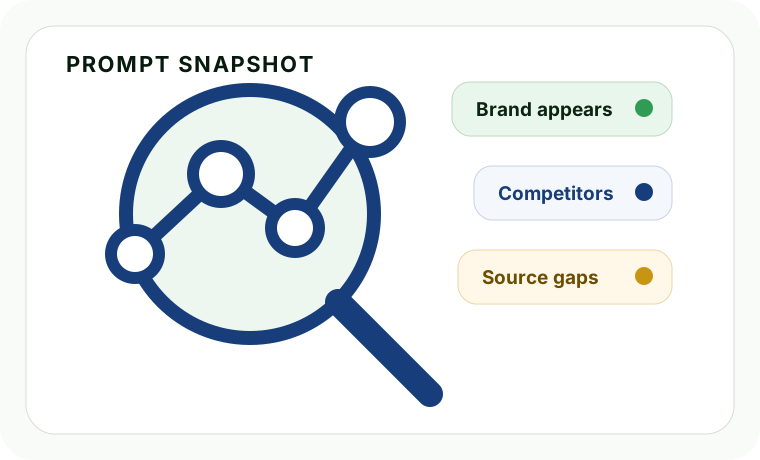
An AI visibility checklist should help you answer four questions: which buyer prompts matter, whether your brand appears, which competitors appear instead, and what source evidence AI systems can use to justify recommending you.
If you want a quick baseline before building a full tracker, start with the free LLM Visibility Checker. Use it to document your first prompt snapshot, then use this checklist to decide what to fix next.
Reader question
"Do I need a complex AI monitoring platform before I can start?"
No. A small controlled prompt set, a simple scoring sheet, and a clear source gap review are enough to find the obvious visibility issues. Advanced tracking becomes useful after you know which prompts and competitors matter.
Useful next steps: LLM Visibility Checker, AI Citation Readiness Checker, and LLMentioned.
Table of Contents
AI visibility is easy to talk about and hard to measure cleanly. One person runs a ChatGPT prompt, sees a competitor, and assumes the market has moved. Another person runs the same prompt later, sees a different answer, and assumes there is nothing useful to track.
The truth sits between those two reactions. AI answers vary, but they do not vary randomly enough to ignore. When a brand is repeatedly mentioned across buyer-style prompts, it usually has stronger entity clarity, stronger third-party references, better topical source coverage, or all three.
A checklist gives you a practical middle ground. It stops the team from chasing one screenshot, and it keeps the work focused on prompts, mentions, citations, competitors, and source quality. That is the level where AI visibility becomes actionable.
What the checklist should prove
The purpose of an AI visibility checklist is not to force every model to say the same thing. That will not happen. Different AI systems use different indexes, retrieval methods, browsing modes, context windows, and answer styles. Even within the same product, answers can change based on wording, location, account history, and freshness.
The purpose is to create a repeatable snapshot. You want to know whether your brand appears often enough to be considered visible, whether competitors appear more often, and whether the answer points to sources that support or weaken your authority.
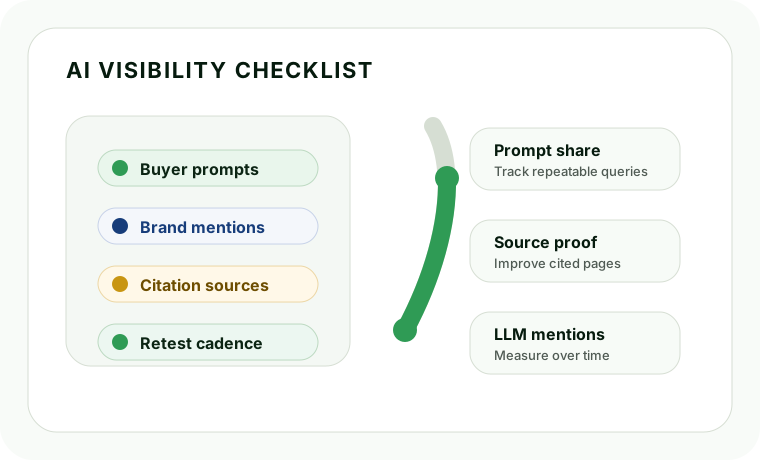
For most brands, the checklist should prove five things. First, you are testing prompts that buyers might actually use. Second, you are separating brand mentions from website citations. Third, you are tracking competitors instead of only tracking yourself. Fourth, you are checking whether the source trail supports the positioning you want. Fifth, you are retesting on a schedule so the team can see movement.
That turns AI visibility into a workflow. It also creates a useful bridge between SEO, digital PR, link building, content, and sales enablement because each team can see which part of the evidence trail is weak.
Core AI visibility checklist
- Build a short list of buyer prompts by category, location, use case, and comparison intent.
- Record whether your brand is named, cited, linked, or ignored.
- Log the competitors that appear and the language used to describe them.
- Review the pages and third-party sources AI answers appear to rely on.
- Prioritize fixes, publish better source proof, and retest the same prompt set.
Define the buyer prompts that matter
The most common mistake is testing vanity prompts. A founder might ask, "What is [brand name]?" and feel satisfied when the answer is correct. That is useful for entity recognition, but it does not show whether the brand is visible when a buyer is choosing a provider.
Start with prompts that represent commercial discovery. These are questions like "best AI visibility agency for SaaS companies," "top link building services for law firms," "compare tools for checking whether a brand appears in ChatGPT," or "which agencies help brands get mentioned in AI answers?" The exact examples will change by market, but the intent should stay close to real buying behavior.
Group prompts into clusters. A small cluster might include recommendation prompts, comparison prompts, problem prompts, source prompts, and local or niche prompts. The goal is not to create hundreds of prompts on day one. Ten to twenty well-chosen prompts are more useful than a bloated list no one reviews.
Every prompt should have a reason. If a prompt does not map to a buyer, a sales objection, a high-value service page, or a competitor comparison, remove it. A tighter set makes it easier to repeat the check and spot changes over time.
Check whether the brand appears unaided
Once the prompt set is ready, run the prompts without forcing your brand into the question. This is important. If you ask an AI system to explain your brand, you are testing recognition. If you ask which brands it recommends in a category, you are testing discovery.
For each answer, record the type of appearance. A strong appearance names the brand and describes it accurately for the right category. A stronger appearance names the brand, includes the website or a citation, and places it in a relevant shortlist. A weak appearance may mention the brand in passing, confuse the category, or provide outdated information.
Do not treat every mention equally. A brand that appears as "one option among many" is in a different position from a brand that is clearly recommended as a specialist. A brand that is cited as a source is in a different position from a brand that is simply named with no evidence.
Use a simple scoring system: absent, weak mention, clear mention, cited mention, and recommended mention. This gives the team enough detail to compare prompts without creating a reporting burden that slows the work down.
Record competitor pressure
AI visibility is not only about whether you appear. It is also about who appears when you do not. Competitor pressure tells you which brands already have the source profile, content clarity, category association, or PR footprint that AI systems find easier to reuse.
When a competitor appears, capture the exact phrase used to describe them. Are they called a platform, agency, marketplace, consultant, specialist, tool, or provider? That language often reveals the entity category an AI answer has assigned to them. If your brand wants the same category but your pages describe the offer in inconsistent terms, that mismatch becomes a fixable issue.
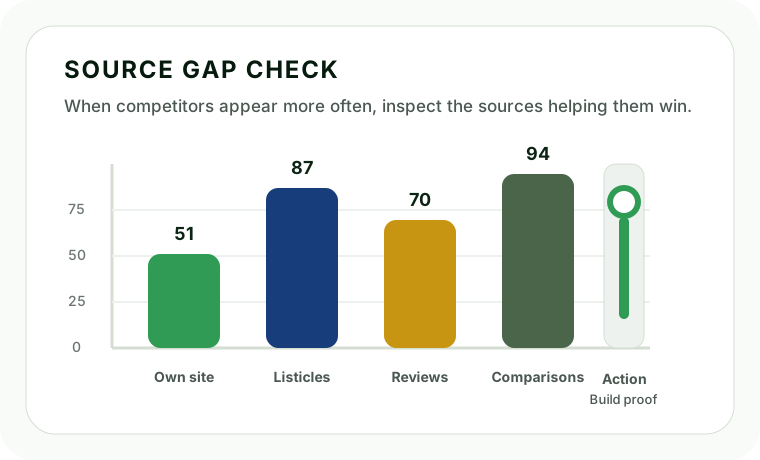
Also capture repeated sources. If AI answers keep referencing the same third-party lists, media mentions, review pages, forum discussions, or comparison articles, those sources are part of the recommendation environment. You may not be able to control them directly, but you can decide whether to earn inclusion, create better alternatives, or build stronger supporting sources elsewhere.
A good competitor log includes the prompt, the model, the date, your position, competitor names, cited sources, and a short note about why the answer may have favored them.
Audit citation readiness
After the prompt check, look at your own pages. AI systems need clear source material. If your site makes it hard to understand what you do, who you serve, what proof you have, and why you belong in a category, you are making the answer harder to generate.
Start with the pages most likely to define your entity: homepage, about page, service pages, case studies, pricing or offer pages, contact page, and any tool pages or resources that show expertise. Check whether each page has a clear heading, direct description, concrete service language, proof points, schema where appropriate, and internal links to supporting pages.
The AI Citation Readiness Checker is useful here because it focuses on whether a page is structured in a way that can be cited, summarized, or understood. This does not replace editorial quality. It simply makes sure the page gives machines and humans enough information to work with.
Look for missing facts. Does the page say the markets you serve? Does it identify the service category? Does it explain the outcome? Does it include examples, case studies, process details, or evidence? Does it use consistent naming for the brand and service? Small clarity gaps can cause large visibility gaps because AI systems often prefer sources that make categorization easy.
Build third-party source proof
Owned pages matter, but AI answers often draw confidence from third-party sources. That includes publisher articles, industry lists, comparison pages, customer discussions, reviews, interviews, podcasts, directories, Reddit threads, Quora answers, and other pages that talk about the brand outside its own site.
The best source proof is specific. A vague mention that says your company "does marketing" is weaker than a relevant article that says your company helps SaaS teams measure AI search visibility. A brand mention on a high-authority page is useful, but the context around the mention determines whether it supports the category you care about.
This is where digital PR, niche edits, listicle placements, community mentions, and partner content can support AI visibility when they are planned carefully. The objective is not to spray the web with generic mentions. The objective is to build a consistent evidence trail that connects your brand, service category, audience, and outcomes.
For LLM mentions, prioritize sources that are crawlable, stable, relevant, and semantically clear. If a page already ranks, earns traffic, or appears in comparison research, it may be more likely to influence future discovery. If it is thin, hidden, or unrelated, it is less likely to help even if it technically mentions the brand.
Retest and track share of voice
Retesting is where the checklist becomes valuable. Run the same prompt set after you improve pages, publish source proof, or earn new placements. Do not change every variable at once. Keep the core prompts stable so you can compare results.
Track AI share of voice as a simple ratio: how often your brand appears across the prompt set compared with the total number of brand appearances in those answers. If ten prompts generate forty brand mentions and your brand appears six times, your snapshot share is fifteen percent. That number is not perfect, but it is useful when measured consistently.
Pair the score with notes. A month where share of voice rises but citations remain weak tells a different story from a month where citations improve but recommendations do not change yet. The notes help you understand whether the work is improving entity clarity, source depth, or actual recommendation frequency.
For fast-moving markets, test monthly. For very competitive or high-value categories, test weekly. For early-stage brands, test after meaningful source changes rather than every day. The goal is to create enough measurement discipline to guide action, not to watch answers fluctuate hour by hour.
When to use the LLM Visibility Checker
Use the LLM Visibility Checker when you need a quick structured baseline. It is especially useful before a new AI visibility campaign, after publishing new service pages, before a sales presentation, or when a stakeholder wants to know whether the brand appears in AI recommendation answers.
Use it with this checklist. The tool helps with the first snapshot. The checklist helps you interpret the result. Together, they give you a practical loop: test the prompts, record the answer, check source readiness, build better proof, and retest.
When you need ongoing monitoring, competitor reporting, and deeper source planning, connect the snapshot to an LLMentioned workflow. That is where the same logic becomes an ongoing campaign rather than a one-time audit.
The most important point is to start with a repeatable process. AI visibility will keep changing, but brands that measure prompts, mentions, sources, and competitors will have a clearer path than brands waiting for perfect data.
FAQ
What is an AI visibility checklist?
An AI visibility checklist is a repeatable workflow for testing whether a brand appears in AI answers. It usually includes buyer prompts, brand mentions, competitor mentions, citation checks, source quality notes, and a retesting cadence.
How often should we run AI visibility checks?
Most brands should run a lightweight check once per month and a deeper review after major content, PR, or link building work. Competitive categories may need weekly snapshots, but daily checks often create noise unless you have a specific launch or reputation issue.
Can SEO rankings prove LLM visibility?
No. SEO rankings and LLM visibility overlap, but they are not the same. A page can rank well and still be absent from recommendation answers. A brand can also be mentioned in AI answers because of third-party sources, not only because its own page ranks.
What should we fix first if the brand is missing?
Start with clarity. Make sure your own pages clearly describe the brand, service category, audience, proof, and outcomes. Then build third-party source proof that repeats those same signals in credible places.

Adam O'neil
1stpage Editorial Team
Our 1stpage editorial team combines hands-on SEO agency experience with evidence-backed search performance guidance. These posts are built from real search wins, audit-grade insight, and conversion-tested tactics designed to help agencies, founders, and search teams earn more traffic and trust.