Short answer
Track AI brand mentions by grouping buyer prompts into clusters, recording brand mentions and competitor mentions, scoring the quality of each appearance, and repeating the same prompts on a consistent schedule.
The fastest way to create a baseline is with the free LLM Visibility Checker. Use it before deeper tracking or source-building work.
Reader question
"What is the most important metric?"
Mention rate is useful, but quality matters. A top recommendation with supporting sources is more valuable than a weak mention buried in a broad answer.
Useful next steps: LLM Visibility Checker, AI Citation Readiness Checker, and LLMentioned.
Table of Contents
One prompt is not a measurement system. To understand AI brand visibility, you need to track groups of prompts over time and record how often your brand appears, how it appears, and who appears instead.
This guide gives you a practical tracking framework that works before you invest in a full AI share-of-voice program.
Use it to turn scattered AI answers into a repeatable visibility baseline.
What to track
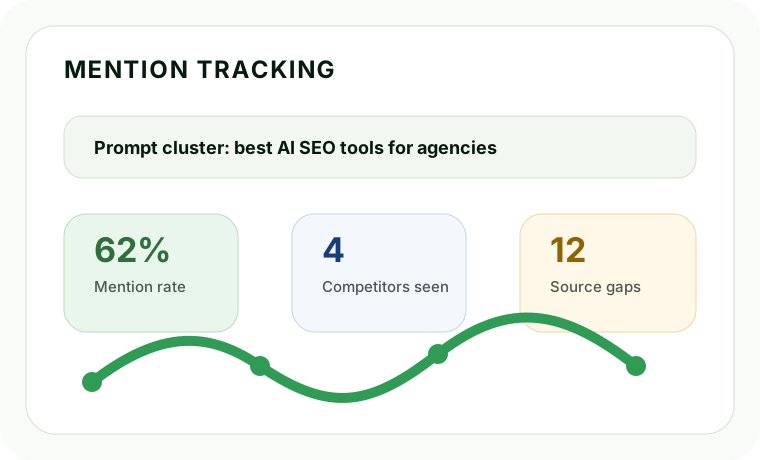
Track more than whether your brand appears. Record the prompt, answer date, brand mention, domain mention, placement, competitor names, cited sources, and next action.
Minimum fields for a tracker
A useful tracker should be simple enough to maintain but detailed enough to explain movement. Start with the prompt, prompt cluster, model or environment, date, brand present, domain cited, answer placement, competitors mentioned, cited sources, and recommended next action. Add a notes column for anything unusual, such as personalization, location wording, or a prompt that returned a very generic answer.
The next-action field is important. AI visibility tracking should not become a spreadsheet that nobody uses. Every row should point to a decision: improve a page, build a comparison source, add a stronger answer section, pursue a publisher mention, monitor a competitor, or retire a prompt that does not match buyer intent.
Build prompt clusters
A prompt cluster is a set of related questions around the same buyer intent. For example, a SaaS brand might track prompts around alternatives, best tools, implementation help, pricing comparisons, and category recommendations.
Do not mix every use case into one score. Cluster prompts by buyer intent so the results are easier to interpret.
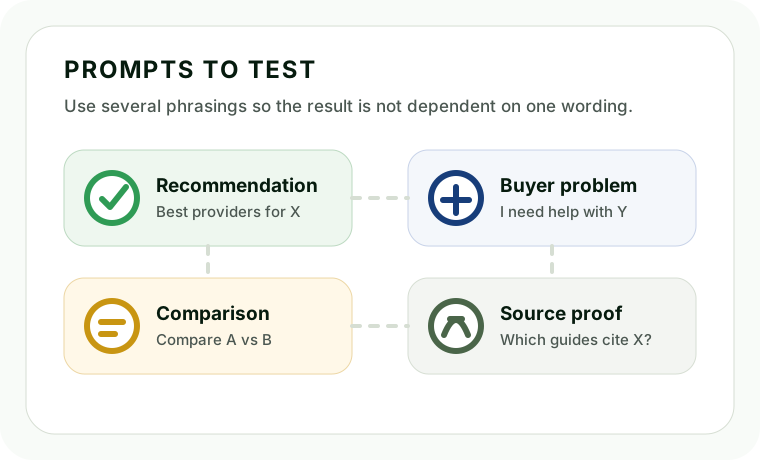
Cluster examples
Most brands can start with five prompt clusters. A recommendation cluster asks for the best providers in a category. An alternatives cluster asks what to compare against a known competitor. A problem cluster asks how to solve a pain point and which companies help. A proof cluster asks for sources, reviews, or case studies. A fit cluster asks which provider is best for a specific buyer type, industry, budget, or location.
Each cluster should contain several phrasings because buyers do not ask in one perfect way. For example, "best AI visibility agencies," "who helps brands show up in ChatGPT," and "agency for LLM search visibility" may all represent the same commercial intent. If your brand appears in one wording but not the others, the cluster tells you where the association is strong and where it is still fragile.
Avoid mixing unrelated use cases into the same score. If one prompt is about enterprise software and another is about local services, the combined mention rate will be hard to interpret. Keep clusters focused enough that a missing mention points to a real content or source gap.
Score mention quality
A simple mention quality score can use five levels: absent, weak mention, neutral mention, recommendation, and recommendation with supporting citation.
This is more useful than a binary yes/no check. It shows whether the brand is becoming more central to the answer.
Five-point scoring rubric
- Absent: the brand and domain do not appear.
- Weak mention: the brand appears only in passing or only after the prompt names it.
- Neutral mention: the brand is included but not clearly recommended.
- Recommendation: the brand is presented as a relevant option for the buyer problem.
- Cited recommendation: the brand is recommended and supported by a source, citation, or clear evidence trail.
This scoring makes progress visible before it becomes dominant share of voice. Moving from absent to neutral mention is still meaningful. It means the model can associate the brand with the category. The next step is to improve the evidence layer so the answer has a reason to recommend the brand rather than simply name it.
Track competitors
Competitor mentions are often the most actionable part of the tracker. If the same competitor appears repeatedly, inspect the sources helping that competitor win.
Look for patterns: listicles, comparison pages, review sites, industry directories, case studies, and high-authority publisher mentions.
Competitor pressure score
Alongside your own mention quality, track how often the same competitors appear. A competitor that appears in eight out of ten prompts has more answer pressure than a competitor that appears once. Add a simple count for each competitor and note the source types supporting them. This helps you decide whether you are fighting one dominant category leader, several niche alternatives, or a rotating set of weak answers.
Competitor pressure also helps with prioritization. If one competitor owns comparison prompts, create better comparison content and source proof. If another competitor owns location prompts, strengthen your local or market-specific pages. If competitors appear because of third-party listicles, the solution may be publisher and listicle coverage rather than another blog post on your own site.
Repeat the check
Run the same prompts on a regular schedule. Monthly is enough for many teams. Run extra checks after new content, digital PR, major reviews, or authority placements.
The exact answer may vary, but repeated prompts reveal directional movement.
How to avoid noisy data
Keep the testing conditions as consistent as possible. Use the same prompt wording, the same target market, and the same tracking format. If you change several variables at once, you will not know whether movement came from the campaign or from the test itself. You can add new prompts over time, but keep a core set unchanged so the trend line remains comparable.
Do not overreact to one answer. AI responses can vary by session, browsing mode, model update, location, and retrieved sources. What matters is repeated movement across a prompt cluster. A single win can be encouraging, but a consistent improvement across several related prompts is much stronger evidence.
Turn tracking into action
Every tracking round should produce an action. That action might be improving a page, building third-party mentions, adding comparison content, improving schema, or launching a deeper AI visibility audit.
For page improvements, use the AI Citation Readiness Checker. For source and prompt gaps, use LLMentioned.
How to choose the next action
If the brand is absent across a cluster, start with entity clarity and category proof. If the brand appears but is not recommended, strengthen trust signals and third-party sources. If the brand is recommended but competitors are cited more often, inspect the source gap and build better evidence. If the brand is cited from the wrong page, improve internal linking and create a more citation-ready page for that use case.
The tracker should make the next move obvious. That is the difference between useful AI visibility tracking and a novelty report. The output should tell the team what to change on the site, what external sources to pursue, and which prompt cluster deserves the next round of investment.
When to use the LLM Visibility Checker
The LLM Visibility Checker is best for fast snapshots. Use it to create a baseline before building a larger prompt tracker.
Then use the workflow from how to check if your brand appears in AI answers to turn the snapshot into a repeatable process.
When to escalate to deeper tracking
Use a lightweight checker when you need a quick read. Escalate to a deeper tracker when AI answers influence sales conversations, when competitors are repeatedly appearing ahead of you, or when leadership needs monthly evidence of movement. Deeper tracking is also useful after a campaign because it shows whether new pages, placements, and mentions changed the answer layer.
For high-intent categories, the goal is not just "we appeared once." The goal is to understand which prompts include you, which prompts skip you, which competitors appear instead, and what proof would make the next answer more likely to recommend your brand.
FAQ
How many prompts should I track?
Start with 10 to 25 prompts across your most important buyer intents. Expand after you know which clusters matter.
Should I track exact wording?
Yes. Store the exact prompt wording so future checks are comparable.
What is a good AI mention rate?
It depends on category maturity and competitor strength. The first goal is a stable baseline, then improving mention quality and consistency.

Adam O'neil
1stpage Editorial Team
Our 1stpage editorial team combines hands-on SEO agency experience with evidence-backed search performance guidance. These posts are built from real search wins, audit-grade insight, and conversion-tested tactics designed to help agencies, founders, and search teams earn more traffic and trust.