Short answer
To check if your brand appears in AI answers, run the same buyer-style recommendation prompts several times, record whether your brand or domain is mentioned, note which competitors appear instead, and compare the results against your citation sources.
The fastest way to start is with the free LLM Visibility Checker. It gives you a controlled snapshot you can use before investing in deeper AI share-of-voice tracking.
Reader question
"What should I look for first?"
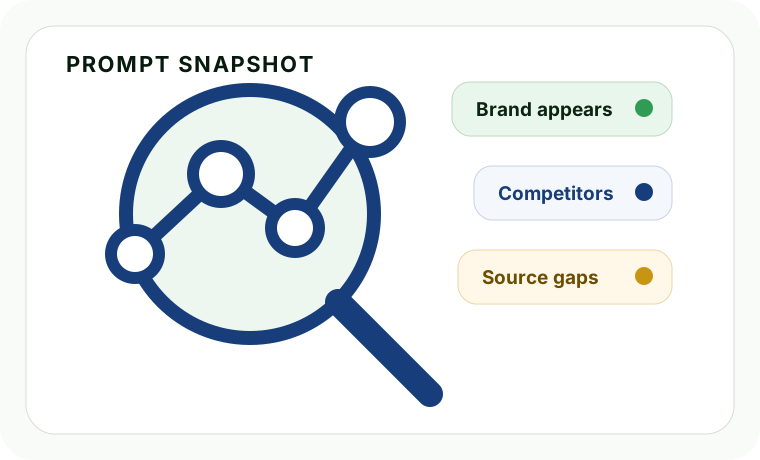
Look for three signals: whether your brand is named, whether your website is cited or referenced, and whether competitors are repeatedly recommended for the prompts your buyers would actually ask.
Useful next steps: LLM Visibility Checker, AI Citation Readiness Checker, and LLMentioned.
Table of Contents
AI answers are becoming a new discovery layer. Buyers can ask for the best firm, tool, agency, broker, lawyer, software product, or service provider and receive a short list before they ever reach a classic search results page.
That means brand visibility is no longer just a ranking question. You need to know whether your brand is being mentioned, whether your competitors are being recommended, and whether the sources behind those answers are strong enough to influence future AI responses.
This guide shows a practical way to check that visibility without overcomplicating the process.
The fast way to check AI brand visibility
Start with a controlled prompt set. A controlled prompt set is a small group of repeatable questions that match how a buyer would ask for help.
For example, a local law firm might test prompts like:
- Best personal injury lawyers in Austin.
- Which personal injury law firm should I contact after a car accident?
- Compare the most trusted personal injury lawyers near me.
- What sources recommend personal injury lawyers in Austin?
The goal is not to prove universal visibility. The goal is to capture a useful snapshot. You can run a manual version yourself, or you can use the LLM Visibility Checker to score a controlled set faster.
What counts as an AI answer appearance?
A brand appearance is broader than a blue link. In AI answers, your brand can show up in several ways:
- Direct brand mention: the answer names your company, product, person, or service.
- Domain mention: the answer names or cites your website.
- Recommendation list inclusion: the answer includes your brand among suggested options.
- Source mention: the answer references a third-party page that mentions you.
- Comparison mention: the answer includes your brand when comparing providers.
The strongest result is a brand mention supported by credible source coverage. A weaker result is a vague mention with no supporting citation trail. A missing result is when competitors are named and your brand is absent.
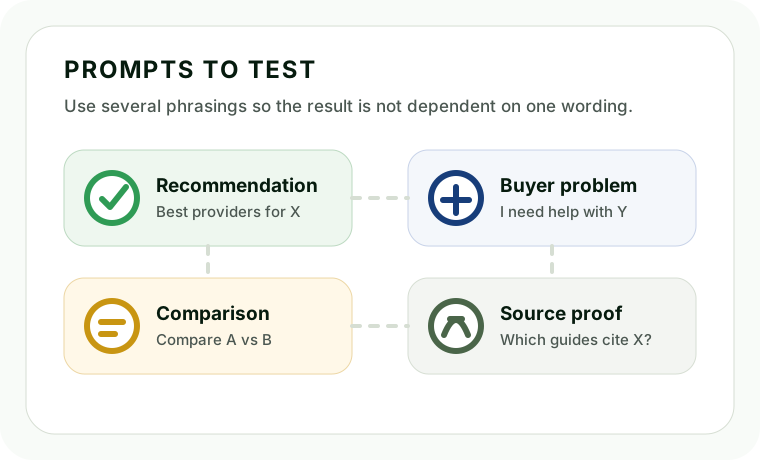
The four prompt types to test
A good visibility check should cover more than one phrasing. AI systems can answer differently when the same intent is framed as a recommendation, comparison, or research request.
1. Category recommendation prompts
These prompts test whether your brand is associated with the broad category you want to win.
Who are the best [category] providers for [audience or location]?
2. Buyer problem prompts
These prompts sound like a real prospect describing the problem they need solved.
I need help with [problem]. Which companies should I consider?
3. Competitor comparison prompts
These prompts reveal whether your brand appears when buyers compare known options.
Compare [competitor A], [competitor B], and other good options for [service].
4. Source and proof prompts
These prompts expose the evidence layer behind recommendations.
Which sources, reviews, or guides recommend trusted [category] providers?
How to run a controlled check
Use the same prompts, the same brand name, and the same target category each time. If you change too many variables at once, the result becomes hard to compare.
- Choose one target category or buyer problem.
- Write 5 to 10 prompts that match realistic buyer language.
- Run the prompts in the same AI environment where possible.
- Record whether your brand, domain, or key people appear.
- Record the competitors that appear instead.
- Note any citations, publisher names, directories, listicles, reviews, or comparison pages mentioned.
- Repeat the check after source updates, page improvements, or new authority placements.
This is also where the GEO / LLM SEO Planner can help. If a prompt snapshot shows weak visibility, the planner can turn that gap into a cleaner content and citation roadmap.
What to record in each answer
Do not only record "yes" or "no." A good AI visibility log should capture the quality of the appearance.
- Brand present: yes, no, or partial.
- Domain present: whether the site is named, linked, or cited.
- Placement: first, middle, bottom, or only in supporting text.
- Competitors: which brands appeared and how often.
- Sources: which pages, publishers, directories, or reviews influenced the answer.
- Answer confidence: whether the AI answer sounded certain, cautious, or incomplete.
- Next action: page improvement, citation building, review generation, or deeper tracking.
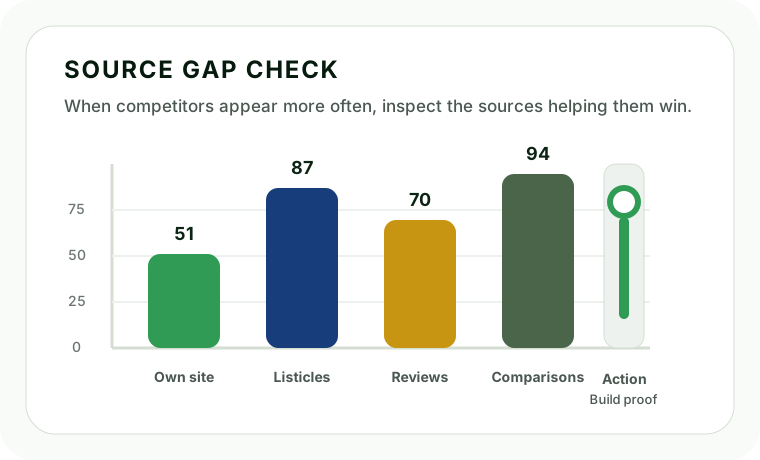
If the same competitors keep appearing, study where they are cited. AI systems often lean on repeated third-party mentions, clear entity signals, list placements, review pages, and authoritative explainers.
Why your brand may be missing
When a brand is absent from AI answers, it is usually not because one page is missing a keyword. More often, the entity and evidence trail is weak.
- Your site does not clearly explain who you help and what category you belong to.
- Your strongest pages are not structured in a way that makes them easy to quote or summarize.
- Competitors have more third-party mentions across trusted sources.
- Your brand is not included in enough comparison pages, listicles, reviews, or niche guides.
- Your content answers broad SEO questions but does not answer buyer selection questions.
- Your entity data, internal links, and schema do not reinforce the same topic clearly.
For page-level issues, run the target page through the AI Citation Readiness Checker. For site-level clarity, generate an LLMs.txt file so important pages and brand context are easier for AI crawlers and assistants to interpret.
What to do after the check
A visibility check is only useful if it produces an action. After you know where you stand, map the gap to the right fix.
- If your brand is absent: improve entity clarity and build third-party mentions around your target category.
- If your brand appears inconsistently: strengthen source coverage and repeat the same prompt set monthly.
- If competitors dominate: identify the pages and sources that help them appear, then build better proof.
- If your page is cited but not persuasive: improve structure, evidence, formatting, and answer clarity.
- If the category is broad: create more specific prompts for buyer type, location, industry, and use case.
For deeper tracking, use LLMentioned to monitor prompt clusters, competitor gaps, and AI share of voice over time.
When to use the free LLM Visibility Checker
Use the LLM Visibility Checker when you need a fast first read on whether a brand appears in AI recommendation prompts. It is useful before a strategy call, after a content update, during competitor research, or before deciding where to invest citation budget.
The tool is intentionally a snapshot. It does not promise coverage across every model, account, prompt, browser mode, or location. That honesty matters because AI visibility changes. What you want is a repeatable way to notice movement and diagnose what might be causing it.
How to keep the check honest
Keep the test close to how a real buyer would ask. Do not force the brand name into every prompt, do not keep rewriting the question until the answer looks better, and do not compare a broad competitor prompt against a narrow branded prompt. A useful check should make the category, problem, and buyer context clear while still giving the AI system room to choose the brands it believes are relevant.
It also helps to separate discovery prompts from validation prompts. Discovery prompts ask which companies, tools, agencies, or providers should be considered. Validation prompts ask whether a specific brand is credible, how it compares, or what sources support it. Both are useful, but they answer different questions. Discovery prompts show whether you are visible before the buyer knows you. Validation prompts show whether the answer can explain and support your brand once it is in the conversation.
- Keep a control set: reuse the same prompts each month so movement is comparable.
- Record competitors: the brands that appear instead are the fastest clue to source gaps.
- Capture sources: cited pages explain why an answer may trust one brand over another.
- Check page clarity: if your site is hard to summarize, AI answers may avoid it even when it ranks.
The best check is not the one that produces the most flattering answer. It is the one that gives you a reliable baseline, a clear source gap, and a next action you can actually improve.
FAQ
How often should I check AI visibility?
For active campaigns, monthly checks are a practical baseline. Run an extra check after major content changes, new PR placements, important reviews, or competitor movement.
Should I test only my main brand name?
No. Test brand name, domain, product names, founder names, service category, and buyer problems. AI answers may recognize one signal before another.
Can AI visibility replace SEO rankings?
No. Treat it as a parallel visibility layer. Classic rankings, citations, reviews, brand mentions, entity clarity, and answer-ready pages all support how AI systems understand your brand.
What is the best first fix if I am not mentioned?
Start by making your target pages clearer, then build third-party citations that describe your brand in the exact category you want to be recommended for. A clean page and a stronger evidence trail work better together than either one alone.

Adam O'neil
1stpage Editorial Team
Our 1stpage editorial team combines hands-on SEO agency experience with evidence-backed search performance guidance. These posts are built from real search wins, audit-grade insight, and conversion-tested tactics designed to help agencies, founders, and search teams earn more traffic and trust.