Short answer
After a failed prompt check, diagnose whether the problem is page clarity, weak third-party proof, unclear category positioning, or competitor source strength. Then improve the relevant pages, build better external mentions, and retest the same prompts.
The fastest way to create a baseline is with the free LLM Visibility Checker. Use it before deeper tracking or source-building work.
Reader question
"What should we do first?"
Start by documenting what failed: prompt, missing brand, competitors shown, and sources mentioned. That tells you whether to fix pages, sources, or both.
Useful next steps: LLM Visibility Checker, AI Citation Readiness Checker, and LLMentioned.
Table of Contents
A failed prompt check means your brand did not appear where you expected it to appear. That can feel frustrating, but it is also useful. It tells you where the visibility system is weak.
The fix is not one magic page. Improving AI search visibility usually requires clearer entity signals, stronger source proof, better citation-ready pages, and repeated measurement.
This guide turns a failed check into an action plan.
What a failed prompt check means
A failed prompt check does not always mean your brand has no authority. It means the AI answer did not include your brand for that prompt, in that environment, at that time.
That snapshot still matters. If the same failure repeats across related buyer prompts, you likely have a real visibility gap.
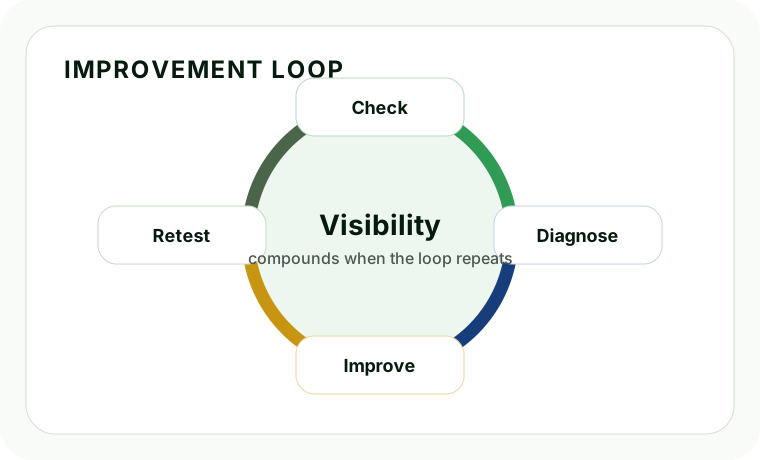
The key is to avoid treating a failed prompt as a verdict. Treat it as a diagnostic signal. A failed answer tells you where the brand did not earn inclusion, but it does not automatically tell you why. The cause may be weak page clarity, limited external proof, poor category association, stronger competitor evidence, or a prompt that is too broad for your actual positioning.
Before making changes, capture the failed answer, the exact prompt, the date, the competitors named, and any sources used. That record becomes the baseline you will compare against after improvements.
Prioritize the fix
Look at the failure pattern. If your brand appears only in branded prompts, improve category clarity. If competitors appear with cited sources, build better third-party proof. If your page is cited but summarized poorly, improve the page itself.
Diagnose by failure pattern
- Absent everywhere: the brand may lack enough category association or accessible proof.
- Branded-only recognition: the model knows the name but does not connect it to generic buyer prompts.
- Competitor-dominated answers: other brands have stronger external evidence or clearer category positioning.
- Cited but weak: your source is visible, but the page does not make the recommendation persuasive.
- Wrong source match: the answer cites an old, thin, or irrelevant page instead of the page you want buyers to see.
This failure pattern tells you where to start. Do not respond to every failed prompt by publishing another blog post. Sometimes the right fix is a clearer service page, better internal links, a comparison asset, a listicle placement, a review profile, or a stronger author and proof section.
Improve entity clarity
Your pages should clearly state what the brand is, who it serves, what category it belongs to, and why it is credible. Avoid vague positioning that forces an AI system to infer the category.
Use internal links and schema to reinforce the same entity story. Keep the language consistent across service pages, case studies, about pages, and comparison content.
Entity clarity checklist
Start with the pages that should represent the brand in AI answers. Each page should make the category obvious in the title, introduction, headings, and supporting copy. It should say who the service is for, what problem it solves, what outcome it supports, and what proof supports the claim. If the page has pricing, process, delivery scope, examples, or case evidence, make those details easy to scan.
Then reinforce the same story across the site. The about page, service pages, case studies, contact page, footer, and schema should not describe the company in conflicting ways. Consistency helps AI systems connect the brand name, domain, service category, and buyer use case.
Build third-party proof
If AI answers recommend competitors, inspect the sources behind those recommendations. Then build credible mentions in the source types your category seems to trust.
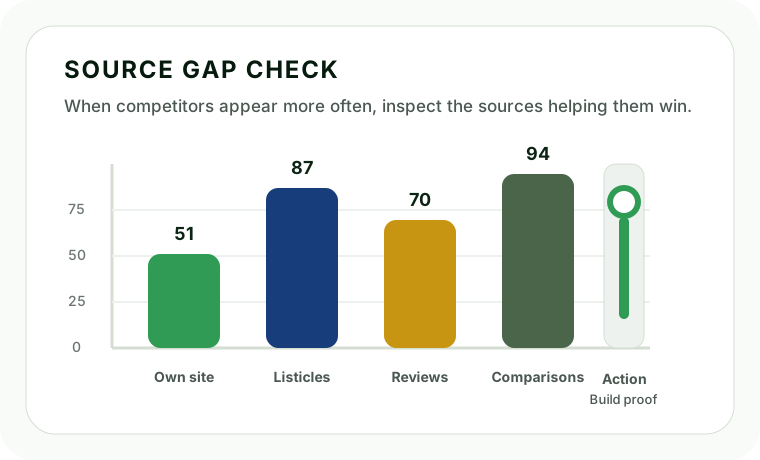
For many brands, this means better category listicles, review mentions, comparison pages, digital PR, partner pages, and niche publisher coverage.
Proof sources to prioritize
Prioritize sources that a buyer or model could reasonably use to justify a recommendation. Relevant listicles, expert roundups, industry directories, comparison pages, customer stories, interviews, partner pages, and credible niche publications usually carry more explanatory value than unrelated links. The goal is not simply to increase link volume. The goal is to create a visible evidence trail that says your brand belongs in the category.
When reviewing competitor sources, note the claims they repeat. Are competitors described as best for enterprise buyers, local businesses, technical teams, regulated industries, or startups? That wording often explains why a competitor appears for some prompts and not others. Your proof layer should support the prompts you actually want to win.
Make pages citation-ready
AI systems are more likely to quote or summarize pages that answer the core question clearly. Use short answer sections, descriptive headings, evidence, examples, and source-friendly formatting.
Run target pages through the AI Citation Readiness Checker. Then use the LLMs.txt Generator to clarify important pages for AI crawlers and assistants.
What citation-ready content looks like
Citation-ready content is easy to identify, extract, and trust. It opens with a clear answer, uses descriptive headings, defines the service or concept, includes proof points, and avoids burying the important details in vague marketing copy. If a page answers "who this is for," "what it includes," "why it matters," and "what evidence supports it," the page is easier for both humans and AI systems to use.
Good formatting also matters. Use short paragraphs, tables where they help comparison, named examples, FAQs, and internal links to deeper proof. If a page is visually impressive but hard to summarize, it may still underperform in AI answers.
Retest and document
After improvements, rerun the same prompts. Do not change the wording too quickly. You need comparability.
Document the original prompt, the failed answer, the action taken, and the follow-up result. This turns AI visibility work into a measurable process instead of a guessing exercise.
How long to wait before retesting
Retesting immediately after a page edit can be useful for checking whether the page itself is clearer, but it may not show the full impact of source-building work. Give new pages, mentions, and placements time to be crawled, indexed, discovered, or retrieved. For many teams, a monthly retest is a practical baseline, with extra checks after major launches or high-authority placements.
When you retest, keep the original prompt set intact. You can add new prompts, but do not replace the baseline every time. Stable prompts make it possible to see whether the answer moved from absent to weak mention, from weak mention to recommendation, or from recommendation to cited recommendation.
When to use the LLM Visibility Checker
Use the LLM Visibility Checker to create the initial snapshot and the retest snapshot. It helps you compare movement without starting from scratch each time.
For deeper monitoring, use LLMentioned to track prompt clusters, source gaps, and AI share of voice over time.
30/60/90 day improvement plan
In the first 30 days, focus on diagnosis and quick clarity fixes. Capture the baseline, improve the most important service pages, add short answer sections, clean up internal links, and make sure the brand story is consistent across the site.
In days 31 to 60, build the proof layer. Pursue relevant third-party mentions, comparison content, listicle placements, partner references, review improvements, and digital PR that connects the brand to the category. Use competitor source gaps to decide which source types matter most.
In days 61 to 90, retest the original prompt clusters, compare movement, and double down on the prompts that are closest to revenue. If the brand starts appearing but remains low in the answer, improve proof and differentiation. If the brand is still absent, revisit category clarity and source quality before scaling more content.
FAQ
Should I rewrite the page after one failed prompt?
Not always. Check a cluster of related prompts first. One answer can vary. Repeated failure is more meaningful.
What is the fastest improvement?
Clarify the target page and add stronger proof. If competitors are supported by third-party sources, build credible external mentions too.
How do I know if the fix worked?
Rerun the same prompts and compare brand mention, placement, competitor pressure, and source mentions.

Adam O'neil
1stpage Editorial Team
Our 1stpage editorial team combines hands-on SEO agency experience with evidence-backed search performance guidance. These posts are built from real search wins, audit-grade insight, and conversion-tested tactics designed to help agencies, founders, and search teams earn more traffic and trust.