Short answer
If your brand is not showing in AI recommendations, check whether AI systems can clearly understand your category, find credible third-party proof, and see your brand repeated across comparison, review, and niche source pages.
The fastest way to create a baseline is with the free LLM Visibility Checker. Use it before deeper tracking or source-building work.
Reader question
"Why would competitors appear when we have a better website?"
A better website helps, but AI answers often lean on repeated external evidence. If competitors are named across trusted lists, reviews, and guides, they may be easier to recommend.
Useful next steps: LLM Visibility Checker, AI Citation Readiness Checker, and LLMentioned.
Table of Contents
When a brand does not show up in ChatGPT-style recommendations, the problem is rarely one missing keyword. It is usually a visibility gap across category clarity, third-party proof, and the sources AI systems can use to justify a recommendation.
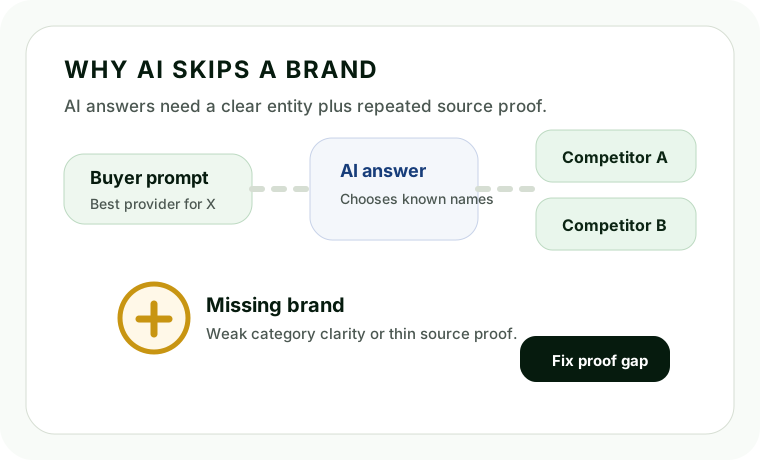
This matters because buyer prompts are often short and high intent. If the answer names three competitors and skips your brand, the buyer may never compare you.
Use this guide to diagnose the absence before you spend money on random content or links.
Quick diagnosis
Start with the simplest question: can an AI system confidently connect your brand to the category the buyer is asking about?
If the answer is uncertain, the model may choose brands that are easier to identify, even when your service quality is stronger. Run a few prompts with your category, location, buyer problem, and competitor names. Then record whether your brand appears, where competitors appear, and which sources are referenced.
Missing vs weakly associated
A brand can be completely missing, or it can be weakly associated. Those are different problems.
- Missing: the brand does not appear in recommendation prompts at all.
- Weakly associated: the brand appears only when the prompt includes its exact name.
- Competitor-owned: competitors appear for the generic category while your brand needs branded prompting.
The goal is to move from branded-only recognition to category-level recognition. That means AI systems should connect your name to the buyer problem without needing your exact brand name in the prompt.
Why competitors appear instead
Competitors often appear because they have a stronger evidence trail. That evidence may include listicle placements, reviews, third-party comparisons, podcast mentions, industry directories, news coverage, or strong explanatory pages that name their category clearly.
For AI recommendation prompts, the strongest signal is not just one perfect landing page. It is repeated confirmation across several believable sources.
What stronger competitor proof looks like
Strong proof usually has three qualities: it is clear, repeated, and independent. A competitor may have one page that explains the service well, another source that compares them against alternatives, a third source that describes the category, and several mentions from communities or publishers where buyers already ask for recommendations. That pattern gives an AI answer more material to work with. It can identify the brand, understand the use case, and justify the recommendation without relying only on the competitor's own sales page.
Look for source patterns rather than isolated links. If several competitors are cited from the same type of page, such as "best agencies for AI visibility" lists or industry buyer guides, that source type probably matters in your category. If competitors appear because reviewers, consultants, or niche publishers repeatedly describe them in the same way, your brand may need a clearer external footprint before it can compete in generic prompts.
Common false positives
Do not assume every missing mention means the model dislikes your brand. Sometimes the prompt is too broad, too local, or too far from the way buyers actually ask. Sometimes the model has enough information to know your brand exists but not enough to include it in a short recommendation list. Treat the first failed prompt as a clue, then test related prompts before making a major strategy decision.
How to test the issue
Use prompts that sound like buyers, not prompts that sound like marketers. Test broad recommendation prompts, problem prompts, comparison prompts, and source-proof prompts.
The LLM Visibility Checker is useful here because it gives you a controlled snapshot instead of relying on one casual prompt. You can also read the full workflow in how to check if your brand appears in AI answers.
Prompt examples to use
Use a small set of prompts that cover different buyer situations. For example, test "best [category] companies for [buyer type]," "who should I compare if I am considering [competitor]," "what agencies help with [specific problem]," and "which providers are cited for [category] work." Then run a few prompts with location, budget, industry, or service depth added. Those modifiers often reveal whether your brand is only absent from broad prompts or absent from the buying situations that matter most.
- Recommendation prompt: asks for a shortlist of options in your category.
- Problem prompt: asks how to solve the buyer's pain point and names provider types.
- Comparison prompt: asks for alternatives to a known competitor.
- Source prompt: asks which sources, reviews, or pages support the recommendation.
Run each prompt more than once over time. One answer can vary. A cluster of repeated misses is more useful than a single disappointing answer.
Fix the source gaps
If competitors repeatedly appear, list the sources that support them. Then compare those sources against your own brand footprint.
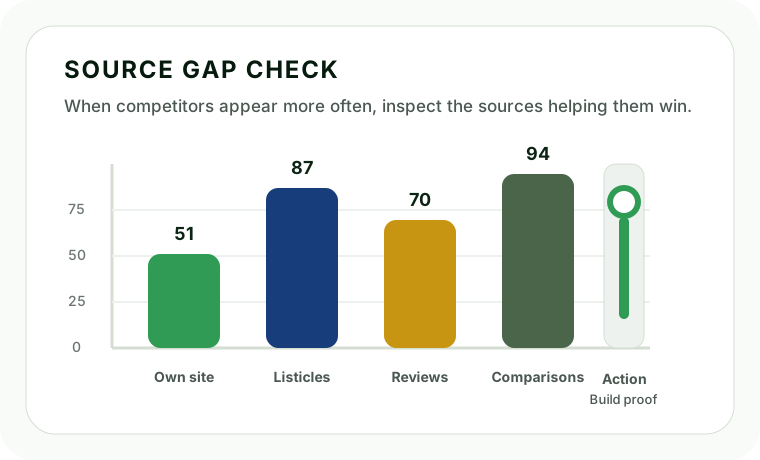
Do not copy competitor placements blindly. Look for the source types that explain why they are trusted: high-quality niche publishers, credible comparison pages, strong category guides, and pages with real editorial context.
How to decide which source gap matters first
Prioritize sources that sit closest to buyer decision making. A mention on a broad, unrelated site may add noise, but a category listicle, specialist guide, partner recommendation, or credible review page can directly support the kind of answer you want to appear in. Start with sources that help an AI system answer the buyer's actual question: who is relevant, what they do, why they are credible, and when they are a fit.
A useful source-gap review should answer four questions. Which competitors appear most often? Which source types appear around them? What claims do those sources repeat? What equivalent proof does your brand already have? The gap is usually not "we need more content." It is more specific: we need better category mentions, clearer comparisons, stronger third-party validation, or pages that make our offer easier to cite.
Improve page-level clarity
Your own site should make the category relationship obvious. Pages should answer who you help, what problem you solve, why you are credible, and which proof points support the claim.
Run important pages through the AI Citation Readiness Checker. Then use the LLMs.txt Generator to clarify important site pages for AI crawlers and assistants.
Page clarity matters because AI answers compress information. If the page forces a reader to infer the category, audience, proof, or outcome, the model may also struggle to summarize it. Add short answer sections, descriptive headings, service definitions, proof points, and internal links to supporting pages. Avoid vague claims such as "we help brands grow" when the page needs to say exactly what kind of visibility, authority, or demand problem you solve.
When to use the LLM Visibility Checker
Use the LLM Visibility Checker before and after source-building work. The first check gives you the baseline. The follow-up check shows whether the brand is becoming easier to associate with the category.
For ongoing tracking across prompt clusters, competitors, and source gaps, use LLMentioned.
What a 30-day recovery plan can look like
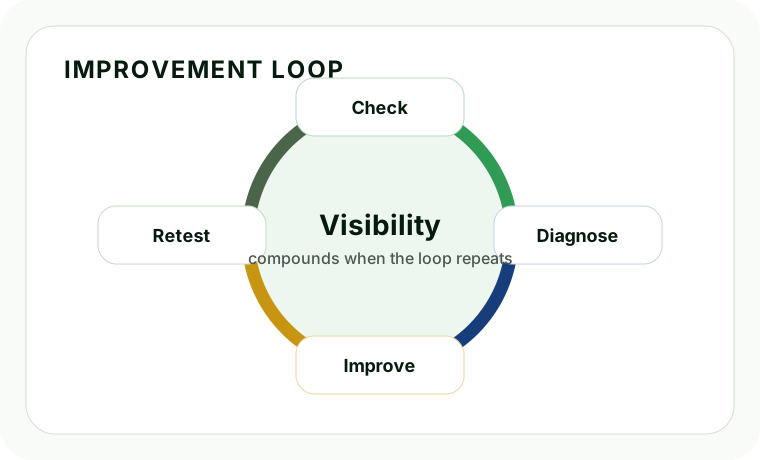
In the first week, collect the baseline: prompts, missing answers, competitor names, cited sources, and the pages that currently represent your brand. In the second week, fix the easiest clarity issues on your own site. In the third week, build or improve the external proof layer: relevant listicles, partner mentions, comparison pages, review profiles, and editorial sources. In the fourth week, retest the same prompt cluster and document whether the brand is still missing, weakly associated, or starting to appear.
This approach gives you a defensible improvement loop. Instead of guessing whether AI visibility is "working," you can show which prompt group changed, which source gaps were addressed, and which competitors still own the answer.
FAQ
Does ChatGPT use Google rankings?
Not in a simple one-to-one way. AI answers may be influenced by many sources, retrieval systems, training data, browsing context, citations, and model behavior. A page can rank and still fail to appear in a recommendation answer.
Should I optimize one page or build more mentions?
Do both. A clear page helps AI systems understand your brand, while credible third-party mentions help justify recommendations.
How long does improvement take?
It depends on how quickly your source footprint changes and whether the AI environment can access those sources. Track prompt snapshots over time instead of expecting immediate universal movement.

Adam O'neil
1stpage Editorial Team
Our 1stpage editorial team combines hands-on SEO agency experience with evidence-backed search performance guidance. These posts are built from real search wins, audit-grade insight, and conversion-tested tactics designed to help agencies, founders, and search teams earn more traffic and trust.