Table of Contents
Kohort is a growth platform for mobile game studios. Its Ktrl product predicts long-term player value and ROAS from early cohort data, recommends which user-acquisition campaigns to scale or cut, and can send signals back to advertising networks. Kohort also presents strategy, budgeting, financing and diligence services.
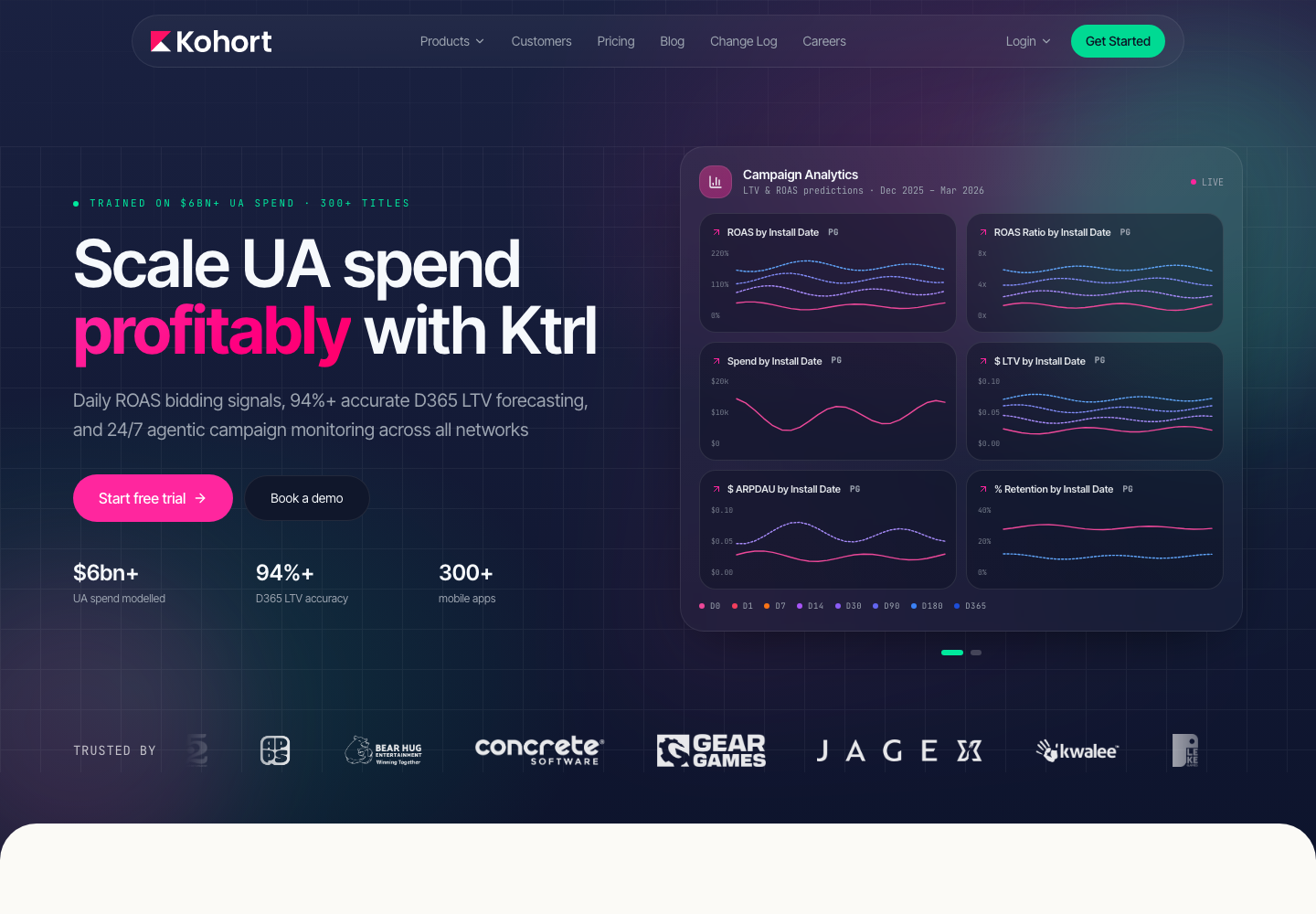
Our short verdict is that Kohort is a specialised and potentially valuable product for studios spending enough on UA that slow payback signals create costly decisions. Predicting D365 value before months of revenue mature can improve capital allocation. The limitation is equally important: every forecast inherits uncertainty from attribution, organic uplift, creative changes, privacy constraints and player behaviour. A 94%+ accuracy claim is not meaningful until its metric and performance on your titles are understood.
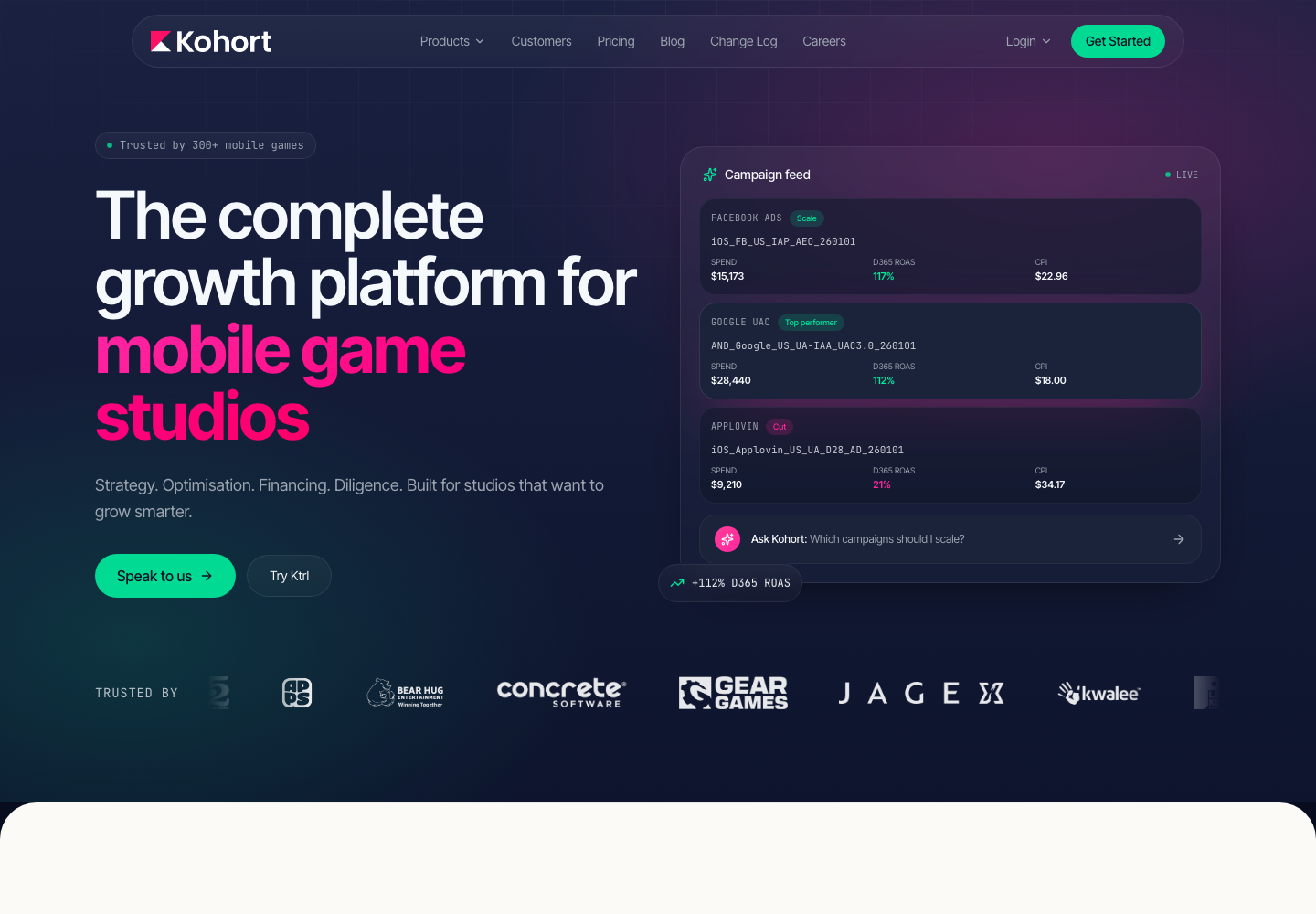
Kohort positions Ktrl as the operating layer for campaign-level LTV and ROAS decisions. Source: Kohort.
Kohort at a glance
| Question | Answer |
|---|---|
| What is it? | Mobile-game LTV forecasting and UA optimisation |
| Core product | Ktrl |
| Integrations | MMPs, data warehouses and major ad networks depending on plan |
| Best for | Studios with material paid acquisition and long payback windows |
| Starting price | From $750/month per title |
| Main strength | Early campaign-level signals tied to network action |
| Main concern | Forecast quality can vary by title, cohort and data regime |
The problem Ktrl addresses
Mobile UA teams often need to decide today using revenue that will mature over weeks or months. Early CPI or D7 ROAS can misrepresent long-term value. Ktrl trains cohort models to forecast D365 LTV and produce campaign-level cut, hold or scale guidance.
Kohort says predictions can be sent to Meta, Google, AppLovin, Unity and TikTok so bidding systems optimise toward future value. This can close the loop faster than spreadsheet forecasts, but it also means model errors can influence spend automatically. Approval thresholds and budget limits are essential.
How we evaluated Kohort
We would run a backtest and live holdout:
- Train only on data available at each historical decision point.
- Compare predicted and realised LTV by title, platform, country, network and campaign.
- Examine mean error, calibration and expensive false scale decisions.
- Separate paid incrementality from organic installs and attribution artefacts.
- Run recommendations in shadow mode before writing signals to networks.
- Use holdout campaigns to estimate incremental profit.
Kohort says its models are trained on more than $6 billion of UA spend and used across 300+ titles. Broad training may help priors, but each game's economy, retention curve and monetisation mix remain decisive.
Main capabilities
LTV and ROAS forecasting
Ktrl forecasts D365 LTV and ROAS from early cohorts. Buyers should ask how the model handles sparse launches, major economy changes, ad-monetised versus IAP titles, subscriptions, seasonality and live-ops events. Confidence intervals matter as much as point estimates.
Campaign recommendations
The campaign feed identifies likely scale and cut opportunities. A recommendation should expose the data window, predicted payback, uncertainty, budget impact and reason. Teams need overrides, annotations and audit history to learn from disagreements.
Direct network signals
Sending predicted values to ad networks may improve bidder learning when true revenue arrives slowly. Test event schemas, deduplication, attribution windows, privacy permissions and rollback. Start with constrained budgets and compare against a stable control.
Strategy and budgeting
Kohort's Kmnd positioning covers scenario planning, UA budgets and growth targets. Forecasting can connect title economics to capital planning, although studio leaders should stress-test acquisition cost inflation, retention decline and platform policy changes.
Agentic monitoring
Ktrl advertises 24/7 agentic alerts and an “Ask Kohort” interface. The useful standard is not conversational polish but whether an answer cites the campaign, cohort, model version and expected financial impact.
Kohort pricing in 2026
| Plan | Public price | Qualification |
|---|---|---|
| Startup | From $750/month per title | Under $100,000 monthly UA spend |
| Growth | From $1,500/month per title | Over $100,000 monthly UA spend |
| Enterprise | Custom | Large portfolios; site references 10+ titles or $1m+ monthly spend |
Annual billing advertises a 10% reduction. Startup includes MMP integration, Angus AI, direct network integrations, unlimited campaigns and live Slack support. Growth adds internal warehouse integration. Confirm onboarding, historical data, minimum term, number of networks, model retraining and portfolio discounts.
Ktrl publishes starting prices by monthly UA scale. See live pricing for changes.
Advantages
- Purpose-built for mobile game economics rather than generic marketing analytics.
- Campaign-level forecasts connect directly to spend decisions.
- Public starting prices are clearer than many enterprise optimisation tools.
- MMP, warehouse and network paths support an end-to-end workflow.
Limitations and open questions
- Accuracy claims need a defined metric and per-title validation.
- One price applies per title, so portfolio cost can rise quickly.
- Network automation magnifies both good and bad predictions.
- Privacy and attribution changes can create model drift.
- Independent public reviews are limited.
Who should use Kohort?
Kohort suits mobile studios with established UA spend, measurable cohorts, long payback periods and teams capable of controlled experimentation. It is unlikely to justify its cost for a very early title without stable retention or sufficient paid volume.
A rigorous Ktrl trial design
Start with historical backtesting, but prevent look-ahead leakage. For each cohort, expose only the events and revenue that would have existed on the original decision date. Compare Ktrl with the studio's current forecasting method and simple baselines such as fixed D7-to-D365 multipliers. A sophisticated model should improve on the baseline consistently enough to justify its operational cost.
Evaluate error by business consequence. Underpredicting a future hit can suppress profitable scale; overpredicting a weak campaign can destroy budget. Report weighted absolute error, calibration, rank accuracy and the contribution impact of simulated cut or scale decisions. Segment results across OS, country, network, creative, monetisation model and acquisition objective.
Move next to shadow mode. Let Ktrl generate recommendations without changing bids, and require UA managers to record agreement, disagreement and reason. This reveals whether the product identifies information the team lacked or merely restates obvious campaign performance.
For a live test, pre-register the budget, control, intervention rules and decision window. Limit automated network signals, preserve a holdout and monitor organic cannibalisation. Measure incremental contribution after media cost, platform fees and subscription—not only attributed ROAS. Re-run the test after a major live-ops or creative change to observe model drift.
Data and operational requirements
Ktrl will need dependable MMP events and, on Growth, may connect to the studio warehouse. Audit event naming, revenue currency, refunds, ad revenue, SKAdNetwork handling, re-attribution and identity limitations before training. Document how historical corrections and privacy deletions propagate.
Ask how frequently models retrain, how confidence is exposed, what happens when a network changes its campaign structure and whether a title can pause billing between launches. Portfolio studios should negotiate shared learning and volume economics without assuming one game's patterns transfer safely to another.
Alternatives
| Alternative | Consider it when |
|---|---|
| AppsFlyer or Adjust | Attribution and measurement infrastructure are the primary need |
| Singular | Cross-network cost aggregation and marketing analytics dominate |
| GameAnalytics | Product analytics and player behaviour need a broader foundation |
| Internal data science | Proprietary economics justify owning the forecasting stack |
Final verdict
Kohort addresses a real and expensive timing problem in mobile gaming. We would trial Ktrl in shadow mode, backtest it without leakage and move only a controlled share of budget based on its signals. If it improves incremental contribution after fees—not merely predicted ROAS—the pricing can be rational for a scaling studio.
Frequently asked questions
What is Ktrl by Kohort?
Ktrl predicts long-term LTV and ROAS, recommends campaign actions and can send value signals to advertising networks.
How much does Kohort cost?
Startup begins at $750/month per title and Growth at $1,500/month per title; Enterprise is custom.
Does Kohort offer a free trial?
Yes, a free trial is advertised on the product and pricing pages.
Was this Kohort review hands-on?
No. We did not test it with a studio dataset or live advertising account.

Tolu S.
Associate Director
Evidence-led product reviews and founder profiles for search, marketing, authority, and AI visibility teams.