Table of Contents
Will Lawrence is co-founder and CEO of Bretton AI, the financial-services AI company previously known as Greenlite AI. The company announced a $75 million Series B in February 2026, less than a year after a $15 million Series A. Bretton's disclosed funding adds to $95 million: $5 million before its Series A, $15 million in the Series A and $75 million in the Series B.
Bretton is building AI agents and operational infrastructure for regulated financial work, beginning with anti-money-laundering, know-your-customer and financial-crime investigations. The founder thesis is that banks should be able to expand without increasing back-office staffing at the same rate.
Will Lawrence and Bretton AI at a glance
| Field | Verified information |
|---|---|
| Founder profiled | Will Lawrence, co-founder and CEO |
| Company | Bretton AI, formerly Greenlite AI |
| Founded | 2023 |
| Product | AI-native financial back-office operations |
| Initial focus | AML, KYC, sanctions, fraud and regulated investigations |
| Latest round | $75M Series B, February 2026 |
| Disclosed funding | $95M across seed, Series A and Series B |
| Series B lead | Sapphire Ventures |
| Last verified | 21 July 2026 |
Who is Will Lawrence?
Will Lawrence is Bretton AI's co-founder and CEO. His company writing consistently starts from a staffing constraint: regulated financial work is high volume, spread across many systems and difficult to scale by hiring or outsourcing alone.
Founder profile: Connect with Will Lawrence on LinkedIn.

Official author portrait published by Bretton AI with Lawrence's funding announcements.
The framing is deliberately operational rather than “AI copilot” language. Bretton says its agents can complete investigations within existing tools and produce traceable, audit-ready outputs. In a regulated market, that governance layer is the product test: faster work is valuable only when an institution can explain evidence, controls, exceptions and accountability to auditors and regulators.
Why Greenlite became Bretton AI
The company launched as Greenlite AI with a focus on helping compliance teams address alert volume. Lawrence announced the Bretton name alongside the Series B, describing a broader ambition to become infrastructure for regulated financial operations.
The name references Bretton Woods, the 1944 agreement that shaped the post-war financial system. Rebranding creates room to expand beyond one workflow, but it also creates execution risk. A broad financial back-office platform must preserve the deep control model that made the initial compliance use case credible.
What Bretton AI does
Bretton provides AI agents for work such as customer due diligence, AML investigations, sanctions, fraud and loan operations. Its public materials emphasize proprietary “Trust Infrastructure” covering model risk management, evaluation, governance and quality assurance.
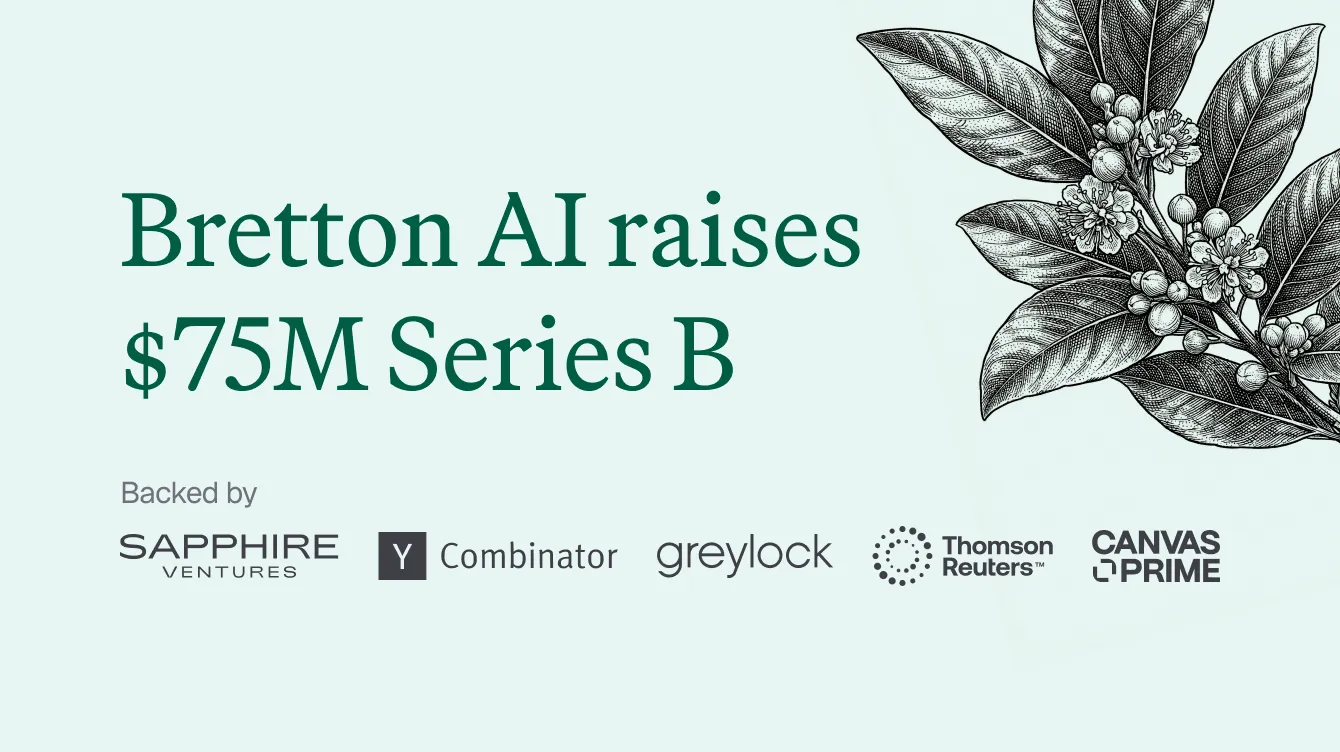
Official Bretton AI Series B presentation announcing the company's new name and expansion strategy.
Bretton reports that regulated banks and financial platforms use the system. Its funding announcement cites examples including reduced BPO spend, shorter institutional onboarding and faster loan origination. These remain company-selected results rather than guaranteed outcomes. Buyers should request the baseline, workflow scope, human staffing, exception rate and measurement period behind any example.
Bretton AI funding history
| Date | Funding event | Amount | Evidence status |
|---|---|---|---|
| By May 2025 | Pre-Series A funding | $5M | Derived from company statement that $15M Series A brought total to $20M |
| May 2025 | Series A | $15M | Confirmed by Bretton |
| February 2026 | Series B | $75M | Confirmed by Bretton |
| Disclosed total | All disclosed equity rounds | $95M | Calculated from company announcements |
Sapphire Ventures led the Series B. Existing backers Greylock, Y Combinator, Thomson Reuters Ventures and Canvas Ventures participated, alongside new investor TIAA Ventures. The investor mix brings enterprise software, financial-services and regulatory-market experience.
What the $75M Series B is intended to change
Bretton says the capital supports growth into large financial institutions, additional geographies and more compliance categories. The rebrand indicates an even larger objective: agents for wider financial back-office operations.
Success should be measured through production use rather than the number of agents announced. Useful indicators include audit outcomes, repeatable accuracy, exception handling, analyst capacity, deployment time, customer expansion and evidence that cost savings persist without weakening controls.
Strengths, risks and unresolved questions
Visible strengths
- A focused entry point in high-cost, document-heavy regulated operations.
- Company-disclosed production outcomes and named financial-platform customers.
- A control narrative that includes model governance and auditability.
- Major enterprise investors returning in successive rounds.
Material risks
- Errors in regulated work can create financial, legal and reputational harm.
- Expanding from compliance into a broad back-office platform increases scope.
- Financial institutions have long procurement, validation and integration cycles.
- Human oversight requirements may limit headline automation economics.
Questions buyers should ask
- Which decisions remain with a licensed or accountable human analyst?
- How are hallucinations, model changes and data lineage monitored?
- Can every conclusion be traced to evidence and policy?
- What happens when source systems conflict or required information is missing?
- Which results were independently validated versus measured by Bretton?
Frequently asked questions
Who founded Bretton AI?
Will Lawrence is the publicly visible co-founder and CEO profiled here. The company was previously named Greenlite AI.
How much has Bretton AI raised?
Bretton's company announcements support $95 million in disclosed funding, including a $15 million Series A and $75 million Series B.
What does Bretton AI do?
Bretton provides AI-native operations for regulated financial work, including AML, KYC, sanctions, fraud and other back-office workflows.

Tolu S.
Associate Director
Evidence-led product reviews and founder profiles for search, marketing, authority, and AI visibility teams.