Table of Contents
- Bluefish AI founders and funding at a glance
- Who is Alex Sherman?
- Who is Andrei Dunca?
- Who is Jing Feng?
- Why this founding team is credible in enterprise marketing technology
- Why the founders started Bluefish AI
- What Bluefish AI actually does
- What makes the Bluefish strategy distinctive?
- Bluefish AI funding history
- What the $43M Series B is intended to change
- Bluefish founder and company timeline
- The founders' public thesis
- Strengths, risks and unresolved questions
- Evidence that would demonstrate progress over the next 12 to 18 months
- Related profiles and comparisons
- Frequently asked questions
Alex Sherman, Andrei Dunca and Jing Feng founded Bluefish AI in 2024 to build enterprise marketing infrastructure for a world in which consumers increasingly discover brands through ChatGPT, Gemini, Claude, Perplexity and other AI systems. Sherman is co-founder and CEO, Dunca is co-founder and CTO, and Feng is co-founder and COO.
Bluefish announced a $43 million Series B on 14 April 2026, co-led by Threshold Ventures and NEA. The company said that round brought its total funding to $68 million. That is the figure used in this profile: it is a company-reported total, not an estimate of the founders' wealth or the company's valuation.
The founding team is notable because its members have already built and operated marketing platforms through earlier changes in digital advertising. Sherman co-founded PromoteIQ, which Microsoft acquired in 2019. Dunca co-founded LiveRail, acquired by Facebook in 2014. Feng held senior leadership roles at LiveRail, PromoteIQ and Microsoft. Bluefish is their attempt to apply that operating experience to AI as a new marketing and product-discovery channel.
Bluefish AI founders and funding at a glance
| Field | Verified information |
|---|---|
| Founding team | Alex Sherman, Andrei Dunca and Jing Feng |
| Current roles | Sherman: CEO; Dunca: CTO; Feng: COO |
| Company | Bluefish AI — bluefishai.com |
| Founded | 2024 |
| Headquarters | New York, according to company funding announcements |
| Product | Agentic marketing and enterprise AI-visibility platform |
| Primary customer | Fortune 500 and other large enterprise marketing teams |
| Latest round | $43M Series B announced 14 April 2026 |
| Latest-round leads | Threshold Ventures and NEA |
| Total funding | $68M, reported by Bluefish in its Series B announcement |
| Earlier disclosed round | $20M Series A announced in 2025 |
| Last verified | 21 July 2026 |
The totals require careful reading. Bluefish's Series A announcement said that the $20 million round brought total funding to $24 million. Its Series B announcement later said that a $43 million round brought total funding to $68 million. Adding the two stated totals mechanically produces a one-million-dollar difference. That may reflect rounding, additional capital or the way extensions were counted. Because the company explicitly reports $68 million, this article attributes that total to Bluefish rather than presenting it as our own calculation.
Who is Alex Sherman?
Alex Sherman is Bluefish AI's co-founder and CEO. His role places him at the intersection of product category definition, enterprise customer development, capital raising and the company's public argument that AI should be managed as a distinct marketing channel.
Founder profile: Connect with Alex Sherman on LinkedIn.

Alex Sherman in the official author portrait used by Bluefish AI. The image is presented as attributed identity evidence; no separate press-kit licence or photographer credit was displayed on the source page.
Before Bluefish, Sherman co-founded PromoteIQ, a retail-media technology company acquired by Microsoft in 2019. Retail media required brands, retailers and technology providers to make a previously fragmented commercial channel measurable and operational. That history is relevant because Bluefish is making a similar argument about AI: enterprise teams need repeatable monitoring, workflows, measurement and ownership rather than occasional screenshots of chatbot answers.
Sherman has described the broader transition as a movement away from conventional web discovery toward AI-mediated research and purchasing. In Bluefish's Series A announcement, he argued that the enterprise marketing stack would need to be rebuilt for this channel. The claim is partly a market thesis and partly the commercial case for Bluefish. Its validity should ultimately be tested through customer retention, expansion, measurable AI-referred demand and evidence that brands use the platform across departments.
An extended 2025 founder interview also provides context for Sherman's operating style. The discussion focused on the difficult early years of PromoteIQ, including constrained personal finances and a long path to product-market fit before the Microsoft acquisition. That account is useful because it shows prior founder experience, but it should not be mistaken for evidence that Bluefish will follow the same outcome.
Who is Andrei Dunca?
Andrei Dunca is Bluefish AI's co-founder and CTO. Bluefish's official Series A announcement identifies Dunca as a previous co-founder of LiveRail, the video-advertising platform acquired by Facebook in 2014.
Founder profile: Connect with Andrei Dunca on LinkedIn.

Andrei Dunca in the official author portrait used by Bluefish AI. The image is attributed identity evidence; no separate photographer credit or press-kit licence was displayed.
That technical background matters to Bluefish's proposition. The platform says it processes millions of prompt responses and serves enterprises that need segmentation across products, markets, audiences and AI providers. Delivering that reliably requires data collection, normalization, monitoring and enterprise controls—not only a polished reporting interface.
In an official Bluefish article on AI personalization, Dunca explained how persistent user context can change which brands and products an AI system recommends. The operational implication is important: a single generic prompt cannot represent all consumer experiences. Bluefish therefore positions custom audiences and segmented prompt methodologies as part of its enterprise differentiation.
The unresolved technical question is how much of Bluefish's measurement methodology customers can independently inspect. Enterprise buyers should ask how prompts are sampled, how often they are repeated, which consumer interfaces or APIs are used, how regional differences are handled, and how model changes affect historical comparisons.
Who is Jing Feng?
Jing Feng is Bluefish AI's co-founder and COO. The company states that Feng previously held senior leadership roles at LiveRail, PromoteIQ and Microsoft. That makes her operating experience unusually connected to both of the earlier platforms associated with her co-founders.
Founder profile: Connect with Jing Feng on LinkedIn.

Jing Feng in the official author portrait used by Bluefish AI. The image is attributed identity evidence; no separate photographer credit or press-kit licence was displayed.
Feng's public contributions emphasize how enterprise marketing teams turn AI observations into repeatable action. In Bluefish's Agentic Campaigns announcement, she framed the product as a way to give executives a connection between AI investment and KPI movement while giving practitioners specific work to execute. In the Series B announcement, she also argued against short-term attempts to manipulate model outputs and instead emphasized becoming a source that AI systems consistently choose.
Those statements reveal a distinct operating thesis: AI visibility is not owned by one SEO specialist. It can require coordination among content, search, communications, commerce, product data and analytics teams. A COO with experience scaling marketing technology may therefore be as central to the product's success as the technical and fundraising functions.
Why this founding team is credible in enterprise marketing technology
The strongest case for founder-market fit is not simply that the founders have impressive previous employers. It is that all three have experience with marketing platforms that had to translate a changing digital channel into enterprise workflows.
PromoteIQ operated where retailer inventory, brand budgets and measurable commercial performance met. LiveRail operated in video-advertising infrastructure at substantial scale. Feng's operating roles connected those environments with Microsoft. Bluefish now applies a similar playbook to AI discovery: measure the channel, identify the factors shaping brand outcomes, coordinate action and connect changes to business performance.
There are limits to this comparison. AI assistants are not advertising exchanges, and a brand cannot purchase or control every organic recommendation. Model providers change retrieval, interfaces and policies independently. A previous acquisition also demonstrates experience, not inevitability. The relevant question is whether the founders can adapt their enterprise-platform knowledge to a less controllable and more probabilistic environment.
Why the founders started Bluefish AI
Bluefish's founding thesis is that AI is becoming a destination where consumers discover, compare and evaluate products. If that behavior becomes material, enterprise marketers will require a dedicated operating layer just as they developed teams and tooling for search, social, mobile, retail media and programmatic advertising.
At launch, the founders described Bluefish as a marketing platform for AI with tools for brand safety, AI discovery and campaign management. The language has since developed into Agentic Marketing Platform, or AMP. That repositioning expands the ambition from monitoring AI answers to coordinating monitoring, activation and measurement across a marketing organization.
This evolution is commercially logical: monitoring alone can become commoditized as analytics platforms add similar dashboards. A workflow that connects diagnosis to approved actions, tracks campaign impact and supports enterprise governance may be harder to replace. It also increases implementation complexity and places a higher evidence burden on Bluefish's attribution claims.
What Bluefish AI actually does
Bluefish presents its platform as an enterprise system for understanding, influencing and measuring how brands appear across AI channels. Public material describes three connected layers:
- Monitoring: collect and analyze prompts, answers, brand narratives, competitors and sources across major AI experiences.
- Activation: turn observed gaps into content, source, accuracy or campaign work across marketing teams.
- Measurement: connect defined collections and interventions to changes in visibility, favorability, influence and commercial performance.
The company has also announced audience segmentation, campaign collections, content optimization, AI Accuracy, Brand Vault, Agentic Campaigns and shopping insights. These additions show that Bluefish is moving beyond a conventional prompt tracker toward enterprise workflow and data infrastructure.
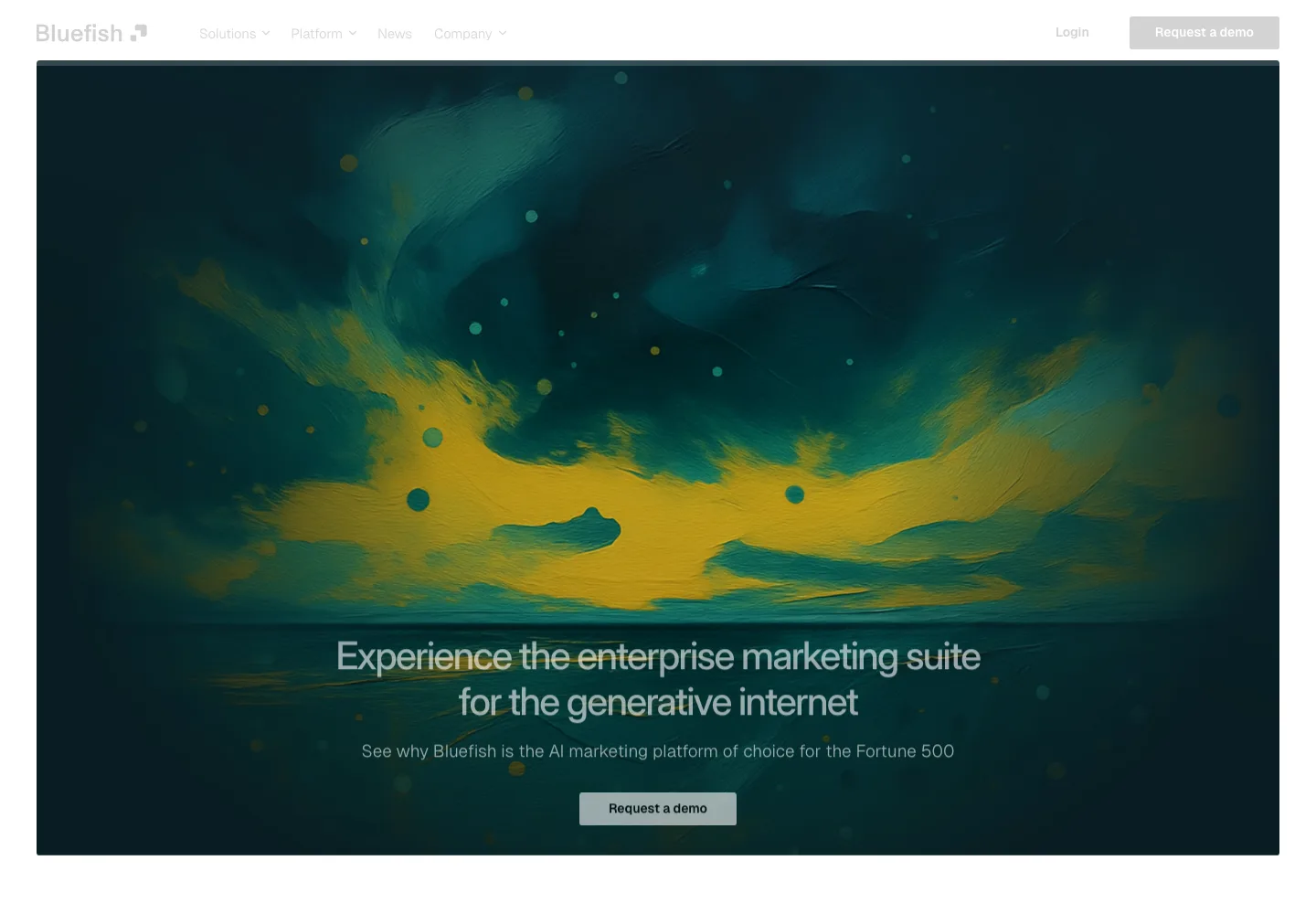
Bluefish AI's official homepage captured on 21 July 2026. This is authentic vendor presentation evidence, not an authenticated product test.
Readers evaluating the software rather than the founding story should use our complete Bluefish AI review, which examines public features, pricing opacity, suitable buyers, limitations and competing platforms.
What makes the Bluefish strategy distinctive?
Bluefish's most defensible visible choices are its enterprise focus, the founders' marketing-technology experience and the decision to treat AI as a cross-functional channel.
First, the platform is explicitly designed for organizations with many brands, products, markets and stakeholder teams. That is a narrower target than a self-serve GEO tracker serving small agencies or startups. Enterprise specialization can support higher contract values, but it also demands security, data governance, procurement support and measurable implementation value.
Second, the founders understand the incentives and operating constraints of large marketers. Bluefish's public product language consistently addresses audience segmentation, campaign workflow, attribution and coordination rather than only citation counts.
Third, Bluefish is building around brand accuracy and commerce as well as visibility. This is important because an enterprise can be mentioned frequently but represented incorrectly, or cited without influencing a buying decision. Accuracy, product data and retailer connections may become meaningful differentiators if AI-mediated shopping expands.
The central risk is that several parts of the category remain difficult to measure. AI answers fluctuate, referral data can be incomplete, and correlation between a campaign and an answer change does not prove causation. The platform's long-term authority will depend on transparent methodology and commercial outcomes that customers can audit.
Bluefish AI funding history
| Announcement date | Round or instrument | Amount | Named investors | Reported purpose | Evidence status |
|---|---|---|---|---|---|
| 2024 | Early funding before Series A | Approximately $4M implied by the later company total; exact composition not established here | Crane Venture Partners, Bloomberg Beta, Firebolt Ventures and Laconia were named around launch | Initial product and company development | Total implied by company reporting; individual early rounds require further verification |
| 1 September 2025 | Series A | $20M | NEA, Salesforce Ventures, Crane Venture Partners, Swift Ventures and Bloomberg Beta | Product expansion and scaling engineering and customer-facing teams | Confirmed company announcement |
| 14 April 2026 | Series B growth financing | $43M | Co-led by Threshold Ventures and NEA; Amex Ventures, TIAA Ventures, Salesforce Ventures, Bloomberg Beta, Crane Venture Partners, Laconia and Swift Ventures participated | Rollout of the Agentic Marketing Platform across enterprise brands | Confirmed company announcement and syndicated release |
| 14 April 2026 | Total funding | $68M | — | — | Company-reported total |
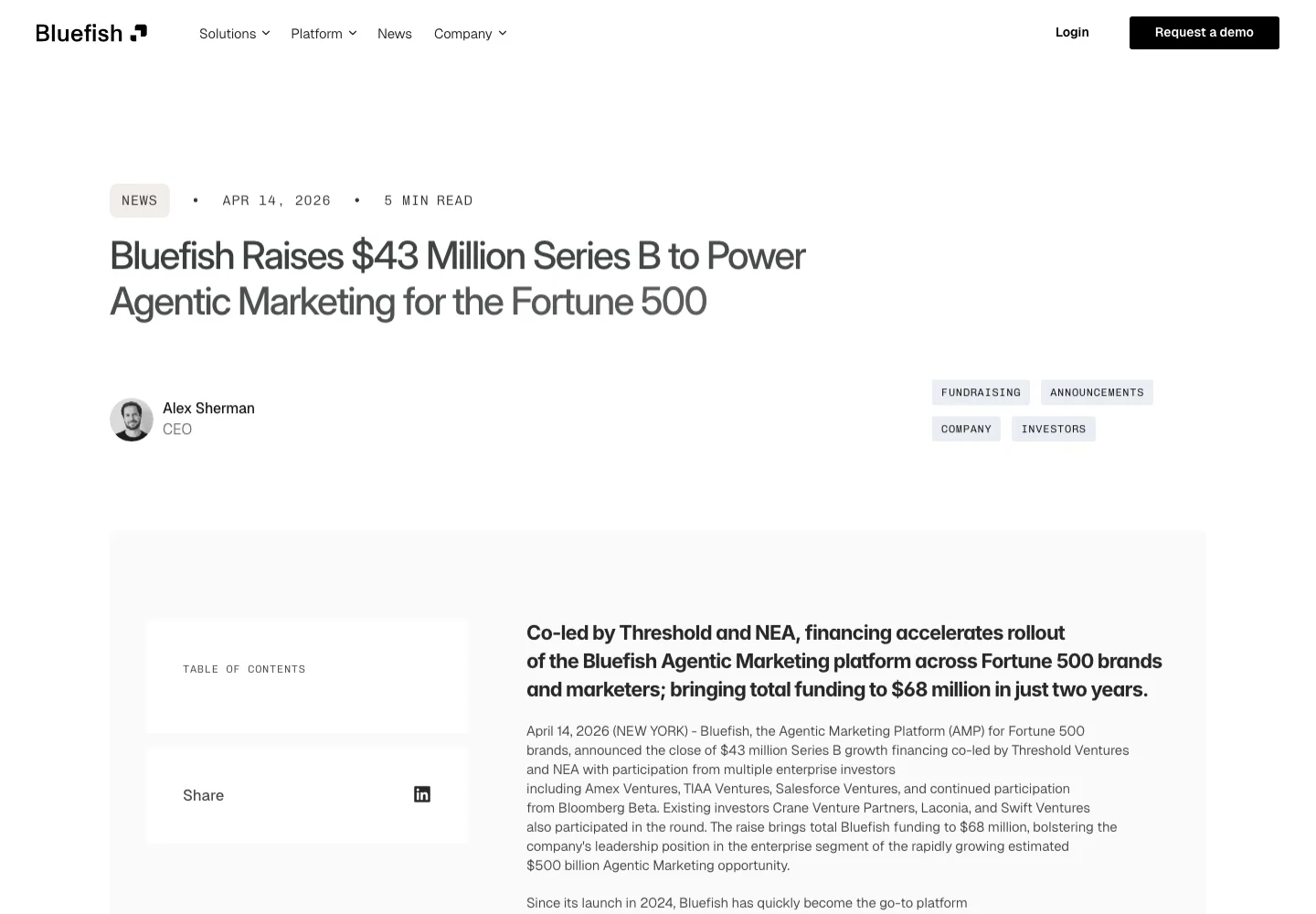
Bluefish AI's official Series B announcement. The page reports a $43 million Series B and $68 million in total funding.
The investor mix is strategically relevant. Salesforce Ventures, Amex Ventures and TIAA Ventures bring relationships with enterprise software, finance and large-company adoption. NEA and Threshold add conventional venture backing. Strategic participation does not prove product-market fit, but it can help a company sell into the complex organizations it targets.
What the $43M Series B is intended to change
Bluefish said the Series B would accelerate rollout of its Agentic Marketing Platform across Fortune 500 brands and marketers. That wording points to three probable investment areas.
Product depth: monitoring must expand into repeatable activation, accuracy management, campaign workflow and measurement. Product announcements after the financing, including AI Accuracy and Agentic Campaigns, are consistent with that direction.
Enterprise delivery: large customers require integrations, governance, support, security review and change management. Growth in customer-facing and engineering teams was already an explicit use of the Series A, and a larger customer base increases those demands.
Category ownership: Bluefish is promoting “agentic marketing” as a category rather than competing only inside “AI visibility software.” Funding supports research, events, executive education and distribution as well as engineering.
These are interpretations based on the company's public trajectory. Bluefish has not published a detailed allocation of Series B proceeds. The best evidence of execution will be sustained customer use, product adoption beyond monitoring, auditable commercial measurement and expansion across customer teams.
Bluefish founder and company timeline
| Period | Founder or company milestone | Why it matters |
|---|---|---|
| Before 2014 | Andrei Dunca co-founds LiveRail | Establishes large-scale advertising-technology experience |
| 2014 | Facebook acquires LiveRail | Gives the founding story a prior major ad-tech outcome |
| Before 2019 | Alex Sherman co-founds PromoteIQ; Jing Feng holds operating roles connected to PromoteIQ and LiveRail | Builds retail-media and enterprise marketing-platform experience |
| 2019 | Microsoft acquires PromoteIQ | Gives Sherman and Feng experience inside a major enterprise technology owner |
| 2024 | Sherman, Dunca and Feng launch Bluefish AI | Applies the team's martech experience to AI-mediated brand discovery |
| 2025 | Bluefish announces a $20M Series A and $24M total funding | Funds product and enterprise-team expansion |
| April 2026 | Bluefish announces a $43M Series B and $68M total funding | Supports the broader Agentic Marketing Platform strategy |
| May–June 2026 | AI Accuracy and Agentic Campaigns are announced | Shows movement from visibility monitoring toward accuracy and cross-team execution |
The founders' public thesis
Sherman's thesis is that AI will become a marketing channel requiring its own enterprise stack. Dunca's product perspective emphasizes personalization and the need to measure different audience contexts. Feng's operating thesis emphasizes durable authority and repeatable cross-functional campaigns rather than temporary attempts to manipulate an algorithm.
Together, those perspectives create a coherent product narrative:
- AI changes how consumers discover and evaluate brands.
- Generic prompt monitoring cannot represent enterprise complexity.
- Brands need structured data about audiences, sources, narratives and accuracy.
- Insights must become coordinated work across marketing functions.
- The company must measure whether that work changes both AI outcomes and business performance.
That narrative is credible, but some elements remain company claims. Bluefish says it serves approximately 10% of the Fortune 500 and processes millions of prompts and responses daily. Those figures demonstrate claimed scale, not independently audited performance. Buyers should request customer references, methodology documentation and controlled pilot evidence.
Strengths, risks and unresolved questions
Visible strengths
- All three founders bring relevant marketing-technology or operating experience.
- Previous platforms associated with the founders were acquired by Microsoft and Facebook.
- Bluefish has a clear enterprise target rather than an undifferentiated all-market proposition.
- The product direction spans monitoring, activation, accuracy, commerce and measurement.
- Named investors and customers create credible enterprise-market signals.
- The $43M Series B gives the company resources to deepen a demanding enterprise product.
Material risks
- Bluefish's pricing remains custom, making total-cost comparison difficult before procurement.
- Many scale and outcome claims come from Bluefish and its investors.
- AI visibility measurement varies according to prompts, interfaces, model versions, location and sampling.
- Campaign attribution can overstate causality when models and external sources change simultaneously.
- Google, OpenAI, Anthropic, Perplexity and commerce platforms control important infrastructure Bluefish cannot direct.
- Large incumbents and enterprise analytics platforms can add overlapping visibility features.
Questions still worth asking
- What percentage of customers use activation and measurement rather than monitoring alone?
- How does Bluefish calculate lift when answers fluctuate without an intervention?
- Which platform measurements use consumer interfaces, search-enabled products or APIs?
- How are regional, language and personalization effects sampled?
- What retention, expansion and AI-attributed revenue evidence can customers inspect?
- How does the company separate improved brand accuracy from increased brand favorability?
- Which workflows are genuinely agentic, and where is human approval required?
Evidence that would demonstrate progress over the next 12 to 18 months
The most useful progress signals will not be another funding announcement. They will be operating evidence.
- Public customer examples that disclose the baseline, intervention, timeframe and measurement method.
- Evidence of enterprise expansion from one team or brand into several business units.
- Clear adoption of Agentic Campaigns, AI Accuracy or shopping capabilities alongside core monitoring.
- Stable reporting definitions across model and interface changes.
- Documented controls for factual accuracy, governance and human approval.
- AI referral or assisted-conversion evidence connected to commercial outcomes.
- Continued founder-led research that distinguishes observed behavior from marketing claims.
Brands establishing their own baseline can use the free LLM Visibility Checker before deciding whether enterprise monitoring is justified. Our guide to why competitors appear in AI answers explains how source patterns and third-party corroboration can shape visibility beyond a company's own site.
When analysis reveals that competitors benefit from stronger publisher evidence rather than only better owned content, LLMentioned provides a human-led route for researching and acquiring relevant third-party authority. Software and execution solve different parts of the problem.
Related profiles and comparisons
Bluefish competes inside a rapidly forming software and services market. The best AI visibility agencies comparison is useful when a team needs implementation support rather than another platform. The best LLM SEO agencies article focuses on multi-model visibility and evidence standards.
This is the first profile in the /founders/ collection. Links to relevant sibling founder profiles will be added as the Arrowhead AI and Deeto profiles are completed. Until then, readers should use the Bluefish AI product review for the commercial product evaluation.
Frequently asked questions
Who founded Bluefish AI?
Bluefish AI was founded in 2024 by Alex Sherman, Andrei Dunca and Jing Feng. Sherman is CEO, Dunca is CTO and Feng is COO, according to the company's current funding and product announcements.
What did Alex Sherman do before Bluefish AI?
Alex Sherman previously co-founded PromoteIQ, a retail-media platform acquired by Microsoft in 2019. That experience is relevant to Bluefish's attempt to turn AI into a measurable enterprise marketing channel.
Who are Andrei Dunca and Jing Feng?
Andrei Dunca is Bluefish AI's co-founder and CTO and previously co-founded LiveRail, which Facebook acquired in 2014. Jing Feng is Bluefish AI's co-founder and COO and previously held senior roles at LiveRail, PromoteIQ and Microsoft.
What does Bluefish AI do?
Bluefish AI is an enterprise agentic marketing platform. It helps large brands monitor how AI systems represent them, identify sources and competitor patterns, coordinate optimization work and measure changes in AI visibility, accuracy and commercial performance.
How much funding has Bluefish AI raised?
Bluefish AI reported $68 million in total funding after announcing its $43 million Series B in April 2026. The total is company-reported and should not be interpreted as a valuation or founder net worth.
Who invested in Bluefish AI's Series B?
Threshold Ventures and NEA co-led the $43 million Series B. Bluefish also named Amex Ventures, TIAA Ventures, Salesforce Ventures, Bloomberg Beta, Crane Venture Partners, Laconia and Swift Ventures as participants.
Is Bluefish AI publicly priced?
No public self-serve pricing was confirmed during this research. Enterprise buyers should request a proposal that defines brands, markets, prompts, AI platforms, sampling, seats, integrations, support and implementation services.
Is this a hands-on review of Bluefish AI?
No. This page is a research-based founder profile. The related Bluefish AI review is also a public-evidence first look and clearly states that an authenticated workspace was not tested.

Tolu S.
Associate Director
Evidence-led product reviews and founder profiles for search, marketing, authority, and AI visibility teams.