Short answer
Traditional ORM focuses on reviews, search results, and public sentiment. AI brand reputation also tracks how language models summarize the brand, cite sources, compare competitors, and decide whether the brand belongs in recommendations.
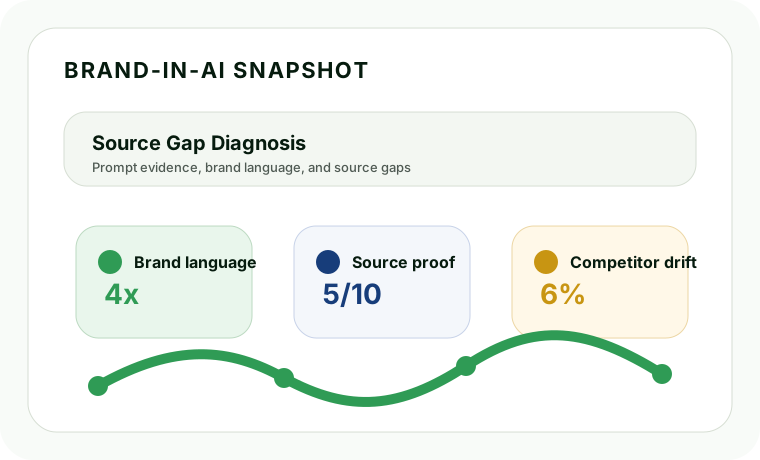
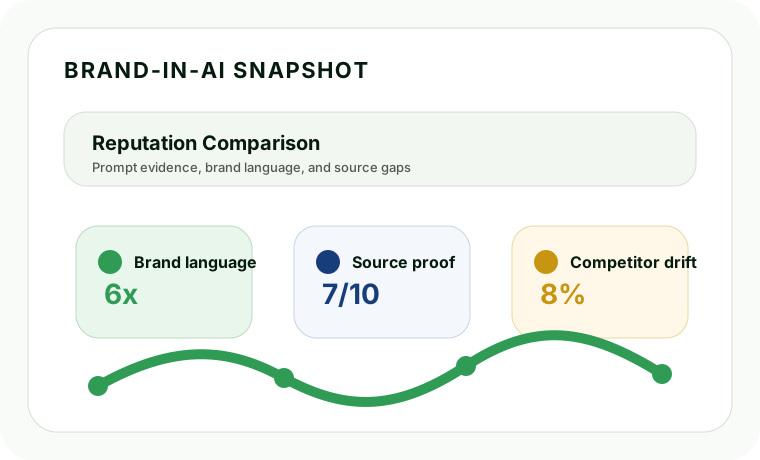
The fastest way to create a controlled baseline is with the Brand-in-AI Snapshot. Use it before you rewrite positioning, launch PR, or build new source proof.
Reader question
"Do I still need traditional ORM?"
Yes. Reviews, search results, and public pages still matter. The difference is that AI systems may compress those signals into one answer, so source clarity becomes even more important.
Useful next steps: Brand-in-AI Snapshot, LLM Visibility Checker, and LLMentioned.
Table of Contents
Classic ORM workflows do not fully explain how AI answers synthesize sources and describe a brand. That is why a brand-in-AI workflow should look beyond a single mention and inspect the wording, confidence, sources, and competitor alternatives in the answer.
The goal is a clearer split between review management, search reputation, and AI answer reputation. A snapshot is not a legal verdict, a ranking guarantee, or a complete reputation audit. It is a practical way to see what public evidence currently allows AI systems to say about the brand.
When teams treat the output as a repeatable diagnostic, it becomes useful for SEO, PR, content, leadership, and sales. Everyone can see which source gaps are creating weak descriptions and which fixes should happen next.
Traditional ORM watches surfaces
Traditional online reputation management looks at branded search results, reviews, ratings, complaint pages, social mentions, and press coverage. The work is still important because those pages shape what buyers see when they verify a brand.
The weakness is that traditional ORM often treats each surface separately. One team watches reviews. Another watches rankings. Another watches social mentions. AI answers can blend those signals into a single summary.
AI reputation watches synthesis
AI brand reputation asks a different question: what conclusion does the answer system draw from the available evidence? The answer may mention reviews, summarize third-party pages, compare competitors, and add caveats in one response.
That synthesis is why a brand can look healthy in classic ORM dashboards but still be weak in AI answers. The sources exist, but the AI system may not connect them to the right category or recommendation intent.
Source quality matters more than volume alone
A large number of generic mentions may not help if none of them explain the brand clearly. AI systems need source material that identifies the company, category, audience, outcomes, and proof.
Traditional ORM often prioritizes suppression, review volume, or sentiment repair. AI reputation also needs source enrichment. The goal is to make the correct answer easier to generate.
Competitor context changes the work
AI answers often frame reputation comparatively. They may say one company is better for enterprise teams, another for startups, and another for budget-conscious buyers. That means your reputation is partly defined against competitors.
A Brand-in-AI Snapshot should log competitor descriptions. If competitors get clearer strengths and you get a vague mention, you have a positioning gap even if sentiment is not negative.
Monitoring cadence should match the risk
Traditional ORM can require daily monitoring during a crisis. AI reputation often benefits from scheduled snapshots because answers fluctuate and need pattern-level interpretation.
For normal monitoring, monthly prompt checks are enough. For launches, rebrands, legal issues, or competitive categories, run snapshots more often and record model, date, prompt, and source notes.
Fixes should combine ORM and AI source work
Review management, PR, SEO, and content still matter. The difference is coordination. A review push should support the same positioning as service pages. A PR placement should use the same category language as your homepage.
When the public evidence becomes consistent, AI answers have a better chance of summarizing the brand accurately. That is where traditional ORM and AI reputation work together.
What to collect before judging the answer
Before you decide whether an answer is good or bad, collect the raw material around it. Save the prompt, model, date, brand name, website, answer text, cited sources, competitor names, and any wording that feels unusually confident or unusually cautious. This creates a useful record for future comparison. Without that record, teams often argue from memory or screenshots, which makes the next fix harder to prioritize.
For AI reputation management, the wording around the brand is as important as the mention itself. Record how the answer introduces the company, which category it chooses, which audience it names, and whether the answer gives proof or simply repeats a claim. If the answer uses broad language, the public source trail may be too broad. If it uses old language, stale third-party pages may still be shaping the description.
Also capture what is missing. Missing details are often more useful than visible errors. If the answer does not mention your best service, strongest audience, real case studies, current geography, or strongest differentiator, that absence becomes a content and source-building brief. The snapshot should move the team from "AI got it wrong" to "these specific signals are missing from the public evidence trail."
How to run the snapshot
Run the same prompt set in a calm, controlled way. Avoid rewriting the prompt after each answer because that makes the results impossible to compare. If you need to test several angles, create separate prompts for each angle: one for brand description, one for comparison, one for recommendation, one for objections, and one for sources. This keeps the snapshot narrow enough to repeat and broad enough to reveal patterns.
Use the Brand-in-AI Snapshot as the parent workflow. Paste the answer text, add the positioning you want AI systems to understand, and review the output for brand mention, positioning overlap, source cues, uncertainty, and competitor drift. Then open the sibling tool, LLM Visibility Checker, when you need to validate the next part of the workflow.
Do not expect the snapshot to settle every question in one pass. AI answers can vary by model, browsing mode, location, time, and prompt phrasing. The point is to create a baseline that is consistent enough to retest. The more stable your method is, the easier it becomes to know whether source improvements are changing the way the brand is described.
How to score the answer
Score the answer across five practical dimensions: accuracy, category fit, audience fit, proof, and risk. Accuracy asks whether the facts are correct. Category fit asks whether the answer places the brand in the right market. Audience fit asks whether the answer understands who should buy. Proof asks whether sources, examples, reviews, case studies, or third-party mentions support the claim. Risk asks whether the answer uses uncertainty, caveats, or competitor-favoring language.
A simple score is enough. Use absent, weak, acceptable, strong, and excellent. The value is not mathematical precision. The value is that the team can compare answers in the same language every month. If a brand moves from weak category fit to strong category fit after page and source updates, that is a meaningful improvement even if the exact answer still changes.
Separate reputation risk from visibility risk. A brand can be visible but described poorly. A brand can be described accurately but absent from recommendation prompts. A brand can be recommended but supported by weak sources. Each problem needs a different fix, which is why a structured scorecard beats a generic "good" or "bad" judgment.
Where source gaps appear
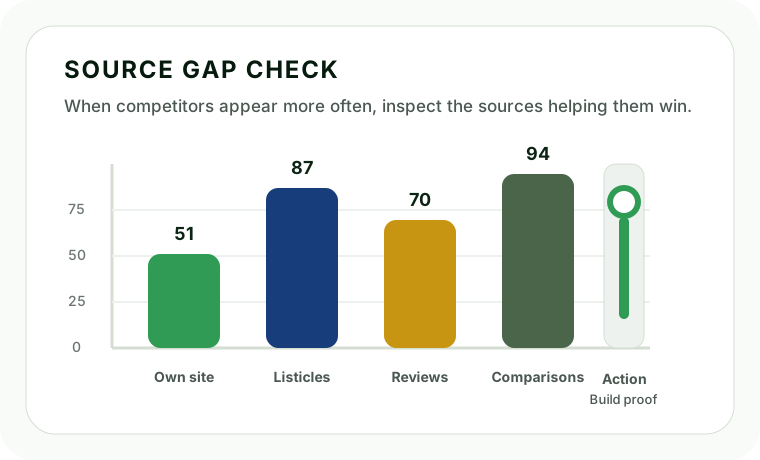
Source gaps usually appear in three places. The first is owned-page clarity: pages do not clearly explain the category, audience, offer, proof, or outcomes. The second is third-party proof: credible external pages do not repeat the brand story in enough detail. The third is competitor context: alternatives have more complete comparison pages, reviews, list inclusions, and community mentions.
When you find a source gap, decide whether it is a clarity problem, a credibility problem, or a coverage problem. Clarity problems are fixed with better owned pages. Credibility problems need stronger evidence, reviews, case studies, and external validation. Coverage problems need more places on the web connecting the brand to the category buyers are asking about.
This is where the hierarchy matters. The blog post explains the issue, the parent tool gives a snapshot, the sibling tool validates the next step, and the service page handles deeper campaign execution. That structure gives users and crawlers a clean path instead of a disconnected pile of pages.
What to fix next
Fix the highest-friction issue first. If the answer does not understand the category, rewrite category and service pages before chasing more mentions. If the category is clear but proof is weak, add case studies, examples, comparison content, and stronger external sources. If competitors dominate, study the sources behind their visibility and decide which source types you can earn or build ethically.
After each fix, retest the same prompt set. Do not change the goalposts too quickly. AI visibility work compounds when the team can compare before and after snapshots. Keep the old answers, new answers, dates, source changes, and resulting actions in one place so campaign owners can see what changed.
For teams that want ongoing measurement, use LLMentioned after the free snapshot. The free workflow is useful for diagnosis. The service layer is useful when the work becomes a campaign with prompt tracking, competitor pressure, source strategy, and reporting.
When to use the Brand-in-AI Snapshot
Use the Brand-in-AI Snapshot when you need a quick but structured view of how AI systems may describe a brand. It is useful before a campaign, after a repositioning, before sales enablement work, and whenever leadership asks whether AI answers understand the company.
Use the sibling LLM Visibility Checker when the next step needs a different lens. The snapshot focuses on description quality. The sibling workflow helps you extend the audit into prompt visibility, citation readiness, or strategy planning.
For ongoing tracking, connect the snapshot to LLMentioned. That turns a one-time review into a monitored AI search program with competitor pressure, prompt groups, source gaps, and retesting.
Brand-in-AI hierarchy for this article
- Parent hub: Brand-in-AI Snapshot.
- Sibling workflow: LLM Visibility Checker.
- Service layer: LLMentioned.
- Related reading: LLM Visibility vs SEO Rankings: What Is the Difference?.
FAQ
What is AI brand reputation?
AI brand reputation is how AI systems describe, compare, cite, and recommend your brand based on public sources and prompt context.
How is AI reputation different from ORM?
Traditional ORM watches public surfaces such as reviews and search results. AI reputation watches the synthesized answer those sources may produce.
Can positive reviews improve AI reputation?
They can help, but only when they are part of a broader source trail that clearly explains your category, audience, proof, and strengths.
Which tool should I use?
Use Brand-in-AI Snapshot for description quality and LLM Visibility Checker for recommendation visibility.

Adam O'neil
1stpage Editorial Team
Our 1stpage editorial team combines hands-on SEO agency experience with evidence-backed search performance guidance. These posts are built from real search wins, audit-grade insight, and conversion-tested tactics designed to help agencies, founders, and search teams earn more traffic and trust.